Posts

Showing posts with the label Communion

The right to receive Holy Communion on the tongue

Image
Many thanks to Rorate Caeli for publishing a significant letter from the Congregation for Divine Worship. (See: It is not licit to deny communion on the tongue due to H1N1 ) I knew from a source in England that several such letters had been sent and was waiting for one of them to be published. Such letters are not, of course, confidential. They are very carefully written and approved because the Vatican dicasteries know that they will be made public. Rorate Caeli has the jpeg which is copied above. Fr Z has kindly posted a transcript: Prot. N. 655/09/L Rome, 24 July 2009 Dear _ This Congregation for Divine Worship and Discipline of the Sacraments wishes to acknowldge receipt of your letter dated 22 June 2009 regarding the right of the faithful to receive Holy Communion on the tongue. This Dicastery observes that its Instruction Redemptionis Sacramentum (25 March 2004) clearly stipulates that "each of the faithful always has the right to receive Holy Communion on the tongue"...

Another Bishop mandates communion kneeling, on the tongue

Image
Cathedral, Juan Luis Cardinal Cipriani Thorne, Archbishop of Lima, has instructed that the faithful receiving Holy Communion in his Cathedral must do so kneeling and on the tongue. His Eminence said: "The most respectful way of receiving the Eucharist is kneeling and on the tongue. We must recover a sense of respect and reverence due to the Eucharist, because the love to Jesus is the center of our Christian lives. Our souls are at stake." H/T Rorate Caeli

Cardinal Cañizares interview with LifeSite

Image
LifeSite news reports today on an interview with Antonio Cardinal Cañizares Llovera, Prefect of the Congregation for Divine Worship. See the full interview and the LifeSite report . Quite properly, LifeSite , which is concerned with Catholic moral teaching on pro-life matters, questioned the Cardinal on the link between faithfulness to the norms of the Liturgy and faithfulness to the Church's moral teachings. The Cardinal affirmed that there is an inseparable link between the Eucharist and the defence of life because in the Eucharist we enter into communion with Jesus Christ and His life. This divine life should make us communicate love and defend human life. His Eminence gives an interesting answer on the question of whether there is a movement in the Vatican to return to the traditional manner of reception of Communion (kneeling and on the tongue): If the papal liturgy is a sign, an indication for all the Church, we should promote Communion kneeling and in the mouth. But, this d...

Holy Communion and Prime Ministers

Last week saw the funeral of Romeo LeBlanc, a politician and statesman who served as Governor General of Canada until 1999, and who died of Alzheimer's disease on 24 June. The Canadian Prime Minister Stephen Harper attended his funeral. First of all, let me encourage you to offer a prayer for the repose of the soul of Romeo LeBlanc, and a prayer for the Prime Minister in thanksgiving for his being good enough to participate in the funeral. Unfortunately, the funeral has been overshadowed by controversy as shown in this clip: The Prime Minister (a Protestant) is in the front row as Archbishop Andre Richard (Moncton, New Brunswick) administers Holy Communion (note to editors - this is not "the wafer" etc. Please show some respect for our "religious sensibilities.") He receives Holy Communion into one hand, rather as if he is accepting a little souvenir token. Given the way that Holy Communion is often distributed today, that is not an unreasonable interpretation o...

Cardinal Caffarra orders Holy Communion on the tongue only

Image
I have only just read the decree issued by Cardinal Caffarra issued earlier this year, giving directions about the distribution of the Eucharist. This was reported by the NLM back in May. Cardinal Caffarra speaks of the duty of the Bishops as successors of the apostles, to exhort people to receive Holy Communion worthily, adding: The shepherds’ catechesis must never miss to linger over [or better: "never fail to emphasise"] the way the Eucharist can be approached in order to avoid as much as possible that the Most Holy Sacrament of Eucharist be treated with superficiality or even in a disrespectful way, or even worse, sacrilegious. The Cardinal laments the many cases of profanation, especially in larger Churches or big celebrations, that have been made easier by the distribution of communion in the hand. He asks that the servers should be vigilant to see that the host is consumed immediately and says that communion should be given by priests, deacons or, in their absence, b...

Marini on the liturgy

Image
Many thanks to the New Liturgical Movement for translating an interview given by Mgr Guido Marini , Papal Master of Ceremonies, to the March issue of the periodical Radici Cristiane . the original Italian text of the interview is carried on the Vatican Website . The whole interview is well worth reading but let me pick out a couple of items that struck me particularly. First of all in regard to vestments: Pope Benedict XVI recently said in an address that "society speaks with the clothes that it wears." Do you think this could apply to the liturgy? In effect, we all speak by the clothes that we wear. Dress is a language, as is every form of external expression. The liturgy also speaks with the clothes it wears, and with all its expressive forms, which are many and rich, ever ancient and ever new. In this sense, "liturgical dress", to stay with the terminology you have used, must always be true, that is, in full harmony with the truth of the mystery celebrated. The e...

Alcuin Reid on "Dominus Est"

This weekend's Catholic Herald carries a review by Alcuin Reid of Bishop Athanasius Schneider's book "Dominus Est" ( The little book that will cause a great storm ). As I reported recently, Bishop Schneider's book is now available in English. (See: Bishop Schneider on EWTN ) The review's comments on Pope Paul VI's Memoriale Domini are important in understanding the background to the widespread introduction of Communion in the hand. (See also: Memoriale Domini - a reminder ) Dr Reid closes his excellent review with some pertinent observations about the impact of the book which makes a strong case for restoring the practice of receiving Holy Communion kneeling and on the tongue: That it will provoke a storm is unfortunate, for the practice it advocates is a practice of love and of humility, one from which no one who truly adores Christ present in the Blessed Sacrament ought to recoil. But perhaps today some controversy is necessary. Future generations, tho...

Bishop Schneider on EWTN

Image
Tomorrow, Wednesday, on EWTN ( US schedule ), there is an interview given by Bishop Athanasius Schneider, the author of Dominus Est , with Fr Mitch Pacwa. For more information, links and pictures, see Te Deum Laudamus: Bishop Athanasius Schneider on his book, "Dominus Est" and the Church in Kazakhstan . The book Dominus Est is now available in English, translated by Rev Nicholas L. Gregoris and published by Newman House Press. Diane of Te Deum Laudamus very kindly sent me a copy - the English edition has a photograph on the front showing Pope Benedict giving Holy Communion to a lady who is kneeling and receiving the sacred Host on the tongue, with an MC holding a communion plate. The book can now be ordered from Family Publications priced £5.99. (For my initial notice of the book, see: " Communion kneeling, on the tongue ." For another interview with Bishop Schneider, see: " As a bishop I cannot be silent ".) One rather special detail noticed by Diane w...

Cardinal Cañizares on Holy Communion

Image
Reading Jane at My heart was restless , I came across a link to this story at Rorate Caeli about an interview given by Cardinal Cañizares Llovera to the Spanish paper La Razón. Here is a link to the full interview (in Spanish). Rorate Caeli has translated a part of the interview: [La Razón:] Nevertheless, Benedict XVI has reiterated in some instances the propriety of receiving communion kneeling and in the mouth. Is it something important, or is it a mere matter of form? [Cañizares:] - No, it is not just a matter of form. What does it mean to receive communion in the mouth? What does it mean to kneel before the Most Holy Sacrament? What dies it mean to kneel during the consecration at Mass? It means adoration, it means recognizing the real presence of Jesus Christ in the Eucharist; it means respect and an attitude of faith of a man who prostrates before God because he knows that everything comes from Him, and we feel speechless, dumbfounded, before the wondrousness, his goodness, and...

Communion at Papal Masses

Mgr Marini, the Master of Pontifical Ceremonies has given an interview to L'Osservatore Romano in which he has said that it will be a habitual practice at papal Masses for Holy Communion to be given on the tongue to the faithful kneeling down. Fr Z has translated part of an interview and added his own comments. ( Msgr. Guido Marini: Communion kneeling and on the tongue will be the standard for papal Masses ) In the same post, Fr Z has included the podcast of the sermon he preached here at Blackfen on the Feast of the Exaltation of the Holy Cross at a High Mass on the occasion of the promulgation of the Motu Proprio Summorum Pontificum .

Dispositions for Holy Communion

Image
In my sermon in the parish today for Corpus Christi (NO) or second Sunday of Pentecost with the commemoration of the Octave (TLM - my attempt to capture the "spirit" of the recent clarification regarding Holydays) I spoke particularly about the required dispositions for receiving Holy Communion. Here is the text I put in the newsletter and on my parish website : At this time of the feast of Corpus Christi, we should remember that to receive Holy Communion, the following are required by the Church: To be a Catholic in communion with the Church and to believe in the real presence of Christ in the Holy Eucharist. To be living in accord with the teaching of the Church and, if married, to be married according to the law of the Church. To be in a state of grace, free from any deliberate grave sin that has not been forgiven through the sacrament of Confession. To have fasted for at least one hour before Communion. To have prepared prayerfully to receive Our Lord in the Holy Eucharis...

Pope Benedict discourages communion in the hand

I recently came across this very good Italian blog Rinascimento Sacro "Blog del Movimento Liturgico Benedettiano per la promozione della Liturgia Romana nella forma straordinaria" ("Blog of the Benedictine Liturgical Movement for the promotion of the Roman Liturgy in the extraordinary form") They have this most interesting piece from AGI reporting on Holy Communion as received at the Papal Mass for Corpus Christi on Thursday. (A teaser for the article comes up in the AGI search results but I have not been able to get a link to the original article.) Here is my translation: (AGI) – Vatican City, 22 May – Benedict XVI gave communion this evening to the faithful who knelt in front of him, following the tradition, that is, not giving the consecrated particles into the hands but putting them directly into the mouth. Both ways are allowed in the present liturgical norms but this way underlines more greatly the meaning of the Eucharist as the renewed sacrifice of Jesus, w...

"As a bishop I cannot be silent"

A month or so ago, I wrote about the book Dominus Est by Bishop Athanasius Schneider, Auxiliary in Karaganda, Kazakhstan , published by the Vatican Press in which he argues for Holy Communion to be received on the tongue and kneeling. Bishop Schneider gave the following interview which has been posted on Gloria TV under the heading "As a bishop I cannot be silent": H/T New Liturgical Movement

Archbishop Ranjith on Holy Communion

Image
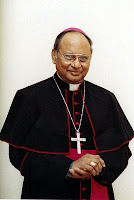
The Italian news site Petrus carries interview with Archbishop Ranjith recently conducted by Bruno Volpe. Gregor Kollmorgen at NLM has a translation of the interview Here are two key points that the Archbishop makes regarding the manner of receiving Holy Communion, first regarding Holy Communion on the hand: We need to recover the sense of the sacred. I speak only for myself, but I am convinced of the urgency of reviewing the practice of Communion given in the hand, returning to giving the particle to the faithful directly in the mouth, without them touching it, reinforcing thereby that in the Eucharist there is really Jesus and that everyone must receive Him with devotion, love and respect. and secondly regarding kneeling for Holy Communion. Beyond the office I occupy in the Vatican, as a Catholic I ask myself and wonder: why be ashamed of God? Kneeling at Communion would be an act of humility and recognition of our nature as children of God.

Communion kneeling, on the tongue

Image
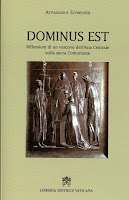
Bishop Athanasius Schneider, Auxiliary Bishop of Karaganda in Kazakhstan, has written a book called Dominus Est , published by the Libreria Editrice Vaticana . Bishop Schneider looks particularly at the question of how we should receive Holy Communion, favouring the practice of kneeling and receiving Holy Communion on the tongue. Not only has the book been published by the Vatican press, it also has a Foreword by Archbishop Malcolm Ranjith, Secretary of the Congregation for Divine Worship. The Associazione Luci sull'Est has the publisher's description and the text of the Foreword by Archbishop Ranjith. Shawn Tribe at the New Liturgical Movement has an (unofficial) translation of the Foreword . Here is my (unofficial) translation of the publisher's description: Holy Communion is not simply a convivial moment of spiritual nourishment but also the closest possible personal encounter for the faithful in this life with their Lord and God. The most authentic interior attitude in...

L'Osservatore article recommends Holy Communion kneeling and on the tongue

Image
There is a most interesting article from Fr Z yesterday, referring to a CNS story quoting an article by Bishop Athanasius Schneider of Karaganda, Kazakhstan in L'Osservatore Romano . Sorry that it is two steps removed: the Italian version of L'Osservatore only stays up on the day of publication and I have been unable to check another article that was referred to in a news service because of this. Perhaps the new team at L'Osservatore will consider running a full web service...? It would certainly enhance their great service to the Church. Bishop Schneider's article is presented as a "historical-liturgical note". He argues in favour of the practice of kneeling and receiving Holy Communion on the tongue. It is significant that L'Osservatore should publish an article in this vein. For many years, the subject has been off-limits: communion on the hand has been treated as though it were entirely of the same status as receiving communion on the tongue. I pre...

Sacramentum Caritatis on Catholic legislators

Image
A correspondent drew my attention this evening to an important passage in Sacramentum Caritatis : 83. Here it is important to consider what the Synod Fathers described as eucharistic consistency, a quality which our lives are objectively called to embody. Worship pleasing to God can never be a purely private matter, without consequences for our relationships with others: it demands a public witness to our faith. Evidently, this is true for all the baptized, yet it is especially incumbent upon those who, by virtue of their social or political position, must make decisions regarding fundamental values, such as respect for human life, its defence from conception to natural death, the family built upon marriage between a man and a woman, the freedom to educate one's children and the promotion of the common good in all its forms. These values are not negotiable. Consequently, Catholic politicians and legislators, conscious of their grave responsibility before society, must feel particul...

Bishop Hollis urges fidelity to the Church’s discipline

Image
Earlier this month, Bishop Crispian Hollis wrote to all the priests of the Portsmouth Diocese to make it clear that the conditions do not exist in this country for a licit celebration of “Rite 3” of the Sacrament of Penance (i.e General Absolution.) He urged priests to find ways in which individual confession could be made available to the people. In the same letter, he re-iterated the norms regarding the admission to Eucharistic Communion of those who are not in communion with the Catholic Church. The Ordinary may grant permission for a particular person to receive Communion on a particular occasion according to conditions laid out in “One Bread One Body.” After referring to this restricted exception, he made it clear that “general invitations to all and sundry to receive Communion should never be offered.” He also emphasised the importance of being faithful to the discipline of the Church: In the matter of General Absolution and Sacramental sharing with other Christians, I ask you, t...

Popular posts from this blog

Is your alb back to front?

1962 Missal pdf online

The blessing of a chariot

Litany of Syrian Saints

Saint Gabriel