Pages

Wednesday, 14 November 2012

Liturgical music in Church - without the Liturgy

Recently I had occasion to look at the November edition of the listing events@brugge. Now let's blow up the second item down in the sixth column:
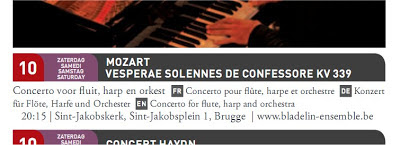

There is also an advertisement for the event at the Bladelin ensemble's own website. It reads:
Forthcoming concerts:
Mozart, Sint-Jacobskerk - Bruges
10 november 2012 - 8:15 p.m.

Vesperae solennes de Confessore KV 339
Concerto voor fluit, harp en orkest KV 299
Davide penitente KV 4699
It took a while for it to sink in.

Priests will say that such classical masterpieces as Mozart's "Vespers for a Confessor" are beyond the horizon of modern man or that if they were used in the liturgy, people would not be able to participate. Yet in fact, people pay to go to concert halls to hear this beautiful music. I think they are actively engaged.

Nowadays there are often Concerts in Churches and that is a problem in itself. What we have here is not only a Church being used as a concert hall, but music composed for the sacred liturgy being performed as a concert in a Church without the Liturgy being celebrated.

Sometimes it is hard to fathom the depth of madness to which we have sunk in the rejection of our own patrimony of sacred music. The philistines decided that we couldn't have this sort of music in the liturgy because it was too much like a concert. A few years on, we have the same music advertised as a concert in the Church, without even celebrating the liturgy for which it was written. If the priests are singing anything at all, they must be putting their fingers in their ears and going la-la-la-la.

If you want to hear Mozart's Vesperae Solennes de Confessore, K. 339, here is a video from YouTube - of it being sung (in 1990) as a concert in the Franciscan Shrine Church at Poznan; with the choir on the sanctuary.


As a matter of interest, roughly how much would it cost to hire an outfit like this for an evening? We might have a minor win on the Euro Lottery (before we can fund the minor basilica) and we could always have a retiring collection ;-)

6 comments:

Jam said...

I was in a strange city for Easter last year and since I didn't know anyone there I went ahead and purchased tickets for a choral concert on Easter Sunday. The program was made up of texts related to Holy Week and Easter, and I thought it would be pleasant and help take my mind off of being so far from home. It was so strange to be sitting there listening to this beautiful music so near and yet so incredibly far out of context and ultimately it made me even sadder. Here were these sophisticated patrons of music but did they understand even a tenth of what the composers had been writing about? It was one of those experiences, like attending a protestant "worship session", that made me feel all the more strongly the fullness of what the mass is, and how habitually full of His Presence it is.

It is madness!! When pastors are approached about using their churches as concert halls for sacred music, I wish they would have the energy and so on to work up the proper liturgical action for the music. It would do a world of good all the way around - for the musicians, the parishioners, the concert-goers, etc.

Singalong said...

As a humble member of a local choir, which "performs" such music, and a Catholic for all of my 70 plus years, I often think about what you describe.
Our concerts take place in a prereformation church, now Anglican. I always feel somewhat uncomfortable, and wouldn`t want them to be taking place in our Catholic church, but I love the music and wouldn`t want it to disappear from the local live scene.
A few of my fellow parishioners attend our concerts, but I do not think the majority would appreciate the music as part of our parish Mass, or that it would help many people in their participation.
Occasionally, a Mass is arranged on a weekday evening with such music, and the attendance is very low.
I was with relatives at the English Mission in Zurich recently for the Sunday Mass which included some very fine solo singing followed by clapping and applause from the congregation, which surprised me, but perhaps Our Lord was clapping too?

Colonel Mustard said...

It is such a violence to perform liturgical music in a church as a concert, rather than a liturgy, especially when it would be so easy to celebrate liturgically (i.e. by a priest putting a cope on and incensing the altar at the Magnificat - would that be hard? It wouldn't earn the church much money, though!).

I was interested to read your linked post as well. My church recently hosted a music concert - secular classical music - which people were charged money to attend. I wonder whether the Ordinary's permission was sought; given I had to argue that the Blessed Sacrament should be removed, and that the altar was freely used as a side table - crucifix cast aside - suggests it wasn't. My religious sense was made to feel uncomfortable, so I'm glad to see my anxiety wasn't unfounded!

Sadie Vacantist said...

If a marketing company took over the running of an average English parish they would reintroduce the TLM and its associated musical heritage within less than a month.

Richard Duncan said...

We had the Mozart K 339 setting of the psalms at First Vespers for St Philip earlier this year. I was a bit sceptical about whether it "work" in an acutal liturgical celebration, but it went off splendidly, so much so that I had two of the psalms - Confitebor Tibi and Laudate Dominum - at my diaconate ordination in July, once again to much acclaim.

But I suspect the real reason why this sort of music doesn't get played in church is not that people don't like it, but that it can't easily be shoe-horned into the usus recentior, and that it shows up much of the recent music written for congregational "participation" to be the very paltry stuff that some have us always thought it to be.

I'm having more Mozart at my priestly ordination and came across this lovely little reflection from Pope Benedict (which I must work into the booklet somehow):

Allow me, however, to express once again the particular affection that has united me, I could say, always, to this great musician. Every time I listen to his music I cannot help but return in memory to my parish church, where on feast days, when I was a boy, one of his "Masses" resounded: I felt that a ray of beauty from heaven reached my heart, and I continue to experience this sensation also today every time I listen to this great, dramatic and serene meditation on death. Everything is in perfect harmony in Mozart, every note, every musical phrase is as it is and could not be otherwise; even those opposed are reconciled; it is called "mozart’sche Heiterkeit" (Mozart's serenity), which envelops everything, every moment. It is a gift of the Grace of God, but it is also the fruit of Mozart's lively faith that, especially in sacred music, is able to reflect the luminous response of divine love, which gives hope, even when human life is lacerated by suffering and death.

josephmchardy said...

Last Good Friday I found myself performing a beautiful sequence of Spanish music for Passiontide, in a beautiful Spanish cathedral, at 12 noon. We were done by 130, after which the organisers gave us lunch; we were packed off on the bus back to Barajas airport just as the liturgy for which the music had been composed was about to begin in the cathedral in which we had just performed it. It was part of a festival of sacred music! Absurd, really.

Related Posts Plugin for WordPress, Blogger...