Therefore every scribe who has been trained for the kingdom of heaven is like a householder who brings out of his treasure what is new and what is old.
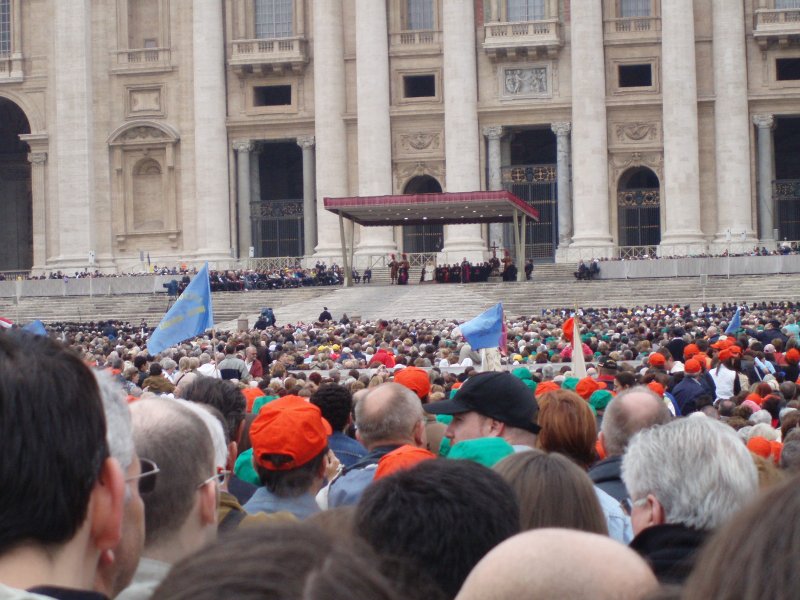
Not very near to the Pope ...
As you can see, we didn't get very near to the Pope: there were about 40,000 people in front of us! It was still great to be there, though.
The text of the new ICEL translation of the Ordinary of the Mass, courtesy of Fr Sean Finnegan and friends. I will get working on producing some nicer versions in Word and pdf unless someone else can do that little job and let me know in the combox. UPDATE Fr Sean has sent me a rough and ready pdf which you can download [Ed: link removed.] (Please note that this is not from an official source, and is not the final text, and there may still be quibbles about a word here or there.) [text removed at the request of ICEL] See the post " Letter from ICEL " for explanation.
The Church Music Association of America and Jeffrey Tucker of the New Liturgical Movement have made available the 1962 Missal online in pdf format (72Mb). The file is hosted at Musica Sacra , the website of the CMAA, thanks to a generous gift from Fr Robert Skeris While you are at it, take a look at the articles clarifying the rules for music at Low Mass and music at High Mass .
St Agatha, from Catania in Sicily, was martyred in 251 during the brief but ferocious persecution of Decius. At that time, everyone was ordered to sacrifice to the Roman gods by a certain day determined by the local authorities. When you had done so, you got a certificate (a libellus ). Some Christians were able to bribe an official or knew someone who could get a libellus – they were referred to as libellatici and were considered as having betrayed the faith; though not as seriously as those who had offered sacrifice to the Roman gods. St Agatha’s martyrdom is a classic example of the combination of two virtues, chastity and fortitude even in the face of torture and death. The Virgin Martyrs are sometimes despised in the world today by those who are particularly outraged by chastity and the readiness to quit this earthly life for heaven. St Agatha’s passion began when she rejected the amorous advances of a prefect Quintianus. He gave her to Aphrodisia, the keeper of a brothel wh...
A commenter says (of St Jerome's translation of Genesis 3.15) "That is not what the lectionary says." I am sure he/she is right, whichever lectionary is used. In fact, the Nova Vulgata , the Church's new official translation of the Bible in Latin, translates the Hebrew with the neuter ipsum . Here is the (old) Vulgate text again for the sake of reference: Inimicitias ponam inter te et mulierem et semen tuum et semen illius ipsa conteret caput tuum et tu insidiaberis calcaneo eius. (I will put enmities between thee and the woman, and thy seed and her seed: she shall crush thy head, and thou shalt lie in wait for her heel.) The word ipsa translates an epicene Hebrew personal pronoun: one that has only one form to denote either male or female. It can legitimately be translated either as "he", "she", or "it." In one place, St Jerome quoted the Vetus Latina version which gives ipse . (Lib. Quaest. Heb. in Gen. PL 23.943) and this has been t...