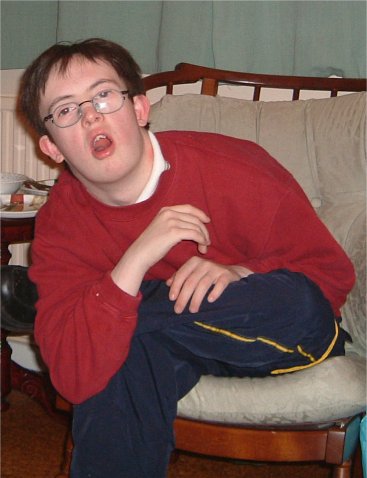
Leticia Velasquez is a co-founder of Keep Infants with Down Syndrome, has written for MercatorNet, pointing out that drawing a new word from the thesaurus, while welcome in itself, is a hollow gesture if we continue to abort most children with trisomy. She says:
My point is this; if an entire class of people, those with three sets of the 21st chromosome, are routinely targeted for destruction -- at a scandalous rate of 90 per cent -- can merely changing the term we use to describe those 10 per cent who escape the net increase respect for their human dignity and intrinsic value to society in a meaningful way? Isn’t a more fundamental change required before having a child with Down syndrome goes from being the greatest fear of pregnant women to being widely accepted by society?She also reports the puzzlement of a psychiatrist who travelled to Ireland and noticed far more people with Downs syndrome than he was used to. Eventually he realised that this was because abortion is not allowed in Ireland and so children with trisomy are by and large casually accepted in everyday life.
See: No more “mental retardation”. So?

10 comments:
Thank you on behalf of my daughter Christina, with T21, for linking to my article.
Excellent observation. Merely changing the name changes nothing. This is a hollow attempt by the PC crowd not to sound offensive. Sadly, the unpardonable sin of our day has become to appear possibly to seem, perhaps, in the general neighborhood of the area of intolerant. It could not get more shallow.
While the descriptive term 'mental retardation' has been suceeded by 'intellectual disability' (or in the uk, 'learning disability') this is not synonomous with Down Syndrome which is a genetic condition. Some people with DS also have cormobid subnormal intelligence, but not all, and it is possible to have DS without significant impairment of intelletual functioning.
It is not correct therefore to say that Down Syndrome has been replaced by the diagnostic label of intellectual impairment - they are two seperate and suctinct scientific entities.
The term mental retardation was replaced by ID or LD have intense lobbying by mncap and other service user organisaions beause they felt it was less prejudicial.
I am surprised that your contact noticed lots of people with DS in Ireland because many if not most will still be warehoused in large institutionalised residenial centres in the middle of nowhere and are therefore not socially visible or included. There is certainly not extensive community support available for such people across Ireland. I know because i have a niece with DS in Ireland and her family are having to send her away to a 'special school' because there are not resources to support her through mainstream schooloing within the local community.
Whereas in the UK some 20 years ago we adopted the principles of the 'valuing people' white paper where people with DS or learning disabilities live in normal homes in the community with individualised support. You are therefore actually more likely to see people with Down Syndrome in the uk
I am glad that for once the world can learn from us Irish. We have been to the forefront in intergrated education especially in Catholic schools.In the Irish Language a person with a learning or physical disability ( we have been using these phrases for years)is known as Daoine Dia exact translation would be God's person but it really means someone special to God
"many if not most will still be warehoused in large institutionalised residenial centres in the middle of nowhere and are therefore not socially visible or included. There is certainly not extensive community support available for such people across Ireland."
That is not at all true, nor has it been for years in terms of non-visibility and "warehousing". DS people mostly live with their families amd many have been under the care of day centres such as those run by the St. John of God Order and St Michael's House, to name but 2. Most of them therefore ARE very visible in the community, as I can attest from working closely with St Michael's House back in the early-to-mid 90s when we ran an employment programme for them i.e. we took people to work on a supervised basis in some of our work locations doing a variety of specially-chosen work.
Quite close to where I live is a St. John of God centre which has been operating since the 1960s. It is certainly not an institutionalised centre in the middle of nowhere.
It is also very common to see DS people (and others with other disabilities) living in community care. Again, I'm not just going on hearsay or isolated experience: some live around the corner from me and have done for years. They are regular (and popular)visitors to our local pub! So you are just as likely to see DS people in Ireland, and that has been the case for many years. But then again, you have to live here to actually know that rather than making generalisations from one specific case. That said, the situation is certainly not ideal and social care here has never been funded to the degree that it has been in the UK, a position that in current circumstances is likely to worsen.
90%. Wow, I would never have imagined. My son is mentally challenged (not Down's), so he has spent his life with Down's children. Therefore, I see many of them daily. I had no idea that so many more are out there before birth.
Jaykay - your comment got lost in bloggers nutty comment system: after being put in "spam" it was deleted when I pressed "not spam". Could you repost it please.
jaykay - your point is highly debateable. I feel you are making generalisations based on an example rather than looking at the statistical and documentary evidence. Sure some people with Downs or learning disability live in the community or with their families in Ireland but MOST do not. In terms of individualised support within the community, Ireland is generally 10-15 years behing the uk and has many more large institutions (in out of the way places) than the UK. I know this because I am a clinical psychologist working with learning disability adults and have provided consultation to Eire regarding policy change in this area.
My main point however was to critique that the use of intellectual or learning disability rather than mental retardation is some kind of PC change as Fr Tim suggested. It is entirely unrelated to Down Syndrome which remains the correct term for this genetic condition.
Fr Gabriel Burke, the gaelic term 'God's special person' sounds slightly patronising and infantalising to me (and I suspect many people with LD would agree.
big benny: no, I'm going on what was told me by Down Syndrome Ireland viz. that the majority of DS people are not institutionalised in the horrible sort of facilities that unfortunately were too common here (and probably in the UK as well, once). Those who live in residential care facilities tend to be in the older age group e.g. whose parents/carers have died or are unable to give them care.
I'll say it again: DS people ARE relatively very visible here, given that there are only about 5000 in a population of 4 million.
The Gaelic term is more properly "daoine le Dia" meaning "people with God" or in His care. It's very old and dates from a time when disabilities were not understood. I wouldn't agree that it's patronising; it reflects the thinking of the times. That said, it would only be used colloquially nowadays and certainly not in any official sense.
I have the fortunate experience in knowing the young man you picture. three friends of mine with large families have children/adults with Downs Syndrome..I can only see how enriched the family & we as friends are.
Regarding language..I always found the "special needs" label instead of "handicapped" a bit confusing. This new vocabulary is further difficult to understand..
Post a Comment