Pages

Sunday, 11 March 2007

Latin used as a sacred language
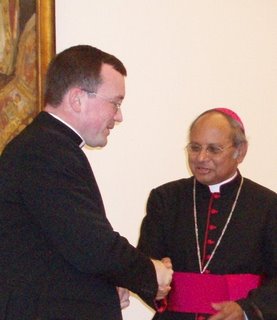
Fr Nicholas Schofield had an interesting post the other day (Sacred Language) reporting on a talk given by Fr Michael Lang (left) to the Giffard Club.

From the post:
Fr Lang spoke of the importance of sacral languages, which are, by their nature, ‘conservative’ and different from everyday spoken languages. The important point was made that, when the liturgical language of the Roman Rite changed from Greek to Latin in the early centuries, this was not an example of vernacularisation (as the likes of Bishop Trautman have claimed) – the aim was not to make the liturgy more understandable. After all, those speaking Gothic or Punic would not have found a Latin liturgy more ‘accessible,’ and the Latin that was used was highly stylised (see the structure of the collects, for example).
I understand that the material for the lecture may be published as a book in due course. This would be another major contribution from Fr Lang to the current liturgical debate. He has written on the question of facing eastward for the celebration of the Mass ("Turning Towards the Lord" - Ignatius). He has also written questioning the received view of the Anaphora of Addai and Mari which presents it as an ancient example of a "Eucharistic Prayer" which does not include the words of consecration.

9 comments:

papabear said...

Father, would you happen to have any info about the journals in which the articles on the Anaphora of Addai and Mari were published?

Anonymous said...

"He has also written articles questioning the received view of the Anaphora of Addai and Mari."

Where?

hilary said...

ooo I've always wanted a secret language.

Elvish was way too hard to learn. and only King Geeks learn Klingon.

Et ego rex stultus non sum!

hilary said...

Oh.

I see.

you said "sacred" language.

never mind.

Anonymous said...

Link to info about Anaphora of Addai and Mari article:
http://cat.inist.fr/?aModele=afficheN&cpsidt=16287032

Fr Tim Finigan said...

Anon- many thanks indeed for the link. I was going to look it up when I got home but was half hoping that a kind commenter would get there first. I'll put the link into the body of the post.

bernadette said...

I know it's a bit late to post this..but I think the re-introduction of Latin is a move of great wisdom and pragmatism on the part of our Holy Father. I believe his chief reason is because it is needed in the increasingly dark times in which we're living. It IS a sacred language, which means it operates on a mystical level, beyond the human understanding and vision that we have. I rarely attend Latin Mass for practical reasons but on the occasions when I can, the one thing which comes across, overwhelmingly, is the POWER of the Mass and the presence of Jesus. And this has been lost to us because of the poor implemention of V11. Fr Gabriele Amorth in his book " An excorcist tells his story" cites many occasions when he is praying with someone for deliverance and he testifies that when he uses Latin to rebuke the spirit which he is praying against, he gets results and the person is freed. Pope Benedict knows the battle we are in these days and he is above all extremely practical ("The Enforcer")- he has seen Latin as a vital weapon in our armoury. I would bet that if we do see the more widespread use of Latin in our liturgy, we will see an increase in Eucharistic related miracles in our parishes and in our families. Then.. watch the young people come flocking back.

CPKS said...

Latin is important (as is Greek) because (like Greek) it enshrines an indispensable part of the Church's perennial tradition. It is essential that we remain in touch with that tradition.

However...

English today is the world's lingua franca. Leading academic bodies in all disciplines use English to exchange and promulgate ideas worldwide.

It is unacceptable for the English translations of Vatican documents to be in any way tendentious. The Vatican needs to recognize that if it is speaking to the world's media, and to the ordinary people of the world - rather than to an audience of scholars - it has a responsibility to ensure that its English translations above all are faithful to the original.

I don't think we should gaily consign to Latin the duty of preserving the Church's teaching in its purity. Nor should we dismiss the power of English, simply because it happens to be a modern language, as a potential vehicle for definitive expression of the Church's teaching. Instead, we should (I submit) see a particularly heavy responsibility resting upon those who promulgate the Church's message in English.

Linda Robinson said...

To CPKS who wrote:

What you say may be true regarding many forms of communication but the liturgy is not addressed to the media, to the ordinary people or the world, or to scholars; it is addressed to God. The media have been hearing it in English for over 40 years and doesn't seem any closer now to "getting it" than ever.

Nor does the vernacular seem to do a lot for the "ordinary" people, who have left the practice of the Faith in droves since the introduction of the liturgical reforms. As to the world in general - it neither attends Mass nor reads Church documents.

Theologians are scholars. As such, they are required to study documents in the original language. Because Latin has been the official language of the Church for centuries, there is an enormous body of Church teaching enshrined therein. Without Latin, Catholic theologians build on sand, even if they are men and women of good will.

Pax et bonum.

Related Posts Plugin for WordPress, Blogger...