Wednesday, May 30, 2007

Two views of Lourdes
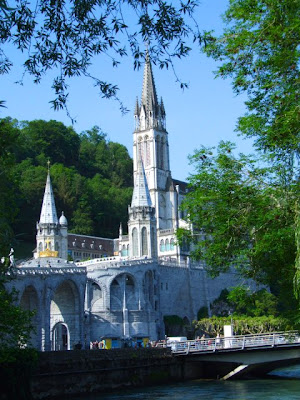
As I was such a glorious day, I re-took one of my favourite views of the basilicas.

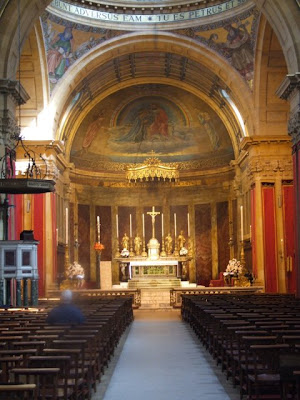
I also tried to reproduce a shot of the hemicycle that I have seen on a postcard. This is the best I could do, together with some slightly wacky colour balancing:

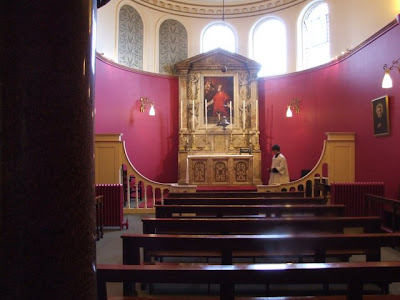
Here is one of the chapels inside. To be frank, I think that the average B&Q warehouse is more attractive.

I drafted that post earlier. This afternoon, in the space of less than half an hour, the weather suddenly changed and there was a violent hailstorm for about five minutes. Unfortunately, it washed out the Blessed Sacrament procession and when it dried up a litle, everyone headed straight to the underground basilica. I'll see if I can get some photos tomorrow.

Finding St Bernadette

There are plenty of statues of St Bernadette around – here is one of my favourites:

In addition to the statues, however, I was looking for the relics of the saint. As I mentioned, they have been moved from the crypt chapel. At the Forum Information, a Spanish sister tells me that they are in “un hotel” on the left side of the esplanade. Feeling slightly confused, and presuming that "hotel" can means something else as well as a place where you sleep, I make my way to the left side of the esplanade. Sometimes, you should look for things in an obvious place:

After seeing a couple of comments, I need to add here that St Bernadette's incorrupt body is kept at the Convent at Nevers. The reliquary under the altar in the photograph just contains some relics, not her whole body.

International Mass

I wanted to take some photographs at the International Mass today so I said Mass just after 7am in one of the little chapels off the Crypt Chapel. It is worth mentioning again for priests that you can walk into the Sacristy there at any time of the day and they will set you up for a private Mass. If you have a small group (less than, say, 10 people), you can bring them with you.

This year, at the International Mass, perhaps in response to Sacramentum Caritatis, the Eucharist Prayer from the epiclesis to the consecration was said in Latin - well it is a start. Archbishop Vincent Nichols was the principal celebrant. Here you can see him from my angle, behind the crowds, and on the hanging screen which shows the angle from a suspended camera:

Looking round the Basilique St Pie X, I see that the hanging pictures of the saints now have new saints on the reverse. I was pleased to see Blessed Charles, the Austro-Hungarian emperor included. Joanna and Jamie Bogle wrote a book about him which I recommend.

Today is a beautiful sunny day in Lourdes so I am carrying round the big camera with me. After Mass I met Fr Greg Hogan, Fr William Massie, and his mother.

Outside after Mass, there were a number of photograph sessions going on. Here is the group from Plymouth Diocese:

Tuesday, May 29, 2007

Mass in the Crypt

Our Mass this morning was at 8am in the Crypt chapel, the first to be built and the only one to be visited by St Bernadette herself. The relics of St Bernadette used to be housed here in one of the side chapels. This meant that people at Mass were often distracted by people shuffling round to venerate the relics. They have been moved now: I’m not sure where and I intend to find out. This is one of the many small practical improvements made by the Shrine authorities. Mass in the Crypt Chapel is now uninterrupted and the addition of an extra pair of glass doors in the corridor leading to the chapel means that it is much quieter than before.

After Mass, some of the pilgrims watched the official film about St Bernadette and in the early afternoon went on the tour “In the footsteps of St Bernadette” run by the very efficient shrine guides. They give a tour which is historically well-informed, doctrinally sound. The guides are friendly and full of faith which they gently share with their pilgrims.

Straws in the wind

Although it is always a delight to visit Lourdes, the liturgy is not exactly "classical" in style. The music can be particularly awful at times. This is not entirely the fault of the French. I heard some soupy crooning coming up from the Pius X Basilica this morning at Mass for a large English group. In the Pilgrimage booklet this year, there is special hymn to be sung at the International Mass in accordance with this year's theme. It is a jaunty song in 3/4 with the words "Penance, penance, holy penance for the Kingdom of God is close at hand!" It has been translated from the French without regard to the stress in the English sentence so that the last phrase goes "is close AT hand."

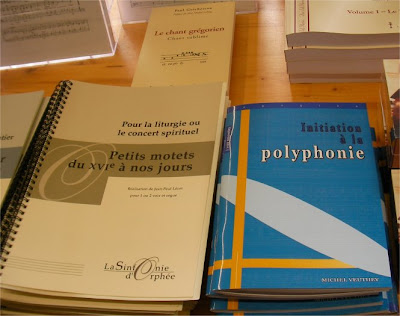
I was therefore intrigued to see the welcome sight of these books in the French section of the official shrine bookshop.

Rue du Bourg

One of the most interesting streets in the town above the Domaine in Lourdes is the Rue du Bourg which cuts across from the Rue de la Grotte almost to the Boulevard de la Grotte. At the southern end, there is a shop with antiquarian books including some devotional books in French from the early 20th century and one or two from the 19th century. On the same side a few yards further along there is the English bookshop which is always worth a visit.

A little further along and across the road is the Pro Life Centre, one of the Permanences – permanent establishments each a with particular pastoral focus.

From there I went to visit the lovely parish Church. Tomorrow promises to be a sunny day so if that turns out to be the case, I will go round with the big camera and take some more photos, particularly of the Church and points of interest around the Domaine.

Charging

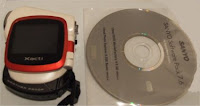
Last evening, surrounded by wires, I counted up the various chargers that I have brought with me. Mobile phone/MDA, laptop, camera batteries, camcorder battery. The camcorder is quite neat – pictured here next to the software CD that came with it. Still photo resolution is up to 10 Megapixels so it will be fine for odd pics here and there. If we have a sunny day this week, I’ll take out the big camera which has a much better lens.

Yesterday evening there were intermittent showers. I did what I usually do in Lourdes and bought a cheap umbrella (6 euros). However that didn’t last long. Up on the esplanade, I was taking a couple of clips of the beginning of the torchlight procession when a gust of wind totalled it – metal spike falling off, that sort of thing.

The coach journey from Toulouse Airport was a full two hours so we only arrived at the hotel just in time for dinner, followed by a quick check-in and then over to the Domaine.

Devotions and wifi

Confession made (absolution received & penance accepted & completed), several large candles lit (paid for first, of course), mortal frame fittingly shocked by dunking in baths (prayers said in Latin), dunking Brancardiers duly blessed, Breviary finished, Grotto visited, rock venerated, ground kissed, water drunk, Rosary Basilica visited... so time for a little blogging.

An enquiry earlier at the tourist office opposite the parish Church was rewarded with a list of locations of internet cafés and wifi hotspots. A big "heads up" to the Café Le Carrefour, just round the corner from the Hotel - it has free wifi. Outstanding! Glad I bought the laptop with me.

There are two big English pilgrimages here this week: Birmingham and Middlesborough. So far, I have met Fr Greg Hogan and Fr John Paul Leonard. Fr William Massie is lurking around somewhere as well...

Being a priest in the square in front of the Basilicas means being on fairly constant "blessing duty." I met two ladies from New York today and blessed their statues and rosaries. Owl of the Remove tells me that there is a group of 40 people from Burlington, Vermont, with their Vicar General here on Pilgrimage. I'll look out for them.

Monday, May 28, 2007

Greetings from Gatwick

Well that's a relief. No nasty settings intervened to prevent me from getting online at the T-Mobile wifi hotspot in the departure lounge at Gatwick airport. Now I know it works, I'll be looking for wifi places in Lourdes. Jolly useful stuff.

Glad to say that I have also found exactly what I was looking for by way of a camcorder. It is very small and only records to an SD card, and will take still photos. It is splashproof so it shouldn't get damamged when I choke on my coffee if I need to video some diocesan group deciding to have Hindu dances at Holy Communion or invoke the name of Allah instead of the Kyrie. YouTube here we come!

Sunday, May 27, 2007

To Lourdes tomorrow

This year our secular substitute holyday happens to fall on Whit Monday. As it is also the school half-term, it is the occasion for the annual parish Pilgrimage to Lourdes. We will have Mass at the Lady Altar first thing followed by the Itinerarium (prayers befoer a journey) and then fly to Toulouse followed by a viewing of Jean Luc Delannoy's excellent film Bernadette on the coach transfer to the Hotel D'Angleterre. I love Lourdes more and more each year and I am really looking forward to tomorrow night's torchlight procession.

Once I have got my Catholic Herald article finshed and emailed to the editor, I will pack: it doesn't take me long - I'm a cleric, I travel light and I don't have to worry what colour shirts to bring. Then I will go to bed happy, knowing that in less than 24 hours I will be praying before the spot where Our Blessed Lady appeared to St Bernadette.

Last year, I blogged from Lourdes via one of the internet cafés. This year I hope to check out the free wifi hotspot that I discovered on the internet. Failing that, I'm happy to pay - there seem to be plenty of hotels with wifi. The challenge will be getting my computer to play along. If not, a café will do.

(By the way: to avoid being flamed, please do not comment on the "terrible commercialism" of Lourdes without first reading my post from last year on... The "terrible commercialism" of Lourdes)

Press photos from Birmingham Oratory

Peter Jennings of "International Media Contacts" sent me these photos from the feast of St Philip Neri at the Birmingham Oratory with his kind permission to post them here. The first is of the sanctuary during the Canon of the Mass. The incense is a fitting symbol of the shekinah, the cloud of the presence and the glory of God:

Picture by Peter Jennings

The second was taken in the sacristy after Mass. (L-R) Brother Lewis (subdeacon) Myself, Fr Paul Chavasse (celebrant), Fr Guy Nicholls (deacon)

Picture by Peter Jennings

Saturday, May 26, 2007

Sermon for the feast of St Philip Neri

Some people asked me for the text of the sermon that I preached at the Birmingham Oratory for the feast of St Philip Neri so here it is:


St Philip, a saint for saints
My soul makes its boast in the Lord; let the afflicted hear and be glad. (Psalm 33.2)

Fr Bowden in his Miniature Lives of the Saints says that the life of St Bernadine was St Philip’s favourite among the saints and the last he read before his death. Fr Bouyer on the other hand says that the last book he had read to him was the Fathers of the Desert. Perhaps we should make a distinction between reading or being read to; or perhaps St Philip inspired the two fathers with different information as a joke.

We can understand why St Philip loved St Bernadine when we think of the great gatherings of feuding renaissance factions listening to his sermons and then ending with an emotional reconciliation with the bacio di pace. The holy Franciscan’s withering attacks on homosexual vice would also have met with approval surely from the Holy Father who could smell the vice of impurity in some of his penitents.

On the other hand, we can imagine the attraction which the Desert Fathers held for St Philip. His nights of solitude in the catacombs, his frugal diet and his devotion to the ascetical life all speak of lessons learned from those holy Fathers.

Yet we know that St Philip’s ascetical life was combined with the love of genuine friendship and holy allegria. His was an asceticism that could also participate in a wine-drinking contest in the interest of the apostolate.

St Bernadines’ original bonfires of vanities, predated that of Savonarola (whom St Philip also admired greatly) by several decades. Those bonfires find an unexpected echo in the glee of St Philip’s companions at singing “vanitas vanitatum et omnia vanitas” (vanity of vanities, all is vanity) as they tramped through Rome from Church to Church.

In the history of the Church, there have been various ways of dealing with corruption and worldliness. Not the least of St Philip’s achievements was to trump the worldliness of Rome in has day with a vivid, existential demonstration of the joy of the Christian life of prayer, penance and charity lived without compromise. As Newman put it:
“he perceived that the mischief was to be met, not with argument, not with science, not with protests and warnings, not by the recluse or the preacher, but by means of the great counter-fascination of purity and truth”
In his lifetime too, of course, St Philip was the mentor and acquaintance of saints. Having such devotion to St Bernadine, it must have warmed his heart to have seen the see the completion of the Church of the Gesu for the now thriving company formed by his friend St Ignatius. We can recall the famous saying of St Ignatius that his friend Philip was like a Church bell, calling people to enter but remaining in his tower.

He was also a friend of St Francis Xavier and would have followed him to the missions but for the famous advice of his confessor “Rome will be your Indies”; advice for which I am sure we are all very grateful here.

St Charles Borromeo came to his assistance when he was falsely accused. St Charles’ cousin, Federico was, of course, one of St Philip’s most regular visitors. He was the confessor of St Camillus de Lellis and advised him to become a priest, thereby indirectly being responsible for the founding of the Camillan fathers, and incidentally for a major contribution to care for victims of HIV and AIDS today.

He was also a friend of St Felix of Cantalice and organised with him a procession with a crucifix during the carnival at the conclusion of which a famous fellow Capuchin preached, effectively wrecking the carnival for that year. St Philip managed to get Giuseppe de Cesari to sketch a portrait of St Felix surreptitiously – a portrait that he cherished ever afterwards. Then of course, the heroic virtue of his protégé, Baronius was recognised by Pope Benedict XIV.

It is rightly said of St Philip that he was very cautious and reserved about falling into bad company. However he seems to have been quite adept at falling into good company. Terrible as the reformation was for the Church, God raised up a new “great cloud of witnesses” in response, several of the most renowned being personal friends and confidantes of St Philip. He is almost like the president of a saints’ club. “Almost”, not because there wasn’t a saints’ club – I think that is quite a good description of these varied characters in 16th century Rome – but because the title “President” would never have fitted his unique self-effacing and humble way of influencing others to follow Christ.

His character was different from the determined and necessary vigour of St Charles to ensure that the decrees of the Council of Trent did not become a dead letter, excommunicating offenders where necessary. He did not require of his company the military obedience that was necessary for St Ignatius to organise the counter reformation. And he did not go around Rome with a shirt of mail studded with spikes as did his friend St Felix. He was radically different from all of them yet a cherished friend of each. He understood the importance of the unique and necessary contribution which God in his providence had called each of them to make to the to the life of the Church; yet he did not find it necessary to imitate their particular characteristics, being a large enough and saintly enough character to bring his own unique and universal attractiveness to his apostolate in Rome itself.

I believe that the “saints club” did not finish at his death. We may discern in St Philip’s life an anticipation of the characteristics of many saints who were to follow him.

When we consider the effect St Alphonsus had in preaching on the last things so graphically, we may recall the tactic of St Philip Neri in getting worldly young men to consider graphic reconstructions of being in the tomb or conversing with a poor soul in hell.

The long hours spent in the confessional by St John Vianney remind us of St Philip’s habit of hearing 40 confessions before dawn and even cutting short his thanksgiving after Mass in order to hear confessions until lunchtime.

Reading the life of the little flower, dear St Therese, we find that she wanted to be a missionary and even became the patron saint of the missions without leaving her native France. She echoes the desire of St Philip to follow his friend St Francis Xavier.

St Francis de Sales’ understanding of the world, St John Bosco’s skill at motivating boys, St John Eudes’ love for the Blessed Sacrament, St Vincent de Paul’s practical love for the poor could all be found in the life of St Philip.

Fr Bouyer said that St Philip lived in an age “captivated by beauty, freed from all control, and suspicious of any restraint…” Newman describes well his response to that age
“he preferred tranquilly to yield to the stream, and direct the current, which he could not stop, of science, literature, art, and fashion, and to sweeten and to sanctify what God had made very good and man had spoilt.”
It has often been said of St Philip that he was, in the best sense “all things to all men”. Perhaps that why he has retained such affection from his many followers in the Oratories and those who come to known him through their work.

Our age has many characteristics in common with his except perhaps that it is captivated less by beauty and more by excitement and sensual pleasure. His uncompromising insistence on purity is necessary today more than ever.

His jocularity and sense of fun is important but should always be seen in conjunction with his asceticism and love of the Mass. It would be easy enough to promote a Catholic life that was superficial and witty. The genius of St Philip is not that he could play jokes on others – any fool can do that. St Philip managed to do so as a part of his apostolate which had the determined aim of saving sinners from hell and producing saints instead.

It is that which the Church needs in any time of reform. It needs it today and we pray to dear St Philip to help us also to begin to do some good.

Oratory hospitality

For me as a parish priest living on my own, it is always a tonic to spend a little time in a community of priests. As you can see from the photos in previous posts, the Birmingham Oratory Church is glorious in its splendour and a fitting home for the worship of God. The Oratory itself is not a place of luxury, however. The house bespeaks a proper sense of priestly moderation and asceticism whilst being a comfortable home for the Fathers. Here is the room which I was given:

Meals are taken in common in the refectory, in silence. Around the walls are portraits of illustrious oratorians:

At formal meals, one of the community reads from the lectern:

The common room is the venue for recreation after meals. The Fathers and their guests sit together and converse on matters of interest, ensuring that the day does not pass without interaction between members of the community. Here is the common room:

The main staircase boasts a good portrait of St Philip Neri:

Upstairs is the library of "the Cardinal" - J H Newman, of course. Browsing the volumes here, the visitor is likely to come across annotations made by Newman himself in the margins of his books.

At the end of the main residential corridor is a bust of St Philip and here is Fr Guy Nicholls, one of the Fathers and a contemporary of mine from Rome:

Round the Oratory Church

Between my own Mass and the High Mass, I had some time to go around the Church and take some photographs. Here is the beautiful Lady Altar:

At the eastern end of the north aisle is a small chapel dedicated to St Philip Neri which recalls the chapel in the Chiesa Nuova in Rome where the Father's body is enshrined:

Last night and today the relics of St Philip were solemnly honoured:

Around the Church are a number of painted canvas hangings with scenes from the life of St Philip. They are now quite faded but the lighting in the Church has been arranged so that they can still be seen. One favourite for any alumnus of the English College in Rome is the scene of St Philip meeting the students. He used to say to them Salvete flores martyrum! ("Hail, flowers of the martyrs!")

The students would go to see St Philip to obtain his blessing before their return to England and, for many of them, death for the faith.

My visit to Birmingham was at the request of the Fathers who had kindly invited me to preach for the feast day. Here is the rather terrifying pulpit from which I spoke:

A couple of views from the sacristy; first the press where vestments were laid out for the priests who came to concelebrate:


And here is the press with the vestments laid out for the Celebrant, Deacon and Subdeacon.
Mass was celebrated according to the Novus Ordo. It represented a real example of the "hermeneutic of continuity" whereby the celebration of Mass with the scripture readings in the vernacular was visibly in continuity with the ancient Roman Rite. The music was absolutely glorious and at the end of Mass, a popular hymn to St Philip was sung with gusto.

Birmingham Oratory High Altar

Last night we had traditional solemn Vespers with four pluvialists (cantors wearing copes) followed by solemn Benediction. One seminarian from Oscott who came thanked the Fathers afterwards for the opportunity to participate in the "Bible service with Hymns" - an excellent example of seminary wit!

Here is a view down the nave of the Oratory Church:

And here is a closer view of the High Altar:

Above the altar is a depiction of the coronation of Our Lady as Queen of Heaven:

And here is a closer view of the beautiful Testa:

St Philip's Chapel

This morning, I said a private Mass in the St Philip's chapel which is where the Fathers have their "Oratory" or spiritual excercises in the evening:

The figure on the sanctuary is Matt Doyle who kindly came to serve my Mass. Here is a close-up of the altar itself

In the chapel, there is a particularly good statue of Our Blessed Lady:

And here is the display of relics:

Brummie bloggers

Jackie Parkes (Catholic Mom of 10) hosted a bloggers' meeting in Birmingham that ended up as an impromotu Catholic family day. Pictured above are Fr Sean Coyle, editor of Misyon Online (left) , Jackie and Fr Gerry. Fr Guy came along later as did another family and my sister, Jane ,with some of her children; including Damien so that we could have a "Dominus vobiscum" session.

I think the star of the show was Maddie, held here by her mother, Wendy:

Matt Doyle, Maddie's father, was also there and has posted on the meeting over at Lacrimarum Valle.

And here is Maria Ines with her mum, my sister Jane:

Friday, May 25, 2007

Cathedral in the Eye

Westminster Cathedral has attracted the notice of Private Eye. In the current edition, there is a piece on page 12 "Music and Musicians" reporting on a new work by John Tavener, commissioned by the Prince of Wales that is to be performed in the Cathedral. According to the article:

It is based on the Koran and sets the 99 names of Allah to music, to be intoned over an hour and a half with choir, full orchestra and Tibetan gongs.
Lunchtime O'Boulez comments
To a liberal minded Christian this may all seem unexceptionable, even worthy. But it's treading dangerous ground, not least because no one seems to have done much research into what Muslims will think about giving the names of Allah full choral treatment in a Catholic cathedral. "It will be a respectful, reverent event and we're not anticipating problems," said a spokesman. So that's alright then.
He has a point. It is not so long ago that the Cathedral piazza (a public highway) saw another form of Islamic expression:

Photo: Joee Blogs

It may be that singing the names of Allah in the Cathedral is intended as a conciliatory gesture but I do hope that Lunchtime O'Boulez is wrong and that somebody has checked how this will go down with the Muslims. Webislam seem happy enough at any rate.

Of course, from a Catholic point of view, there are questions to be raised about the appropriateness of the initiative. I wonder what the Bishop of Cordoba would say. He has resisted requests from the Junta Islámica de España to use the Cathedral (a former mosque) for prayer, saying that it would generate confusion and lead to religious indifference. (Article in Typically Spanish)

Thursday, May 24, 2007

Warsaw declaration on the family

Delegates at the fourth World Congress of Families recently held at Warsaw adopted the Warsaw Declaration. Here is an extract:

"The future of humanity passes by way of the family"[3] and "there is no more efficient way for the rebirth of the society than its rebirth through healthy families"[4] that are faithful to their conjugal and parental vocations.

Such families bring to the world today:
  • Faithfulness to the Divine Truth versus relativism;
  • Real love, being the complete and impartial gift of oneself versus hedonism;
  • Faithfulness in love throughout life versus lack of responsibility toward those closest to us;
  • Respect for the life of every human being from conception to natural death versus discrimination against and extermination of the weakest;
  • Joyful responsibility for every child-to-be, versus fear of the child expressed in the contraceptive mentality;
  • A moral community in which young generations can grow versus false ideologies propagating demoralization;
  • And, last but not least, the "springtime" of a civilization of love and life versus "demographic winter."

3 (Familiaris consortio, 86).
4 Speech of the Pope JP II in Szczecin, 11 VI 1987

Visit to Birmingham

The Fathers have very kindly invited me to preach at the Birmingham Oratory for the Feast of St Philip Neri on Saturday. I will be travelling up to Birmingham tomorrow and meeting first at the house of Catholic Mom of 10 where Matt Doyle is going to join us with Wendy and Maddie.

I was going to say something frivolous and rude about the architecture in Birmingham but reflected that my first view of it is generally New Street Station and environs which is perhaps not entirely representative. In any case, I have already offended Man-U fans and it would be silly to alienate the whole of Birmingham as well. So I point you instead to Matt's post on Birmingham Architecture.

In fact, I have no reason to be superior since I will be leaving from the equally ghastly Euston Station. I might take some pictures of it just for a laugh.

Aid to the Church in Need events

I received notice today from Aid to the Church in Need UK of two forthcoming events that I recommend highly.

LEEDS, Saturday 9 June
Mass celebrated by Bishop Arthur Roche in St Anne's Cathedral. Talks afterwards.

Fr Samer Nassif
In Search of a Future: The Lebanese Church
As a Lebanese priest, Fr Samer has had to witness an exodus from his homeland as the people fled from the tragedy of conflict. With tensions in the Middle East at boiling point, the Lebanese Church is once again facing a crisis. Fr Samer examines how the Church is bringing the hope of a brighter future to a flock that has been the innocent victim of violence, political instability and the rise of militant Islam. He asks what the future hold for the Faith in the lands of the Bible, where extremism and fear reign.

Neville Kyrke-Smith
The Soviet Fall-out
Under Soviet communism, the faithful in nations where Christianity once flourished were forced to worship in secret, or under strict controls, to preserve their spiritual heritage. With the collapse of communism, millions hoped for religious freedom.

Recently returned from a project trip to Georgia and Armenia, ACN UK's National Director examines how religion in the former Soviet states is recovering from decades of brutal oppression and asks how free these newly-independent countries really are from Russia. Join us to hear stories of faith, hope and courage - from the heart of the Caucasus to the former Soviet border.

BIRMINGHAM Sunday 17 June
Talks at 2pmn at the Birmingham Oratory. Mass celebrated by Bishop William Kenney at 5.30pm

Fr Saad Sirop Hanna
Christianity in Iraq: a shattered heritage
Returning home from saying Mass in Baghdad last August, Fr Saad was kidnapped at gunpoint. One of a spate of attacks on Iraqi priests, his capture was part of a militant campaign to force Christianity out of Iraq. Freed after a terrifying month in captivity, Fr Saad vowed to pray for his captors. hear how a courageous faithful, led by heroic priests like Fr Saad, is keeping alive Iraq's historic Church

Fr Samer Nassif
In Search of a Future: The Lebanese Church
(see above)

John Pontifex
An Ancient Faith Renewed
years of famine, civil war, dictatorship and extremism threatened to crush the ancient Faith of the Horn of Africa. Yet ACN witnessed a flourishing Church there. Hear their inspiring stories.

Wednesday, May 23, 2007

Library Thing - brilliant!

Every week, there are dozens of breathless new ideas about how to make use of the internet. Now and again, there is a real gem with tremendous potential. I believe that Library Thing is just such an idea.

Type in a few words from the title of a book in the search box and hit "Enter". The site searches Amazon and the Library of Congress catalogue as well as others. You then select the item which matches the book on your shelf and it is added to your "Library". All the details are included - author, title, date, publisher ISBN etc. It is amazing how quickly it is possible to catalogue a dozen or so books. You can export your "Library" to a file, import from other files, put a widget on your blog etc. The service is free for 200 books and after that it is $10 per year or $25 life membership.

I'll be using this big-time as it is the first practical answer to cataloguing me library without taking a six month sabbatical. I will be doing a shelf at a time. Going through the first Patristics shelf, I found that one or two books didn't show up but I was surprised at how many did.

This site is likely to be a big hit with Catholic bloggers who seem mostly to be quite avid bookworms. Very grateful hat tip to Dilexit Prior at Letters from a Young Catholic.

First experience of the Classical Rite

I thought I would pass on to you (with permission) this comment I received the other day by email from a parishioner:

I attended last Thursdays traditional latin mass which was a first for me. I must admit I had thought I wouldn't really enjoy it,as it seemed a strange and exclusive concept with the priest having his back to the congregation. I couldn't have been more wrong. It was wonderful and very surprisingly I found my concentration and spiritual contribution was far more intense than the normal mass, where at times my imagination takes me away from the celebration, despite my resolution that it will not. I think that because the mass is in latin and because there is far less 'activity', the atmosphere is such that distractions are very minimal.

Many thanks for introducing me to this tradition.

Tom Ward at Warsaw

Dr Tom Ward was one of the speakers at the World Congress of Families in Warsaw earlier this month. He was speaking on behalf of the National Association for Catholic Families. The following is an extract from his speech:

The Rights of the Family
Pope John Paul taught us that loving the family means identifying the dangers and evils that menace it in order to have the knowledge, ability and confidence to overcome them. True optimism is based on realism. The United Kingdom is a nation in an advanced stage of the Culture of Death. Our policies have a pivotal role in the attack on families both in that quarter of the world which shares our Common Law Jurisdiction and in the European Union. As a family doctor of almost 40 years standing and as a founder of an association of families I now wish to highlight three dangers to our families.

Danger 1
The failure of many of those in authority in the Church to follow the unequivocal teaching of the Popes on the grave immorality of the artificial separation of the unitive from the procreative components of human sexuality in spite of the evidence of the damage done to marriage and young people from contraception, from the horrors of IVF and now the sinister homosexual revolution. It is urgent that the beauty of Humanae Vitae is now taught. Only such a recovery will bring great hope of a new spring -time to our dying continent.

Danger 2
In the United Kingdom a legal infrastructure has now been laid down for a massive attack on the Church and on our families. In particular the Sexual Orientation Regulations seek to privatise and penalise the Magisterial teaching of the Church on human sexuality, marriage and the family. The financial penalties are severe. The lives of our families are based on these God-given truths. We will respond to these threats to our families by continuing to joyfully announce these truths to all and by remaining totally faithful to our beloved Holy Father Pope Benedict.

Danger 3
The usurpation by the State of the right and duty of parents to be the primary protectors and educators of their children. The removal of this God-given inalienable right leaves their children without protection from pressures both for premature sexualisation and now homosexualisation.

So how better to respond to these challenges than with these words of Pope John Paul II?

‘Be not afraid - The power of Christ’s Cross and Resurrection is greater than any evil which man could or should fear…There is every reason for the truth of the Cross to be called the Good News.’

That is our hope.

Dr Thomas Ward
President, National Association of Catholic Families
The Feast of Our Lady of Fatima 2007

Tuesday, May 22, 2007

Connexions interview

One of my young parishioners was recently interviewed by a Connexions officer. I asked for a written account and am told that part of the interview last year went something like this.

C= Connexions officer, P=Pupil
C Can I have your moble number?
P I don't have one.
C Can I have your home number?
P Why?
C You are the first one to ask that. Because we might need to contact you.
Now this is interesting. The Child Potection Officer for our diocese has advised that Youth Workers should not communicate with young people by mobile phone or text messages because the informal nature of young peoples' use of mobile phones can mean that a wrongly over-familiar personal line of communication is set up. This seems a reasonable precaution to me. Furthermore, schools will not even release under-age pupils contact details to the police without the parents consent.

Another part of the interview went something like this:
C= Connexions officer, P=Pupil
C What do you want to do?
P Medicine
C That's rather difficult to get into, have you considered nursing?
P Well, no, I really want to apply for medicine.
C You'll need good grades. You should do psychology for A level, its easier to get into medicine with that.
Then followed more encouragement to look into nursing.
This would be laughable if it were not so outrageous. Our area is one in which low aspirations of students is a significant factor in preventing the take-up of High Education. The school serves a deprived part of the Borough, the student is well-motivated and gets outstanding results for public exams. And of course the conversation smacks of old-fashioned stereotyping.

Connexions is a Government "support service" for young people in the UK, offering advice and information on careers, housing, work, money... oh, and of course "sexual health" and "relationships". They'll put you in touch with the FPA, the Brook or others if you need condoms, the MAP or a secret abortion.

Their "sexual health" advice includes such gems as:
  • It's much easier and safer to prevent catching STIs by using condoms with all sexual partners
  • Don't be pressured into having sex without using a condom - you're worth it!
Presumably valuing young people like that is meant to make them feel good about themselves. Pass the sick bag!

No smoking at the crematorium?

Yesterday, Stuart Bell was answering questions in Parliament for the Church Commissioners on the matter of no-smoking signs in Churches.

18. Mr. Gordon Prentice (Pendle) (Lab): What the Commissioners’ policy is on smoking in properties for which they are responsible. [137945]

22. Mr. Desmond Swayne (New Forest, West) (Con): What preparations the Church Commissioners have made for the coming into force of the ban on smoking in enclosed public spaces with respect to cathedrals. [137949]

24. Michael Fabricant (Lichfield) (Con): What advice the Commissioners are giving to cathedral deans in England with respect to the enforcement of no smoking laws from 1 July 2007; and if he will make a statement. [137951]


The Second Church Estates Commissioner (Sir Stuart Bell): Smoking in places of worship has never been acceptable. Policies for many other Church properties, from offices through to schools and church halls, vary, although many, including the national Church offices, are already smoke free. By way of a statement, guidance about the new provisions is being discussed with the Department of Health and will be promulgated as widely as possible, including to cathedral deans

Mr. Prentice: But we are only a few weeks away from the smoking ban coming in, so would it not be absolute lunacy to require cathedrals and churches to affix no smoking signs to their doors?

Sir Stuart Bell: I agree with my hon. Friend. His original question had to do with the Commission’s offices, and I can tell him that the national Church institutions have had a no smoking policy in place since 2000. They have updated the policy recently, to comply fully with the Health Act 2006.

Mr. Swayne: I speak with some feeling, as a man whose wedding photograph is marred by the fact that an exit sign on the ancient church door appears between my wife and myself. Will the hon. Gentleman resist the regulations vigorously? It would be ironic indeed if we were to give way on this matter as, when the members of the council of my parish church applied for permission to put up a plaque containing the 10 commandments, they were told to get lost.

Sir Stuart Bell: I certainly agree with the sentiments expressed by the hon. Gentleman. I am glad that his marriage is steadfast, notwithstanding the exit sign. I also agree with the Dean of Southwark that it would not be sensible to place no smoking signs on a beautiful Norman doorway that has been locked closed for 500 years. Discussions on the matters are taking place with the Department of Health, which I believe is taking a reasonable approach to signage.

Michael Fabricant: I was somewhat alarmed to hear the hon. Gentleman say that all smoking was banned, as I presume that incense is not covered. I support the smoking ban in general, and voted for it but, if he is right and we have to have signs, does he agree that they could be Gothic, with twirly whirly bits, or Norman? Signs like that would fit in more appropriately with beautiful cathedrals such as the one in Lichfield.

Sir Stuart Bell: I am grateful to the hon. Gentleman. The House will be pleased to know that the Government’s signage policy will be reviewed in the next three years. In the meantime, I anticipate that we will see Gothic signs, if nothing else.

Simon Hughes (North Southwark and Bermondsey) (LD): The hon. Gentleman has got the idea that there is general outrage among anybody who has an interest in cathedrals. I have the privilege to represent two and I used to sing in another. I hope that he will tell the relevant Ministers that, if it is required, all parties should be absolutely willing to agree a very quick change in the regulations so that things can be absolutely clear before D-day and so that we have no stupid notices on buildings that have not needed them for the last 1,000 years.

Sir Stuart Bell: I agree entirely with the hon. Gentleman. The point that he made about regulations is interesting and I will put it to the Department of Health, but we require local authorities to be sensible in their approach and, as of this moment in time, we have no reason to believe that they will be otherwise.

Sir Patrick Cormack (South Staffordshire) (Con): Have the nincompoops who have insisted upon these signs also asked for them to be put up in crematoriums?

Sir Stuart Bell: If we are moving from churches to crematoriums, the hell fires are getting very close, but I can assure the hon. Gentleman that the lighted cigarette in our churches and cathedrals will not be the beginning of those hell fires.
Text from Hansard.
As a Croydon boy myself, I'm happy to give a Birettat Tip to The Croydonian

Since the Sistine Chapel is also an enclosed public space, perhaps the EU - the real nincompoops from which this daft legislation has originated - will need to insist on an alternative method of announcing a new Pope.

Pro Ecclesia downloads

Pro Ecclesia et Pontifice has now uploaded a number of talks by Catholic speakers including Archbishop Fulton Sheen, Fr Hugh Thwaites and Daphne McLeod. They are available as free downloads. Especially useful if you drive a lot and need something other than mindless radio to listen to.

See the talks page at Pro Ecclesia et Pontifice

East Anglia Seminarians blog

A new blog East Anglia Seminarians by Padraig Hawkins from Cambridge Luke Goymour from Peterborough Michael Collis from Ipswich (pictured left) who (I think) are all studying at St Mary's College, Oscott.

I had a trip to Oscott last month to give a talk on Pro-Life preaching - it is great to see that some of the seminarians joined in with the the Birmingham Oratory's pro-life "Siege of Jericho".

Monday, May 21, 2007

Visit to the Adur Valley

Today I enjoyed a tour round the South of England. After driving to Wonersh last night, I joined the community for 7.30am Mass and then spent the morning marking some exams and then going through them with Fr Dingley to check that we were marking fairly. This is a laborious but important task for those students who are taking the BTh degree.

A lunchtime drive along the A281 with a detour round Horsham took me to the Carthusian Monastery at Parkminster where I give a class on Sacramental Theology for the novices and simply professed. We nearly finished the section on the sacrament of Holy Orders today and had some good discussion on the question of the episcopate, the form for the ordination of priests (particularly the ICEL translation) and the theology of gender. It is very helpful for me to get a Carthusian perspective on various disputed questions in theology. As usual, I stayed to join the community in choir for Vespers which is a wonderful privilege.

It was exciting to hear that the paintings in the Chapter Room are being cleaned. These show scenes from the martyrdom of the Carthusians under Henry VIII. When they are finished, I will take my camera down and get some more photos. Here is one that I took last year:

Leaving at 4.30pm, I set the satnav to take me to Shoreham-on-Sea, the home of Fr Sean Finnegan, a fellow alumnus of The John Fisher School in Purley. He had some further things to add on the question of the theology of the episcopate which will be helpful in this summer's revision of my notes. It is always good to spend time in the company of another parish priest discussing matters pastoral, liturgical and theological.

Mercifully, the drive back from Shoreham along most of the length of the M23 and a quarter of the M25 was uneventful, getting me back in reasonable time.

"The Risk of Education" launch

The presentation of the English edition of "The Risk of Education", a book by Fr Luigi Giussani, the founder of the Communion and Liberation movement. The speakers at the event will be Fr Julian Carron (Fr Giussani's successor as leader of CL), Dr Peter Hodgson (Senior Research Fellow in Physics, Oxford University) and Prof John Milbank (Professor of Religion, Politics and Ethics, Univ. of Nottingham).

In the book, Fr Luigi Giussani describes true education as "one that matches human reality, that is, educating what is human in us, our source or origin". While the book is written with Christian education in mind, the method outlined - of proposing a tradition which is lived out in the present and that can be critically verified personally by the pupil and educator together - is valid for any human experience.

The event (open to all) is on Thursday 24 May, 7pm at 1 Great George St, SW1P 3AA.

Further information

Birmingham Oratory on Blair

Jackie Parkes has the text of an article by Fr Guy Nichols in the Oratory Bulletin in her post: 'JESUS IS STILL WITH US ' & Mr Tony Blair!. It is an excellent short critique of that hackneyed question "What would Jesus have done?"

Sunday, May 20, 2007

HFEA consultation - Not!

Mulier Fortis has been digging away at the latest HFEA consultation. They are apparently consulting until 20 July 2007 about whether to allow the creation of human-hybrid embryos for the purposes of experimentation.

But the Government has decided to allow it anyway. Details over at:
Consultation ?? Oh Really??

What everyone should read meme

Fr Z has tagged me with a meme. Well, I'm no literary critic and I don't read much fiction but I'll do my best - here goes, off the top of my head.

Three fiction books everyone should read:
1) Charles Dickens: Barnaby Rudge
2) R H Benson: Come Rack, Come Rope
3) Walter Scott: Rob Roy

Three non-fiction books everyone should read:
3) St Francis de Sales Introduction to the Devout Life
1) Broderick's life of Robert Bellarmine
2) Newman's Development of Christian Doctrine

Three authors everyone should read:
1) Seneca
2) St Alphonsus Liguori
3) G K Chesterton

I tag Fr Justin (Nova et Vetera) and Fr Ray Blake (St Mary Magdalen, Brighton).

Saturday, May 19, 2007

FA Cup Final

I just realised that the FA Cup Final was today. Completely passed me by, I'm afraid. Chelsea beat Manchester United 1-0 after extra time. As a Palace fan in my youth with Milwall second best (I used to go and watch them when I was in Camberwell) I wouldn't normally want Chelsea to win anything. But I'm glad they beat Man-U. The match was in the new Wembley Stadium.

By all accounts, I didn't miss much. Whalley's World of Sport has a six word summary of the match: "DROGBA scored. Chelsea won. Terrible match."

Shot to Nothing has FA Cup Final in quotes from the commentators John Motson and Mark Lawrenson

“Sorry we’re a bit quiet, it’s just that there’s nothing to talk about…” - 30 mins

“Maybe the grass is too long and it’s affecting the play…” - 42 mins

“Any body bored yet?” end of 1st period of Extra Time.
But I think the best comment has to be Whalley:
Today's FA Cup final was the closest I have ever seen a football match get to an episode of Hollyoaks. If you've never seen Hollyoaks (you've probably never lived with a woman under 35), it consists entirely of a lot of very glamorous people constantly arguing with each other about nothing.
If you want to see some real football, featuring Stan Mortenson and Stanley Matthews, here is a Pathe film about the 1948 Cup Final when Man-U beat Blackpool. There are some great moments here "Sun warms the stadium as 100,000 spectators settle themselves for an afternoon's enjoyment as the King greets the players with a friendly handshake", "Blackpool kick orf" etc.

The pro-life power of the blog

An excellent and very encouraging article by Hilary White in Thursday's LifeSite news tells of the power of the blog to fight back against the mainstream media, especially in pro-life matters where we have, over the years, simply become numbed into apathy by the relentless anti-life bias.

This year's March for Life in Canada had a record attendance of just under 7000 people. The organisers have meticulously counted numbers during the past few years because of routinely inaccurate media reporting. This year most media reports "estimated" numbers at about 3500. CBC National News said “about 1,500 demonstrators” gathered on the Hill. CTV News affiliate Ottawa's CJOH said "Hundreds of people from across the country marched from Ottawa's St. Patrick's Basilica and then gathered on Parliament Hill." (They got the route wrong too.) Many other major national and local papers just ignored the march all together. Here's a LifeSite photo of the crowd:

I remember as a teenager first being angered at the media coverage after a major pro-Life rally in Hyde Park - they did the same, "estimating" numbers at about a fifth of the genuine total. Until recently, there has been little we could do to counteract this bias...

But with the advent of so-called ‘citizen journalism’ and such popular websites as YouTube, bloggers are pushing news media towards greater accountability. This year, the mostly under-thirty crowd of 7000 was filmed with hand-held cameras and cell phones and the digital videos were posted to the internet, making it impossible even for such diehard pro-abortion mainstream news outlets as the CBC to ignore.
The quotation is from Hilary White's article:
Bloggers Trump Mainstream Media With YouTube Videos of Canadian March for Life.

This follows up a previous article by Gudrun Schultz and Steve Jalsevac
Mainstream Media Ignores, Falsifies Canadian March for Life Attendance

The LifeSite article has a list of videos on YouTube. Here is one:


And here is a powerful speech by a pro-life Canadian MP


One thing that strikes me is the importance of getting a video camera to carry to events that are likely to be misreported. Off to Amazon...

More on the Ascension

Henry Dietrich posted on the moving of the feast of the Ascension back in 2003 and his post Ascension Sunday? is well worth reading.

Friday, May 18, 2007

Nova et Vetera

Fr Justin has a new blog Nova et Vetera. In his profile, he says that Fr Justin is not his real name but a way of being able to say what he really wants to. He has a post today "The Reign of Terroir" in which he explains his distaste for New World Chardonnay. He also explains how to make it:

Now, if you like New World Chardonnay (and why not? some people even like Harvey's Bristol Cream), you can make your own. Take one bottle (or more) of white wine. Use a chardonnay grape if you like, but it won't make much difference by the end. Uncork it, and leave it in the garage for five years or so. Now, brush off the cobwebs, and pour all the wine into a large saucepan. Reduce it by half. Add several large spoons of golden syrup. If the resultant mixture is too gloopy, you could always top it up with water, I suppose. The colour should be like old urine. Now, export it to the French and see what they say.

Thursday, May 17, 2007

Ascension dissension

At Blackfen this evening, we had a Low Mass in the Classical Roman Rite to celebrate the feast of the Ascension. (I'll also be celebrating the Novus Ordo on Sunday for the same feast.) For two young lads in my parish, this was their first chance to serve the Mass after lots of practice with me - they did a great job. They need a little more practice with the responses at the foot of the altar but they managed to get through them and serve the whole Mass with great reverence and enthusiasm.

We had a good congregation of families and individuals from the parish, people from the Deanery Pastoral Council, and the Latin Mass Society. I reflected on the beauty of being able to celebrate the traditional Mass as something for the parish and the deanery together with those who have stuck to it through difficult times.

The Curt Jester amusingly refers to today as the Feast of the Rant that today is not Ascension Thursday

Joanna Bogle points up the disunity that has been brought about by the decision to move the Ascension to Sunday.

Lacrymarum Valle has a report with photos on the High Mass today at the Birmingham Oratory. (Alleluia! Ascendit Deus in Iubilatione

Man with Black Hat has a good post Hail which festival day? proposing a fictitious "biblical scholarship" argument that Our Lord ascended to heaven 43 days after Easter and then saying

And if you believe all that, moving a Feast Day to a Sunday because we're all too damned lazy to go to Mass on a weekday (or a weeknight) makes about as much sense.
I'm sure there are many more posts around the blogosphere exhibiting similar disaffection with this decision.

Here's a competition. Does anyone have a link to anything on the internet (excluding official Bishops' Conference websites) that actually welcomes moving the Ascension to Sunday?

Cardinal Hoyos at CELAM

Fr Z has a post on Cardinal Hoyos' speech to CELAM. He was giving a report on the work of the Ecclesia Dei Commission. This is of particular relevance because of the arrangements made for Bishop Rifan and the Diocese of Campos.

A few points are repeated there - the traditional Mass was not abolished, the Holy Father wants to extend the option of celebrating it to the whole Church, the two rites can co-exist peacefully. He asks for prayers that this wish of the Holy Father can be put into effect for the sake of the unity of the Church.

The translation (not by Fr Z) is not good. Here is the original text in Spanish.

More "Blair to become Catholic" news

The Times today carries an article called Blair will be welcomed into Catholic fold via his ‘baptism of desire’, a title which provides further justification for John Allen and Jimmy Akin's remarks about religious reporting in the British press (see John Allen on the British Press).

Fr Michael Seed is cited as authority for the prediction that Blair will "declare himself a Catholic" upon leaving office. Then apparently he also expressed doubts as to whether Blair would be "formally" received into the Catholic Church.

Gledhill et al. provide some obfuscation at this point showing that they have heard of the RCIA but have no idea what it is:

"To do so he would have to take part in a ceremony called the rite of Christian initiation for adults, followed by confirmation and taking the sacrament of Holy Communion."
Errr, no. The Rite of Christian Initiation of Adults includes the celebration of the sacraments of initiation. Before that there is a process of catechesis (sometimes limited to "faith sharing" as recently criticised by the Holy Father) and this is sometimes referred to as the RCIA. This process is not a "ceremony".

But the best bit is the "another Church source" who says that many of the early saints and martyrs were not baptised and were held to have a Baptism of desire. Yeees - but where is this going? Oh Lord, no!
He said that Mr Blair was a Catholic by desire and that this did not necessitate a formal conversion.
Just to clear up a little bit if anyone needs me to: the "desire" that is spoken of is a desire for Baptism and all that Baptism involves. You know, believing the creed, the teaching of the Church, living publicly in accord with that teaching, that sort of thing. (A desire for reception into formal communion would involve the same things.) Such a desire does necessitate a formal conversion. In the case of the martyrs mentioned, the rite of baptism was not possible on account of their being eaten by lions, set on fire, dying in squalid prisons or other similar pressing circumstances.

Fr Anonymous continues:
“He is an ecumenical Catholic,” said the source. “He is a liberal Catholic. In terms of his private life, he is a Roman Catholic.”
If this is a fair portrayal of Mr Blair's "catholicism", a good RCIA course might help him to understand that being received into the Catholic Church involves a formal profession of faith in the teaching of the Catholic Church. After professing the Nicene Creed, those being received into full communion with the Catholic Church state publicly:
I believe and profess all that the holy Catholic Church believes, teaches, and proclaims to be revealed by God.
Some things that might be thought necessary in terms of preparation for such a public avowal of the faith could include the recognition that:
  • Abortion should not be allowed up to birth for disabled babies because all children have a right to life from conception
  • It is profoundly evil to allow experimentation on human embryos since all human life is sacred
  • Catholic legislators should oppose laws introducing homosexual civil unions and should insist on the right of conscientious objection

Wednesday, May 16, 2007

Down's syndrome - declaration of interest

By way of keeping to the Nolan Standards in Public Life, I hereby make a declaration of pecuniary or other interest ("other" actually) in the matter of Down's syndrome. To save going into detail, here is a picture of my nephew Damien:

Since Damien goes to Mass at the Birmingham Oratory, he knows many of the responses and chants in Latin. A favourite game when we meet is for me to sing "Dominus vobiscum", for him to respond "Et cum spiritu tuo" and for me then to ruffle his hair while we both shout "Aaaargh!"

You could tell me that Damien's life is not worth living or you could start trying to chew a brick. Either way you will lose some teeth.

Down's syndrome and the dark forces

It was at the exhibition in Lourdes dedicated to Jérôme Lejeune that I first found out the horrible statistic that in Britain 90% of all children with trisomy are now killed before birth. It is routine to offer pregnant women one or other pre-natal test for Down's syndrome with the sole purpose of offering an abortion if the test is positive.

Here's a story. The parents of a severely handicapped child made a heartfelt case for the child to be given a merciful death. The Government agreed and then set up a committee to register such serious disabilities and to allow others a legal route to end the suffering of such children.

Shortly afterwards, the ministerial department required health care professionals to report cases of severely disabled children under three years of age. It was particularly stressed that children with Down's syndrome or hydrocephaly should be included in the statistics.

Some Catholic parents were suspicious of this initiative. The Government told the parents that their children were being sent to "Special Sections" where they would receive appropriate care. They were in fact killed by lethal injection but the parents were told that the child had died of pneumonia. Samples were taken from cerebral matter for further research so the parents were reassured that their children's lives were not in vain.

Actually, this is a true story. See Action T4

Jérôme Lejeune

The Curt Jester today references a very good post from MercatorNet, Saintly scientists: Hate the disease, love the diseased. This is about Jérôme Lejeune who discovered the genetic reason for Down's syndrome and spent 40 years of his life trying to find a cure for Down's syndrome or trisomy. The Jérôme Lejeune Foundation continues his work. They seek a cure while others limit themselves to detecting the syndrome early in order to offer abortion as a solution.

I was delighted to hear that the Archbishop of Paris has introduced the cause for his beatification. Subject to the judgement of the Church, pray to the holy doctor for a miracle at the intercession of this great and good man.

Parenting video

Funny toddler tantrum that starts and stops depending on whether there is an audience:


H/T Dilexit Prior

Birmingham Oratory's "Siege of Jericho"

News of the Birmingham Oratory's "Siege of Jericho" which began on Monday. Each day the Siege begins with Mass at the Oratory at 3pm, and continues with a procession of prayer around the grounds of the Calthorpe Abortion Clinic in Arthur Road, Edgbaston.

On the final day, Sunday 20th May, a Solemn Blessed Sacrament Procession will begin at 2pm in Arthur Road. This will involve solemn Benediction outside the abortion clinic with a portable altar, incense, and the Fathers properly vested.

If you are anywhere near Birmingham, this is something not to miss. The rest of us can unite our own prayers and sacrifices to this pro-life campaign.

Tuesday, May 15, 2007

Servant and Steward

Fr Daren Zehlne is a young priest in Effingham Illinois who has a blog called Servant and Steward. At the time of writing, his top post is on a book called The Catholic Priesthood and Women: A Guide to the Teaching of the Church which looks interesting.

Father has some photo albums at Webshots. These are well worth browsing (the above is one of his scenic views on Oahu). Any good recommendations for web photo album hosting thingies? I'm going to need one sooner or later. Do you just use Picasa or is there a better option?

The search for a Catholic spouse

I was looking up Fr Daren Zehlne's blog (more about that in a mo') and found an article about Meeting Online at the Ride of the Rohirrim blog. With a name like that you have to go and look.

Daniel met his girlfriend Catherine through CatholicMatch.com and they are planning to get married once they have finished what Americans call "school". To be honest, when I followed the link, I expected to find a post saying how dreadful Catholic online dating services were. Instead, Daniel makes a thought-provoking case for their value in proper and prudent discernment.

I just looked up CatholicMatch and found that it is endorsed by Fr Frank Pavone and Michael Rose among others. It seems to be regarded as a real step forward in helping young people to found families that will rebuild the culture of life.

What I'm reading meme

Ages ago, The Kid Sister of Blessed Imelda tagged me with a "What I'm reading" meme. This has to be something of a confession since I have a bad habit of starting other books before I have finished the ones I am reading.

Books for meals
I have a pile in the kitchen on the breakfast shelf type thingy where I take my meals.

The one that I am focussing on finishing is "After Asceticism" - I have to review that this week. In the pile down there is also Trochu's life of the Curé of Ars which is nearly finished. I want to read the whole lot because there are so many excellent nuggets about the Curé that I don't want to miss any.

Lower down is "Londonistan" by Melanie Philipps, a journalist's take on the rise of militant Islam in Britain - not such a priority read. Underneath is Colin Harte's "Changing Unjust Laws Justly" which I must return to and finish. This makes a thoroughly argued case for preferential treatment for the weakest and smallest human people. Thus he is arguing strongly against such things as time-limit bills and any bill that would allow abortion more easily for disabled babies.

If I am travelling on the train, I try to remember to take one of the kitchen books with me.

Spiritual Reading
There is another pile of books on the table in my study upstairs. These are books for morning meditation and for spiritual reading. At the moment, I am using Fr Bowden's "Miniature Lives of the Saints" although I have the edition that was corrected and updated by Attwater in the 50s which makes me want to get hold of the first edition and compare them. Bit of a distraction, really! Then there is St Alphonsus' Treatise on Prayer. Dom Guillerand is still lurking as is a book compiled by the Franciscans of the Immaculate about St Therese of Lisieux.

Most recently read
"Saint Philomena. Powerful with God" by Sister Marie Helene Mohr SC. All the basic stuff - now I need to get hold of the proceedings of the 2005 conference in Rome on the "Philomena controversy".

Waiting on the shelves
Lomborg's "The Skeptical Environmentalist", recommended by Edmund Nash; Meagher's "How Christ Said the First Mass", an interesting Edersheim-style book about the Mass and the fulfilment of the Jewish roots of the Liturgy; Stacpoole-Kenny's "Life of St Francis de Sales", because the Counter-Reformation is great and you can't get enough of those saints; Claire Asquith's "Shadowplay", a book about Shakespeare's Catholicism that has been waiting since Christmas to be read.

Jumping the queue
Fr Germanus' "Life of Gemma Galgani" should be on the shelves waiting its turn. But some books just seem to get priority treatment. This is a lovely blue cloth hardback edition of the book that TAN have reprinted. I'm going to scan in the photographic plate because it is such a fine reproduction of one of the famous photos of St Gemma. The pages on this book have never been cut so I have my page-cutting knife to hand and enjoy the thought that this book published 94 years ago in 1913 has been waiting all this time to be read. As I say, St Gemma should have remained on the shelves but she got past the queue.

I have a couple of train journeys coming up - Birmingham for the feast of St Philip and Edinburgh for the ordination of Rev Kevin Douglas. I look forward to some good long reading sessions.

Monday, May 14, 2007

DTI interference in the Church

The UK Government's Department for Trade and Industry apparently set up a "Clergy Working Group" in 2004 to look at the working conditions of the clergy. In March this year, they came up with a Model Statement of Good Practice (Word document)

This says that we should have job descriptions, there should be a "clear procedure" for resolving disputes, there should be personal support and "ongoing development" and individuals should be kept informed of and consulted about changes affecting them.

My answer to that would be to supply the Department for Trade and Industry with a copy of the Bible, the Catechism of the Catholic Church and the Code of Canon Law. A note could add that further information could be found at www.vatican.va

I don't deny that clergy are sometimes treated unjustly and sometimes have poor working conditions. These things should be addressed within the Church, not by a secular Government. To insist that clergy are not "employees" is not merely a technical legal distinction: as priests, we are men configured to Christ the High Priest with the sacramental character of the priesthood. We have voluntarily undertaken to follow Christ and to live in his service. The living of that priesthood cannot be legislated in terms of employment law.

As it stands, much of the "Model Statement of Good Practice" is harmless enough although stated in the ghastly management speak that seems to be compulsory in such documents. However the DTI has no business in principle interfering in the way that clergy are "managed." Once we have allowed them in with a relatively harmless statement, we will have opened the way for further interference. The trend of secularisation in Britain should make us very wary indeed of allowing any encroachment by the Government on the rights of the Church.

St Thomas Becket. Pray for us.

Serving Mass in school time

A short piece in the Catholic Times caught my eye this week. The Department of Education and Science in Ireland has criticised two primary schools in Limerick because

some pupils were engaged in non-curricular activities during school time, were not directly supervised and had no acess to teaching and learning facilities
They were in fact serving Mass.

I doubt if there can be many schools left in England who allow children to go to serve Mass at their local Church. The inspectors would choke on their coffee and biscuits if they saw such a dreadful transgression of the national curriculum. Let's face it, we are not really running our schools any more - the Government is, via OFSTED. It is sad to see that Ireland is going the same way.

Whe I was a small boy, we took it in turns to walk round from school to serve Mass. It was actually a very educational experience. We learned about being given the responsibility to get ourselves there and back without messing around: going to serve Mass was a privilege we didn't want to lose. We learned to respect the different priests of St Mary's in Croydon. And of course, we learned to love the Mass and the care of the altar and the sacristy. I thank God that the "curriculum" was not such an idol then.

"The Church is our home"

From Pope Benedict's address to seminarians, priests, deacons and religious at the conclusion of the recitation of the Rosary on Saturday:

The Pope therefore wants to say to all of you: The Church is our home! This is our home! In the Catholic Church we find all that is good, all that gives grounds for security and consolation!

Telegraph obit for Professor John Henry

Thanks to Bernadette for pointing me to the Daily Telegraph Obituary for Professor John Henry which was published a couple of days ago. As well as speaking of his distinguished professional career, the article mentions his membership of Opus Dei and his devotion to St Josemaria Escriva. Professor Henry suffered kidney failure and St Josemaria himself prayed that a suitable idney would be found for transplant. Shortly after his death, a perfect match was found. The article speaks of Professor Henry's spiritual life:

Throughout his busy life he went to Mass every day; and every day he made time for two periods of prayer or meditation, one in the morning and the other in the afternoon or evening. It was from this deep spirituality that he derived his drive and dedication to his work, as well as his infectious cheerfulness.
May the good Lord reward the Professor for his witness to the faith in his professional life. Say a prayer for him today that the Lord may forgive "any sins he committed through human frailty" and bring him swiftly into the company of his beloved "Father" St Josemaria, Our Lady and all the angels and saints.

Sunday, May 13, 2007

Canonisation and infallibilty

One question which arose in the discussion about St Philomena is that of whether a papal decree of canonisation is infallible. St Thomas Aquinas said that because of divine providence, the Church was not liable to error in the matter of canonisations.* St Robert Bellarmine and St Alphonsus (among many others) also taught that the Pope was infallible when he canonised a saint. The majority opinion is that it is "theologically certain" that a canonized saint is in heaven.

In 1837, Pope Gregory XVI confirmed a decree of the Sacred Congregation of Rites approving the public cultus of St Philomena including a Mass and a fourth lesson in the Office. This is often asserted to be a "canonization" but it is not the same thing. I believe that St Philomena existed and that many miracles have been worked through her intercession but I don't think that we can use the "infallible canonisation" argument in her case.

More generally with regard to canonisations, it is important to note the formula that the Pope uses. Here is the text for the canonisation of St Edith Stein:

For the honour of the Blessed Trinity, the exaltation of the Catholic faith and the fostering of the Christian life, by the authority of our Lord Jesus Christ, of the holy Apostles Peter and Paul, and our own, after due deliberation and frequent prayers for the divine assistance, and having sought the counsel of our Brother Bishops, we declare and define that Bl. Teresa Benedicta of the Cross, Edith Stein, is a saint and we enrol her among the saints, decreeing that she is to be venerated in the whole Church as one of the saints. In the name of the Father, and of the Son and of the Holy Spirit.
The formula is very similar to that used for the definition of the doctrine of the Immaculate Conception and the Assumption. Fr Holloway often used to highlight the thrilling quality of the words
auctoritate Domini nostri Iesu Christi, sanctis apostolis Petri et Pauli ac nostra
The Pope humbly speaks of his own authority in the same breath as the authority of Saints Peter and Paul. This is what we must expect in consequence of our belief that the Pope is the successor of Saint Peter with the same living teaching authority in the Church.

So can we "pick and choose" between saints? We certainly have the "liberty of the sons of God" in choosing particular devotions and favourite heavenly patrons. But I do not think that we have the liberty to disparage saints canonised by the Holy Father. If you want to look around, you can find websites saying that Pope John Paul was not the true pope because he canonised one particular person or another. (One I saw described Blessed Teresa of Calcutta as "one of the greatest apostates in history" - riiiight...)

If on the other hand, you accept that Pope John Paul was really the successors of St Peter, then it seems to me that you have to accept that the saints he canonised are actually in heaven. I know that there is controversy over the process of canonisation - and perhaps Pope Benedict will further tighten this. But St Thomas says nothing about the process. He deals with the objection that in using human testimony, the Church could err because human testimony is fallible. He replies:
divina providentia praeservat ecclesiam ne in talibus per fallibile testimonium hominum fallatur
(divine providence preserves the Church lest in such matters it should err through the fallible testimony of men)
So let's all pray for the intercession of Saint Antonio Galvao, canonised by Pope Benedict on Friday!

* If you look up the Catholic Encyclopaedia article Beatification and Canonization, the author quotes St Thomas in the Quodlibets giving the reference IX.16. But in the Corpus Thomisticum the quote he gives is in Question IX.8.)

Fatima 90th anniversary

Today is the 90th anniversary of the first appearance of Our Lady to the children in Fatima on 13 May 1917.

I first visited Fatima in 1998, leading a Pilgrimage not long after coming to Blackfen. We went there again in 2000 and 2003. In recent years, we have stuck to Lourdes in order to ensure that we established a sense of Pilgrimage rather than simply holiday and to get used to running all the bookings ourselves. But it may be time to go to Fatima again soon.

If you want to go to Fatima independently, it is not that difficult. You can take a flight to Lisbon. From there you get a bus to Fatima (or "Cova da Iria") which is 88 miles to the north. Accommodation in Fatima is very cheap: the top hotel (4 star) is the "Hotel Do Fatima" right next to the shrine which has rooms for about £50 a night and the cost goes down from there. The hotels run by the Paulists and the Verbites are very near to the shrine and perfectly comfortable.

You need to arrange your trip so that you are there for the 13th of the month between May and October. That way you can participate in the vigil Mass and then the great "Farewell" ceremony on the morning of the 13th itself. The highlight each day is the torchlight procession in the evening. I found this a very moving expression of "popular religion" in the sense that Newman used that expression in "Loss and Gain".

Priests can concelebrate at the daily English Mass. If you have a group with you, it is quite likely that you will be able to preside and preach at the Mass one of the days you are there. When I was last there, the MC gave instructions before the International Mass. He was brilliant: he explained in fluent Latin that the priests should behave reverently and not take photos etc. during the Mass. Sadly some of the clergy either didn't know enough Latin or didn't take any notice.

There are many books about Fatima. In my view, the most important are the two volumes "Fatima in Lucia's Own Words" I and II and the follow-up book "Calls from the Message of Fatima" (also by Sister Lucia) This is important because it corrects the unkind picture that had been painted of her parents, as well as answering a number of other questions and doubts that had been brought to Sister Lucia.

(I'm not even going to post a link to Amazon for this - the UK Amazon lists 5 copies from £27.45 which is ridiculous. My copy cost me 7.50 euros from the sanctuary bookshop. I'm sure you could find it somewhere at a reasonable price - even if you have to write to the sanctuary and get it from there.)

Here's a photo I took of the roundabout at one end of the town (sorry, I forgot what the American was for roundabout!):

And here is the baptismal font where the three children were baptised:

Saturday, May 12, 2007

Pope Benedict sets priorities

Zenit news has the text of the Pope's address to the Brazilian Bishops yesterday. There are 400 Brazilian Bishops - I think I heard that this was the largest Bishops' Conference in the world. Several bloggers have already commented on this speech and Fr Z has a copy of the speech in which he has highlighted some elements in bold. Fr Ray Blake suggests that it is really addressed to all the Bishops of the world. There are lots of good things in the speech. I will just focus on a few.

The Holy Father clearly sets out the first priority of the mission of the Church:

"The mission entrusted to us as teachers of the faith consists in recalling, in the words of the Apostle of the Gentiles, that our Saviour "desires all men to be saved and to come to the knowledge of the truth" (1 Tim 2:4). This, and nothing else, is the purpose of the Church: the salvation of individual souls."
He makes some important points about those who have "abandoned the life of the Church" and emphasises the centrality of the sacramental life of the Church:
"As Pastors, it is your primary task to ensure that the faithful share in the eucharistic life and in the Sacrament of Reconciliation."
He goes on to reiterate that General Absolution should only be given in cases of physical or moral impossibility. (How many times does this have to be said?)

On catechesis itself, he says,
"It is therefore clear that the catechist’s task is not simply to communicate faith-experiences; rather—under the guidance of the Pastor—it is to be an authentic herald of revealed truths."
The Holy Father affirms that
"At this time, there is an urgent need for an adequate knowledge of the faith as it is presented in the Catechism of the Catholic Church and its accompanying Compendium."
and he emphasises the Bishop's responsiblity to ensure that the sacred character of the liturgy is "restored" by boserving liturgical norms with fidelity.

On the responsibility of the Bishop for doctrine, he says:
"Indeed, "within the particular Churches, it is the Bishop’s responsibility to guard and interpret the word of God and to make authoritative judgments as to what is or is not in conformity with it" (Congregation for the Doctrine of the Faith, Instruction on the Ecclesial Vocation of the Theologian, 19). As the primary Teacher of faith and doctrine, the Bishop will rely on collaboration with the theologian, who, in order "to be faithful to his role of service to the truth, must take into account the proper mission of the Magisterium and collaborate with it" (ibid., 20). The duty to preserve the deposit of faith and safeguard its unity calls for strict vigilance so that the faith may be "preserved and handed down with fidelity and so that particular insights are clearly integrated into the one Gospel of Christ" (Directory for the Pastoral Ministry of Bishops, 126)."
Regarding ecumenism, he speaks of an "aggressive proselytism" of some sects that makes ecumenism "more complex". Setting priorities for ecumenism, he says:
"The greatest area of common ground for collaboration should be the defence of fundamental moral values—transmitted by the biblical tradition—against the relativistic and consumerist cultural forces that seek to destroy them. Another such area is faith in God the Creator and in Jesus Christ his incarnate Son."

Pope's Brazil visit - official site

The Brazilian Bishops' Conference have an official site for the visit of Pope Benedict to Brazil. The photos section carries excellent high resolution photos of the trip.

Friday, May 11, 2007

I'm usually proud to be an American

You Are 69% American

Most times you are proud to be an American.
Though sometimes the good ole US of A makes you cringe
Still, you know there's no place better suited to be your home.
You love your freedom and no one's going to take it away from you!

Go on, gissa job!

Petition for historic apology

Leo Walsh has started a 10 Downing Street petition which reads:

We the undersigned petition the Prime Minister to make a statement of regret concerning the Dissolution of the Monasteries.
Further information section:
With the object of publicising the serious historical injustice done to a major British faith group, thereby strengthening the foundations for dialogue between faith communities.
Outstanding!

There are 37 signatures at the time of posting so if you signup quickly you can get your name near the top. (You must be a British Citizen or resident to sign the petition.)

Sign the petition here

Professor John Henry RIP

Jamie Bogle passed on the following message (sent 8 May) asking for prayers for the late Professor John Henry.

Spare a prayer for my very good and well-beloved friend Professor John Henry, late Professor of Accident and Emergency Medicine at St Mary's Paddington and the UK's top toxicologist, who identified the isotope that killed Litvinenko, last year and had formerly been a Director of the Poisons Unit at Guy's Hospital where he saved a great many lives, particularly children accidentally ingesting household products of varying degrees of lethality. Many a distraught mother has had the best of reasons to be grateful to him. In his retirement, he generously gave even more of his time to others. and to good causes.

He had been living on one kidney for the last 30 years but it packed up and he went into hospital and last night suffered an aneurysm which, sadly, carried him off this morning.

John's primary foray into the international scene came in the aftermath of the Ukrainian elections not long ago, when he was the first to point out that opposition candidate Viktor Yushchenko, since elected President, may have been poisoned with dioxins, a diagnosis confirmed by doctors a month later.

His second foray came when he was asked for his advice on the suspected poisoning of the former KGB agent Alexander Litvinenko. Told some of the symptoms, John suggested radioactive thallium might be to blame. Characteristically, he worked on this celebrated case free of charge.

No great age - 67 - he was also a director of Netherhall House and a Numerary (i.e. celibate) member of Opus Dei. He has been a familiar face to students and others at Netherhall and around London for many years. His genial and kindly manner and generous soul endeared him to all who knew him and he will be very sadly missed. I shall certainly miss him greatly.

The funeral arrangements are expected to be announced soon. Please pass this on so that others may pray for John.

Orate pro eum et invicem.

With many thanks for your prayers,

Jamie Bogle

Faith Council photos

After borrowing Fr Hugh MacKenzie's computer to look at various items of interest including the extraordinary "laugh or cry" video of the yodelling priest singing the Collect at Mass (see this page and scroll down to "Der Kollekten-Jodler"), three of us posed for a bloggers' photo.

(L-R) Sir Dan of the Nesbitry, me, Richard Marsden of Bashing Secularism)

Sir Dan doesn't have a blog himself but is an avid follower and discerning critic of Catholic blogs. He also keeps up with the statistics for the Faith Movement website. This has improved vastly under the diligent care of Brian O'Gorman. He is keeping up a large archive of articles from the Faith Magazine, the text of our pamphlets and mp3 files of the talks at various events. Our policy is to make these all available free of charge - we are interested in using the internet to evangelise.

The picture below shows (L-R) Ann McCallion who is our indefatigable conference organiser, Paul Butcher who handles the sale and distribution of the Faith Magazine (congratulations on the recent birth of his 5th child), Fiorella Nash who organises events at Cambridge, and is a sterling pro-life worker (expecting her 2nd child), and Fr William Massie who is a parish priest in Middlesborough Diocese and edits the Faith Book Reviews section. (I have promised him a review of After Asceticism.)

The meeting was hosted at St Mary Magdalen's, Willesden Green by Fr Hugh MacKenzie who is seen here (right) with Fr Dylan James who recently returned from Rome after completing his doctorate in moral theology, studying the personhood of the embryo.

Thursday, May 10, 2007

Faith Council Meeting

This is a gathering of people who are involved with the work of the Faith Movement, priests and laity. We looked at the events of the last year such as the Summer and Winter Student conferences to see what we could learn for the future, and various new ideas for publications were put in progress. It is all very workmanlike and practical: genuine "collaborative ministry" if you want to use that expression (I don't) with a united purpose.

Sir Dan of the blogosphere, an avid blog reader is looking over my shoulder as I am writing on Fr Hugh MacKenzie's computer. He wanted to see how a blog post is put up. Photos later...

Universal Living Rosary Association of St Philomena

A correspondent has sent me a link for the Universal Living Rosary Association of St Philomena, founded by Ven Pauline Marie Jaricot who was cured at Mugnano through the intercession of St Philomena.

A member of the Association undertakes to pray a decade of the Rosary every day - decades are assigned as fifteen new members join up.

The website gives the following summary:

This is a "perpetual" rosary. That is, you accept to pray your daily mystery faithfully for the remainder of your life. These obligations do not bind under pain of sin, but your effort and desire to remain faithful are necessary. Your decade may be offered at any time of the day or night. A regular quarterly newsletter, "Dedicated Decades," is posted to every member.
The intentions of the Association are:
The Triumph of the Immaculate Heart of Mary and the honor of St. Philomena our patroness and protectress.
There are currently over a million members of the Association around the world. The UK promoter of the Universal Living Rosary is Anne Curran: curran.family@hotmail.com

Comic book Catholics

There has recently been some discussion of the use of Manga comic characters to promote vocations at the website Called Today.

Adherents.com gathers information about adherents of different religions. One section has the Religious Affiliation of Comic Book Characters. They found a catholic priest making a cameo appearance in Batman: Dark Night Returns

They also do a list of famous Catholics. Some of these are a bit obvious: I think I knew that GK Chesterton, Leonardo Da Vinci and Galileo were Catholics - but I didn't know about James Cagney, Nicholas Cage and Sean Connery.

CIEL UK Mass and conference 2007

The Conference will be on Saturday 19 May at the London Oratory. The theme of this year's conference is the liturgical devotion to Our Lady.

11am - Solemn High Mass in the traditional Roman Rite
2pm - Conference: St Wilfrid's Hall

Speakers include:
Msgr Michael Schmitz, Institute of Christ the King
Fr Jerome Bertram, Oxford Oratory

Tickets for the conference cost £6.50 and will be sold on the door.

Sad to say, I will not be able to go. The Parish schedule makes Saturday events difficult for me and on that day we have a first Holy Communion Mass. I do recommend this Conference both for the High Mass and the excellent choice of speakers.

Wednesday, May 09, 2007

Moving pro-life video

Called 99 balloons, this is a video about a Trisomy-18 baby who lives for 99 days after he is born, lovingly cared for by his parents all the while. Produced by Igniter Media which has also provided us "Me Church" and "That's my King".


H/T Cosmos Liturgy Sex (via the Curt Jester)

Pope Benedict on pro-abortion politicians

The Holy Father seems to have got off to a flying start on the trip to Brazil. Reuters reports an interview on the plane: Pope warns Catholic politicians who back abortion. The article gives selected quotations in which Pope Benedict supports the Mexican Bishops who have threatened to excommunicate politicians who have voted to legalise abortion.

Ed Peters has a good post (Legislating in mid-air? First thoughts: possible, but not likely) including news of clarifications by Fr Lombardi with the Holy Father's approval.

Fr Z also has some helpful analysis.

Trains, meetings and automobiles

Another hat I wear is that of "Dean of Bexley". Two appointments today in this capacity. In the morning, after saying an early Mass I took the train up to Waterloo then walked round to Amigo Hall for the Council of Priests meeting. There was a chance over lunch to catch up with Fr Stephen Langridge who runs the Southwark Vocations blog. The mobile phone-computer makes it possible to use the travelling time to catch up on some blogs that I haven't read for a while.

I plumped for the Dartford via Bexleyheath train back, hoping that it would not be too long a wait for a 51 bus to Blackfen. The good Lord sent one straight away so I was back in Blackfen just in time to visit to a local garage to test drive a youngish used Hyundai. This is a possible replacement for my current motor which is about to fall apart at the seams. MOT is up in June, service about due, tyres and exhaust nearing the end of their life, couple of dents to fix, and various innards probably due to fail soonish means that it is a good time to part-ex it and let the garage fix it all up. The actual part-ex value isn't much but it gets me a decent discount on the sticker price of the newer one.

After that and rearranging my insurance, I just have time to finalise a presentation for a meeting with representatives from the parishes of the Deanery and Bishop Pat Lynch.

Tomorrow the Reception class (age 4-5) are coming on an educational visit to the Church as part of their RE programme, then confessions in the school in the afternoon and on to Willesden for the tail end of the meeting of the Faith Council which plans the various activities of the Faith Movement.

Alternative sources for "After Asceticism"

A kind correspondent The page for After Asceticism on the US Author House Book Store offers the book as an e-book for a $5.99 download. The US price for the book itself is $19.99 which compares well with the UK Amazon price of £18.99. (As ever, we pay in UK pounds roughly what you pay in US dollars - with an exchange rate of about 2 dollars to the pound.)

There are some used copies on UK Amazon (same link) and this page on AbeBooks lists it for £9.51 from Quartermelon books in the UK.

Tuesday, May 08, 2007

After Asceticism

This morning I received from Amazon my copy of "After Asceticism: Sex, Prayer and Deviant Priests" by the Linacre Institute. Catholic World News gives a short review and the text of the book's introduction. See the article The Forum: Church scandal reflects ascetical breakdown, authors argue

This is a much-needed analysis of what went wrong in the Catholic priesthood. Essentially, the authors are arguing for a return of genuine priestly asceticism.

The book is available from Amazon. (I have to warn you that it is a bit pricey at £18.99 for a 276 page paperback.)

Pope Benedict video

Great video of Pope Benedict over on Daily Motion posted by Le Bon Larron. Worth looking at his other videos too.


H/T American Papist

Monday, May 07, 2007

Photos from Rome

Time to share a few photos from my Rome trip last week. First off, an illustration of what I meant when I said that Rome was "rammo". Here is a small section of St Peter's Square on a normal Monday afternoon:

Here is my shot of the Pantheon on the evening that we had dinner with Fr Z. -

The garden at the English College is lovingly cared for by Mgr Brian Chestle, one of the seven Protonotaries Apostolic at the Secretariat of State who has lived at the College for many years. It is a delightful haven in the heart of Rome:

Mgr Hudson, the Rector, showed us the newly restored third library. Difficult to capture well because of the bright ceiling but I hope this gives you some idea:

I mentioned that I invited bloggers and readers to join us at the Bar Pantheon. Here is Fr Z (What Does The Prayer Really Say) being (unsuccessfully) anonymous:

And here is the group, (left to right) Fr Charles Briggs, Don Marco (Vultus Christi), Fr Z, Michael from the English College (Northampton Seminarian), Bernard from the Irish College, and Aaron from the English College.

(Don Marco had a most interesting story about a young girl buried at Santa Croce, whose cause for canonisation is currently being investigated. I'll post more when I have read about her.)

And I must not omit another student who joined us later: Brother Edward from the London Oratory who is currently studying theology in Rome.

Tyburn Pilgrimage

Above is a photo of the East window of St Etheldreda's, Ely Place from traditionalcatholic.org.uk. At one time, the Tyburn Walk was was a public procession with three divisions of a thousand people each, walking in the road escorted by the police (rather as the Rosary Crusade is today.) Many years ago, Mgr Goulder advised his successor as Master of the Guild of Ransom, Mgr Stark, to discontinue the walk if the numbers fell below a thousand. Mgr Stark kept the walk going until a few years ago when numbers had dwindled below 500. He then changed the character of the event to a pilgrimage, stopping at various places of interest along the way.

Sadly, this change was widely misreported as though the Police had ordered the walk to cease. In fact, the Police were always very helpful and used to join us for tea and cakes at Tyburn Convent. I was saddened when this elderly and faithful priest was subjected to personal abuse for supposedly "caving in". .

The Pilgrimage is a fascinating tour. We begin at St Sepulchre's, Newgate, by the site of the Newgate Prison where many martyrs were confined awaiting execution. The first stop is at St Etheldreda's, Ely Place where we remember the martyrs of Smithfield and St Paul's Churchyard. Then on to The Ship Inn where Bishop Challoner used to hold clandestine meetings of clergy. Round the corner is St Anselm and St Cecilia's where we remember the martyrs of Grays Inn Fields, Lincoln's Inn Fields and Fleet Street.

At St Giles Churchyard, we say the De Profundis for all those who are buried there. Alongside the common criminals executed at Tyburn, some of our later martyrs were buried, including the very last, St Oliver Plunkett. His body was subsequently removed to the continent and finally to Downside Abbey where it rests today - apart from his skull which is a much-venerated relic at Drogheda.

At St Patrick's, Soho Square, we have the chance to venerate relics of St Oliver Plunkett and St Cuthbert Mayne, the first seminary martyr (1577).

In the old days, the procession solemnly moved along Oxford Street which was deserted on a Sunday afternoon. In the later years of the walk, this was the most unpleasant section because Sunday afternoon is now the busiest day of the week on the busiest shopping street in London.

We keep up the tradition of ending at Tyburn Convent. In recent years, I have given Benediction here. Mgr Stark leads the litany of the London martyrs: a most impressive list of over a hundred priests, religious, laymen and laywomen from every walk of life.

The thriving community of sisters is a contemplative community devoted to the perpetual adoration of the Blessed Sacrament at the place where so many Catholics were put to death for their love of the Mass.

The sisters are currently undertaking some works to the entrance of the chapel but when that is finished (early this summer) it will possible once again to visit their downstairs chapel with many relics and mementoes of the martyrs.

Mulier Fortis also has a post (Tyburn Walk) with pictures.

Sunday, May 06, 2007

Marr's banana skin for Cardinal Cormac

A kind commenter alerted me to an interview with Cardinal Cormac on the BBC's Sunday AM programme this morning. Here is a link to the transcript of the interview.

Andrew Marr started by bowling an easy underarm question on migrant workers to which the Cardinal responded promoting the "Strangers into Citizens" initiative.

He then asked about the Tony Blair's legacy, focussing on Northern Ireland to begin with, but then asking for a wider appraisal. The Cardinal said:

Tony Blair's faith, his, his Christian commitment does help, yes. He's a man who prays. He's a religious man. He believes in God. He, he, in fact I'm quite sure that his religious commitment which he doesn't wear openly on his sleeve, but quietly and unobtrusively, I think that's had a very great effect ...
Pushed on the rumour about his possible conversion to Catholicism, the Cardinal said that he anyone would be very welcome in the Roman Catholic Church who came for the right reasons.

This is frankly a disappointing response. Under Tony Blair, we have had the Sexual Orientation Regulations, the Mental Capacity Act and the determined promotion of contraceptive sex-education for children. This is definitely a part of his legacy of which he is proud (see "Tony Blair's "little skip" at first gay marriage"). Would it be outrageously partisan to mention something of this general anti-life, anti-family agenda at least as a reservation?

The "banana skin" was a final line of questioning about the Classical Roman Rite. Marr took the now established BBC party line about the Old Mass being a barrier to Christian-Jewish relations. Marr himself spoke only of praying for the conversion of the Jews. It would have been easy to point out that most world faiths pray for the conversion of people of other faiths. Instead, the Cardinal himself introduced the question of the phrase "perfidious Jews."

This phrase has become an urban legend in discussion of the restoration of the old Mass. So let's set down a few facts for reference in case anyone else is interviewed by the BBC or anyone else on this question.
  1. The impression is given that this phrase is used in every celebration of the old Mass. In fact, it was used only once a year, in the intercessions on Good Friday.
  2. The phrase was not said in English but in Latin. "perfidious" is a rather over-enthusiastic translation of "perfidis" which could simply be rendered as "faithless" - i.e. not coming to faith in Christ.
  3. In any case, the word "perfidis" was removed in 1960 by Pope John XXIII so it is not in question if we are talking about the Motu Proprio which will allow the use of the liturgical books of 1962.
Now I know there are various opinions about the liturgical reforms that had taken place before 1962. But in the public square, it is surely sensible to get the facts straight. (It seems that Marr's researchers may have done their homework since he did not mention the word "perfidious.")

Saturday, May 05, 2007

Fr Andrew Pinsent

I have received news of Fr Andrew Pinsent's Scholastic website. Father is currently researching for a doctorate in Philosophy at St Louis University where he is also teaching some Philosophy courses.

Take a look in particular at the Evangelium page (Fr Pinsent is joint author of Evangelium.) I reported on the launch of this catechetical resource in September last year. They are currently seeking additional US channels for Evangelium. (Contact email)

St Gemma prayers

Well I have looked for a Novena to St Gemma but can't find one. I'll give it a day or so and then if nobody has come back with a prayer already in use, I suppose we had better make one up so that we can do a Novena in time for the feast day.

In the meantime, here is one prayer of St Gemma and one prayer to her that I found.

Prayer of St Gemma
O my crucified God, behold me at Your feet; do not cast me out, now that I appear before You as a sinner. I have offended You exceedingly in the past, my Jesus, but it shall be so no longer.

Before You, O Lord, I place all my sins; I have now considered Your own sufferings and see how great is the worth of that Precious Blood that flows from Your veins.

O my God, at this hour close Your eyes to my want of merit, and since You have been pleased to die for my sins, grant me forgiveness for them all, that I may no longer feel the burden of my sins, for this burden, Dear Jesus, oppresses me beyond measure.

Assist me, my Jesus, for I desire to become good whatsoever it may cost; take away, destroy, utterly root out all that You find in me contrary to Your holy will. At the same time, I pray You, Lord Jesus, to enlighten me that I may be able to walk in Your holy light. Amen.
Prayer to St Gemma
O Most Glorious St. Gemma, Mirror of innocence and penance, may we who humbly invoke thy Heavenly intercession obtain from thee the grace of purity in all our thoughts, words and actions. Amen.
Incidentally, many websites list 11 April as the "Feast Day" of St Gemma. That is indeed the day of her death (she in fact died on Holy Saturday). However, Fr Spencer and the Passionists seem to celebrate the feast day on 16 May (see the post Saint Gemma for last year's feast day.)

St Gemma Galgani

I knew there was another saint I had to find out about! Saint Gemma Galgani was the first saint who lived in the twentieth century to be canonised. Pope Pius XII approved the decree on her miracles just three weeks after being elected and then canonised her on 2 May 1940. This information and more comes from Laus Christi, the blog of Fr Spencer, a Passionist Priest. (see the post Venerable Pius XII, Saint Gemma Galgani and the Basilica of Saints John and Paul) Thanks to Father, there is also a photo of the canonisation:

St Gemma is another saint who is not terribly popular with rationalist liberal skeptics (Catholic or otherwise.) She was a mystic who died at the age of 25. Among other things, she received the stigmata over a period of about a year and a half. This would happen on Thursday evening and continue to Friday afternoon. She saw her Guardian Angel and was on familiar terms with him, and she was frequently tormented by the devil who scorched her spiritual diary. St Gemma tried to join the Passionist Sisters but they wouldn't have her because of her health. The Passionists now have a shrine in their Church in Rome, the Basilica of San Giovanni e Paolo up on the Caelian Hill. Pope Pius XII personally arranged for an altar in honour of St Gemma to be put in the basilica which was formerly his titular Church. Here is a photo I took of the altar last year:

Her canonisation was a focus of heated controversy, apparently, with some people very much against anything that might seem to approve of the extraordinary manifestations that were a a part of her life.

TAN books have her life in their catalogue. I have just ordered a copy of the original hardback via AbeBooks - there was one more listed if you are quick.

Saint Gemma's feast day is 16 May so you have just time to do a Novena. Let me see if I can find one...

Friday, May 04, 2007

Saint Philomena - pray for us!

As I rather expected, there were one or two skeptical comments about my post on St Philomena. It is instructive to see the appalling article in the old Catholic Encyclopedia which illustrates the influence of rationalistic prejudice at the beginning of the 20th century which infected even Catholic circles.

I am indebted to Jason who posted a link in the combox to a comprehensive article by Mark Miravalle on the Present Ecclesial Status of Devotion to St. Philomena.

(UPDATE: If that link does not work properly, go to Saint Philomena page and scroll down to the link for "Present Ecclesial Status of Devotion to Saint Philomena".)

Two points from his conclusion which seem particularly pertinent:

Nineteen acts of the Holy See during the pontificates of five popes were issued in positive promotion of popular devotion to St. Philomena, in the forms of liturgical cultus, archconfraternities, plenary and partial indulgences

Numerous saints, blesseds, and venerables have testified to the reality and exceptional intercessory power of St. Philomena, including Ven. Pauline Jaricot, Bl. Anna Maria Taigi, St. Peter Julian Eymard, St. Peter Chanel, St. Madeline Sophie Barat, St. Magdalene of Canossa, Bl. Bartolo Longo, Bl. Pope Pius IX, St. Pius X, and especially St. John Vianney.
Frankly, that's good enough for me. She has worked sackloads of miracles and I will pray for more.

You may also have perceived a certain agenda here as well - and you would be right. The cult of Virgin Martyrs has been the object of particular opprobrium during the past century or so. For example, the canonisation of St Maria Goretti was opposed by ugly and distasteful comments from a high-ranking ecclesiastic which I will not repeat.

The challenge of chastity has been one of the defining battles of our time and it is met head-on by the cult of the Virgin Martyrs such as St Agnes, St Philomena, St Joan of Arc, and St Maria Goretti (any other favourites welcome in the combox.) They were all subjected to assaults on their purity and stand for all of us as examples of heroism for our time.

So I shall not desist from invoking the aid of the Vigin Martyr:

St Philomena, pray for us!

Taxis from Fuimicino Airport

After taking the bus back to the Domus Romana, we ordered a taxi to Fiumicino Airport. This is not an extravagant way of travelling: the fixed cost is 40 euros. Were we to have gone by train from Termini Station, that would have cost us 11 euros each and a taxi across the City to Termini would have seen off most of the remaining 18 euros.

Our taxi driver was a good young lad who was interested in our view of the social challenges for young people in England. After talking about this for a while and making comparisons with Italy, he enlightened us as to the problems faced by honest taxi drivers in Rome.

As he said, when a foreign visitor arrives at Fiumicino, the first person they meet is likely to be someone who says to them in English "Wanna Taxi?" We had this when we arrived but knew to pass on without showing any interest. What you need to do is to find the queue for the licensed taxis. They will take you from Fiumicino airport to anywhere within the Aurelian walls for 40 euros (30 from Ciampino Airport.) Apparently, the rogue taxis ("ladri" he called them - "thieves") charge unsuspecting visitors anything up to 160 euros. They are run by the Mafia, of course, and therefore nobody does anything effective to stop them.

The result is that newly arrived visitors, having been ripped off, never trust Roman taxis again on their visit.

So when you go to Rome, don't trust anyone who touts for taxis: go to the official taxi rank, find a white licensed taxi and pay them your money - they are honest, efficient and reasonably priced - a great way to get around Rome.

Back from Rome

Fr Charles and I had a very good last day in Rome. Having managed to get to bed reasonably early last night, I was able to celebrate Mass early in the morning in the chapel at the Domus Romana and say the day hours after breakfast.

We took a taxi over to St Paul's outside the walls to have a leisurely visit, intermittently taking advantage of the commentary by a very good tour guide who was leading a group of well-behaved Italian teenage schoolchildren.

After taking the metro to the Colosseum, we made a brief visit to the Church of San Clemente. I always recommend this to parishioners visiting Rome for the first time. The top level of the Church has a wonderful apse mosaic, cosmatesque paving and a stone ambo and paschal candlestick.

When I was in Rome as a student, there was a silly table, wrought iron paschal candlestick and lectern plonked in among of the ancient furniture. Fr Guy Nicholls was told by one of the priests there at that time "It's a beautiful Church but not very good for celebrating the new liturgy." That just about summed up the approach to liturgical reform that dominated the 70s and early 80s. Thankfully, the aforementioned modern artifacts are no longer there.

We had eaten rather well during the week so it was a relief to find a good restaurant off the main street which served us some simple spaghetti alle vongole (with clams) and some mixed fried fish suitable for a Friday.

Bishop-elect Peter Elliott

My mobile device came up trumps on Monday when I found that I could access the internet on the fly while in Rome. Looking as I often do at the Vatican News Service, I was delighted to see that Mgr Peter Elliott has been named as an auxiliary Bishop of Melbourne.

I met Mgr Elliott when I was a student in Rome and he was living at the Casa del Clero in the Via della Scrofa. At that time he was studying for a doctorate on marriage and the family. His book "What God has Joined" is an excellent study of the Theology of Marriage in the light of Pope John Paul's teaching.

Roman secrets and lies

No, I'm not really going to tell you any lies - that would be a sin, of course. But by now I know that some of you will be screaming at me to say if there is any news about the Motu Proprio. I could pretend to have some well-informed sources and stir things up a bit but to be honest, it's a big nada on that one as you should really expect. It's done, as far as anyone knows, it is going to be issued - and that will happen as and when the Holy Father decides.

For the rest, it is always interesting to hear what people say who live here - those who are teaching and studying at the universities in the City. I think I could sum up my thoughts by saying that it has all reminded me to pray for the Holy Father every day.

St Vincent Ferrer pointed out that in the case of the Holy Father, prayer takes on the particular character of communication with his immediate superior.

Blogging, beer and scooters

The meeting at the Piazza del Pantheon yesterday was a great success and I can happily report having bought a beer (or fruit juice or coke or whatever)for those who came.

You'll have to wait for a full report and photos because not everyone can be identified publicly. Fr Z is au fait with the restaurants in that area so we repaired to L'Angoletto who prepared us a wonderful selection of antipasto to suit all tastes. I was glad of the opportunity to eat something a little lighter, too.

Dinner in the evening with an old friend who is now living in Rome. I actually got to ride on the back of a scooter, Roman-style. They are impressive little machines and just right for Roman traffic.

New archive at the VEC

On Wednesday evening, Charles and I were at the Venerable English College in the Via Monserrato for Mass and dinner. There was a large group of priests at Mass and the Sisters of Mercy who are celebrating their 150th anniversary this year. There was also a chance to say a brief "Hallo" to Fr Philip Whitmore. He and I were contemporaries at Oxford and he is now an official at the Secretariat of State.

Mgr Nicholas Hudson, the Rector, was a perfect host as ever. He and I were at the College at the same time - it is strange to think that it is now 27 years since I started there.

After dinner, Nick kindly gave us a tour of the newly restored Third Library and the new facilities for the storage of the College's important archives. The Third Library is absolutely magnificent. I will post a photo when I get back. I have happy memories of organising a Latin evening there with Fr Reginald Foster when I was a student.

Fr Charles is the diocesan archivist for Southwark and has a particular interest in Mgr George Talbot. He knows the College archives well and was in Rome not too long ago for the official opening celebrations.

Wednesday, May 02, 2007

Latest craze - Saint Philomena

You may have noticed that I get crazes about Saints from time to time. My latest is Saint Philomena. I am delighted to find that the 19th century Popes were also quite enthusiastic in promoting devotion to her.

My interest was prompted by a visit to Ancora bookshop where I picked up a small book by Rick Medina. I' call back there later to pick up the larger TAN book about her. She works some great miracles and has a sense of humour.

Plans for today

Fr Charles and I have decided to stroll down mid morning to look from a distance and receive the Apostolic Blessing. I want to get a video clip of that for YouTube to show next year's Confirmation candidates. This has given me some time to say the Office without rushing and then do some posts here at the friendly local internet cafe.

This evening, will be going over to the Venerable English College for Mass and dinner. I want to get some good photos of the College because there are some artefacts that illustrate its fascinating history.

Invitation to Roman readers

I promised to arrange an incontro in Rome for any readers of the blog. I'll be at the Bar Pantheon from midday to 1pm on Thursday and happy to buy a beer for anyone kind enough to read this stuff! I'm happy to say that Fr Z will be able to join us too.

The Bar Pantheon is next to the Pantheon. If you are facing the Pantheon it is to your left. You really can't miss it. Also, we'll be wearing clerical dress and you've seen the pictures so I think we can dispense with the folded copy of the Daily Telegraph.

Met Fr Z at last!

Fr Z has already posted (Supper with the Hermeneutic of Continuity) about our very enjoyable dinner last night at Da Fortunato, an excellent restaurant he recommended. It struck me that perhaps we should set up a joint blog called "What does the Hermeneutic really mean?" :-)

One thing that we agreed is that blogging and other means of communication through the internet make it possible to meet people who would otherwise be unknown to us. We both have friends all over the globe that we have not met face to face and it is always a joy to have an opportunity to meet up as at this evening's gathering.

It was a lovely Roman evening which reminded me and Fr Charles very much of our time here over twenty years ago. A warm breeze, lively crowds of young people, good Roman food and wine and a pleasant stroll after dinner taking in some of the finest views in the world. On his blog, Fr Z has a photo of the Pantheon and the oblelisk with a full moon in the sky behind.

My photos will have to wait until I get home, I think.

More chant resources

Andrew of Unam Sanctam has recommended A MIDI collection of traditional Catholic hymns. I'm not going to start playing these files in the internet cafe but it looks like a resource that could help those who are trying to get some Gregorian chant going.