Monday, July 30, 2007

Off to Faith Summer Session

OK, time to stop posting, and go and pack my stuff for the Faith Summer Session at Woldingham. Don't sweat it! I'm a bloke - and there are fully 20 minutes before we leave. One advantage of celibacy is that you don't have to be nagged about things like this :-)

I hope to be posting throughout the Conference. There will be several other Catholic bloggers there so I will try to get video footage of any riots that ensue from people fighting for access to computers. I have several cunning plans up my sleeve to outflank the competition but if I told you those, I'd have to kill you.

Taking offence - double standards

This video Eucharistie Lisbonne shows Bishop Jacques Gaillot presiding over various chants and dances leading Christopher Gillibrand to label it The Red Bishop and the Stealth Priestesses. I'm not going to embed the video here. To be honest, I couldn't bear to watch more than the first two minutes and it is over 19 minutes long.

What struck me was the first song which had the swaying ladies chanting "Yahveh, Yahveh, Yah-a-a-veh something something" with the Bishop shouting in the background. Now my point is this. There has been was a tremendous fuss about a prayer in the older form Good Friday Liturgy which prays for the conversion of the Jews. A lot of ink has been spilled about this, some of it sensibly to point out that if we believe that our faith brings eternal salvation, it is an act of charity to pray for the conversion of others. If they do not agree with us about our faith, surely, they could agree that if it were to be true it would be reasonable and good to want to share that eternal salvation with others?

But using the tetragrammaton, the most sacred name of the Lord, wantonly in songs like this must surely be far more offensive to any orthodox Jew. Why have the secular papers not taken this up at all, ever?

Fairly obviously, the answer is that the "offence to the Jews" story has largely been manufactured by the secular press and liberal Catholics as an opportune stick with which to beat Pope Benedict; one that serves conveniently at the same time to attack traditional Catholicism.

Edmund in St Petersburg

Auntie Joanna has reminded me of Edmund's blog from St Petersburg. There are some very interesting accounts there of the Church in Russia.

More RSV

The University of Michigan has the text of the RSV online with some useful tools (proximity and boolean searches).

Crosswalk also has various bible study tools including the text of the RSV.

(Thanks to commenters.)

Sunday, July 29, 2007

An aid to meditation?


From Kirche und Kunste:Kreuzweg, we have the Stations of the Cross. Above, for example, is the station where Jesus meets his blessed Mother.

I found these on Catholic Church Conservation. I can't understand how he could possibly have mixed up "Jesus meets the women of Jerusalem" with "The second fall of Jesus under the Cross."

A new rumour

Now that the Motu Proprio is out, it is surely time for another rumour. This from Androkronos via Fr Z.

The Pope could celebrate publicly Mass in Latin according to the Rite of St. Pius V. An official introduction of the Rite which, as far as ADNKRONOS has learned from authoritative Vatican sources, could take place on the 1st Sunday of Advent, the beginning of the liturgical year.
I agree with fr Zuhlsdorf that
[...] a single Mass by the Holy Father, with all the necessary solenmity, would effect as much if not more than the Motu Proprio.

However, having both would be even better!

Charities and political activity

Guido Fawkes, the popular political blogger, reports on an investigation into the Smith Institute. He says that it has dragged on too long and that the charity broke existing Charity Law by acting as a campaign slush fund for Gordon Brown. (Sith Break the Rules, Sith Change the Rules)

Leaving new Labour sleaze to those better equipped to comment, the thing I find interesting is that Ed Milliband is now of the view that:

Charities should be free to participate in appropriate ways in political activities. There are clear benefits to society from allowing charities to do so.
(See Times Online:Plan to let charities become political)

For some time, certain dioceses in England and Wales have been worried about allowing the White Flower Appeal organised by the Society for the Protection of Unborn Children (SPUC) because it is "political". In fact, many other pro-life groups engage in what is obviously political work - and indeed SPUC has many pastoral and caring initiatives in addition to its much-needed political campaigning.

What SPUC and others do is to have a charitable arm which only funds activities that are "charitable" in the sense that the charities commission currently accept. In any case, the White Flower Collection is not designed to be taken up as a second collection in Church - it is taken up outside Church by SPUC volunteers.

If the law is changed to allow charities to engage in appropriate political campaigning, two questions arise:
  1. Will pro-life political campaigning be treated on an equal footing with, say, campaigning for Labour ministers?
  2. Will the opposition of some English Catholic dioceses to the White Flower collection be withdrawn because their worries have been allayed?
If you think that the answer to either of those questions will be "Yes", you have more to learn about life in England today.

Joining in with the responses

One point of controversy that often comes up in relation to the classical form of the Roman Rite is that of the responses. The usual practice was for the server (or the Deacon and Subdeacon at High Mass) to make the responses on behalf of the people. The "Dialogue Mass" was introduced under Pope Pius XII whereby everyone could "join in" with the responses.

Nowadays, when the older form of the Roman rite is used, aficionados get annoyed if people join in with the responses. People who are used to the newer form of Mass get annoyed and say that it is ridiculous that we cannot join in with the "Our Father", for example

One source of the problem was the rather dictatorial way in which the English responses were introduced in the early 70s. People were cajoled and hectored because they didn't say "And also with you" loudly enough. In some places it became a pantomime: "The Lord be with you... I can't HEAR you ... The LORD be WITH you..." and so on. The result is that people feel that they are somehow participating better if they shout out the responses as loudly as they can.

It seems to me that a good compromise when re-introducing the older form of the Mass would be to accept it if people want to join in with "Et cum spiritu tuo" or "Amen" at various points but to encourage them do so in a reasonably quiet voice to allow the server to lead the responses. At the same time, it can be made clear (to the relief of many) that people can be quiet and say their own prayers in union with the priest if they want to.

When celebrating Mass in Latin, the older form is more pastorally suitable than the newer form in that it is natural for the server to take up the more complex responses on behalf of the people. With the newer rite, people have to either read from a book or learn the Latin Confiteor and the Suscipiat by heart. For some people that is fine - for others it is indeed a "barrier to participation" if such a chorus is seen as being of the essence of real participation.

Of course the real participation called for by the Liturgical Movement and by Vatican II is primarily concerned with uniting ourselves spiritually with the Divine Victim. For some people this can be reinforced externally by joining in quietly with the responses. For others it is fine to pray quietly, uniting the mind and heart in a contemplative spirit with the Liturgical Action that is taking place at the altar.

With the older form of the rite, a wider range of external participation is possible. With the newer rite, it seems to me that only one sort of participation is allowed - that of joining in audibly with the responses, reading things in a book or listening attentively to today's passage from the book of Numbers.

Catholics and the Nazi vote 1932

Two interesting maps of Germany. On the first, the black areas are those with the highest concentration of Catholics according to the 1934 census:

On the second map, the black areas show the highest concentration of Nazi votes in the 1932 election (white the lowest)


Well fancy that!

The post Catholic Church Conservation:Catholics fiercest anti-nazis in pre-war Germany has larger versions of the maps if you want to see more detail.

Saturday, July 28, 2007

Copyrighting the Bible

Earlier this month, I mentioned that the RSV Catholic edition of the Bible was online. Thank goodness it is! Today I noticed via John Three Sixteen that the Virginia etext version of the non-Catholic RSV has now been removed because of the assertion of copyright by the NCCCUSA:

We regret that we are unable to host the Revised Standard Version of the Bible on our website any longer. We were recently contacted by the National Council of Churches of Christ (http://www.ncccusa.org/), who own the copyright for the Revised Standard Version of the Bible in the USA. They have asked us to remove the text from our website, and we have complied with their request. We apologize for any inconvenience this may cause.
The NCCCUSA owns the copyright to the RSV and the NRSV. It has a page for its Permissions Policy which seems to rule out the possibility of anyone publishing the texts online.

On the Bible menu page, it says:
The Bible Translation and Utilization program ministry seeks:
  • to encourage the widest possible use of the NRSV and RSV in their various editions,
  • to maintain the purity and integrity of these texts, and
  • to provide a plan whereby all who profit financially from the use of the various editions of the NRSV and RSV will participate in the cost of further Bible translation and utilization under the NCC.
Let's take a look at these three because they seem to be a fairly standard justification for preventing people from freely accessing texts online.

The first is in direct contradiction of the action that they have taken. By hounding the text off the etext website, this version of the Bible will be used less widely. Inferior versions that are not subject to copyright will be used instead because they are easier to access, copy, paste, search, and compare. The Virginia etext site offers a link to the King James Version - criticised in the preface to the RSV (as published by the NCCCUSA.)

The second is a spurious justification for taking texts offline. The myth is that if it is on the internet, anyone can interfere with the text and damage its integrity. In fact, if someone interferes with a text on the internet, others notice quickly and the vandal is discredited. The internet acts in favour of the integrity of texts. A good example is the immediate scrutiny of texts made available by the Vatican. Corrections to texts and translations are posted very rapidly by those who take an interest in the texts. Besides which, electronic texts can be easily checked for integrity - electronically.

The third seems also quite spurious to me. If a site is obviously making a profit out of the bible, by all means chase up some fees or something. But what seems to happen is that people who are not trying to make money (university etext resource providers, for example) are simply blown aside so that people who do make money can publish printed texts without any competition. This is short-sighted in the extreme. Profits on the internet do not come from the sale of content but from a high hit-count which can pay off in terms of advertising or other means of revenue - as Google realised some time ago. If the copyright holder of a Bible text want to generate revenue for further research, they need to provide a site with good resources and content worth reading.

The RSV Catholic edition is still online but I expect that will probably be hounded out in due course in another triumph for greater availability and integrity.

Ave Maria in a Roman Theatre

This video comes via Catholic and Enjoying It. A reader wrote to Mark Shea, saying

It's a DIY recording I made of the Schubert Ave Maria at Aspendos in Turkey. The acoustics in this almostly perfectly preserved Roman theater are nothing short of amazing -- a singer's dream. There was no amplification, no digital manipulation, and the only microphone was the little pinhole one on my three-year old digital camera. Notice too that the kind young woman from Kazakhstan who held my camera for me was halfway up the theater steps.


I get tempted to do this when visiting ancient theatres. Somebody usually stops me. Then again, I haven't got the voice that this fellow has. The alternative is to declaim as much of Cicero's first Oration against Catiline as I can remember. Friends usually try to distract me from that too - beer, sedatives, plank of 4x2 to the kidneys, that sort of thing.

23 today

Today is the 23rd anniversary of my priestly ordination on 28 July 1984. Please remember me in your prayers today. My Saturday morning Mass is celebrated according to the usus antiquior so I will be adding the prayers pro seipso sacredote (for the priest himself). I will remember you all at the memento of the living.

Friday, July 27, 2007

Seewald interviews Mgr Gänswein

Many thanks to Gerald Augustinus who has done us all a great service by translating an interview which Mgr Gänswein gave to Peter Seewald for Sueddeutsche Zeitung. As he says, "it is one of the most interesting insider interviews you'll come across."

I was very impressed by this exchange in which Seewald tried hard to put Mgr Gänswein on the back foot:

PS: A quote from one of your homilies, on the occasion of some ordinations: "You are granted to know that you have a dignity that distinguishes you from all who aren't priests. You are allowed to have the consciousness that you are doing something great, that you are allowed to do something great." Pretty aloof.

MG: I'd say that again without ifs ands or buts.

PS: You take it seriously.

MG: Yes, I do.

PS: It also sounds a bit romantic.

MG: I don't think so. They are words that were made true by life, and life wasn't romantic. The sentences quoted by you may sound a bit ceremonious on paper but behind them there is a lot of personal experience and I did not want to keep it from the new priests that there is something grand ahead of him, that it costs something and that he has to be willing to pay that price.

PS: In 1984 you were ordained a priest, then you spent two years in the Black Forest. In 1993, you wrote your dissertation in Munich, about "Ecclesiology according to the Second Vatican Council." Did you have moments of great doubt ?
See the full text at: The Cafeteria is Closed:The interview with Msgr. Gaenswein

Fr Z on this week's Tablet

Fr Z has a post on two articles in this week's Tablet (The Tablet: another piece on the Motu Proprio). He commends an article by Michael McMahon who is a lay chaplain in a provincial prison, and writes a vigorous fisk on a letter by Mgr Boylan which attacks the Holy Father and Summorum Pontificum. These responses to the Tablet are proving to be a very useful service.

10 reasons why I never wash

Mulier Fortis has posted the classic 10 reasons why I never wash. Must put it in the parish newsletter again sometime.

¼ million visitors

Fr Stephen Langridge of Southwark Vocations made the amusing observation to me recently that everyone knows exactly how many friends they have on Facebook. They don't admit it but say "Oh... I don't know, roughly 83, I think".

I replied that it was rather like that with bloggers. If you ask them how many visitors they get, they say "Oh... not sure, couldn't tell you exactly.. probably about 1108 a day or something like that."

A couple of days ago, without paying any attention to statistics or anything like that, you understand, I realised that we would hit the ¼ million mark some time today. In fact the 250,000th visitor dropped by just after lunchtime. Thank you all for your interest!

And yes - the daily average is 1108 visitors and 2253 page views at the moment. So do feel free to send review copies of books ...

Booked in at Pluscarden

I heard today from Pluscarden Abbey that my booking can be accepted for a few days in August when I will be taking some time for retreat.

This will be my first visit to Pluscarden. My parish organist has kindly lent me an illustrated guide to the Abbey: borrowed from her Godson who is one of the community at Parkminster. I will need to return it on one of my visits since she only sees her Godson once a year at the time of the family visit.

Must now book my flight to Inverness ...

Photo credit: Joee Blogs

Prayers for the dying

I have just updated by parish website's Downloads Page to include a leaflet produced by the Guild of Catholic Doctors. It includes prayers for the dying and prayers to be said immediately after someone has died.

The prayers should be led by the priest if he is present - he would also give the sacrament of anointing, viaticum, and the apostolic blessing with the plenary indulgence. However, the prayers in this leaflet can be very helpful for the family and for the dying person to repeat again after the priest has gone, or if a priest cannot be had.

The family may request that the priest use the older form of the rites. However if the priest is unable to do so (because he doesn't have the relevant book, because he does not know any Latin etc.) it is obviously more important for the person to receive the sacraments than to worry about which rite is used.

Thursday, July 26, 2007

The Holy Father's holiday

Andrea Tornielli of Il Giornale has an interview with Mgr George Gänswein, the personal secretary of the Holy Father. The interview is in Italian. Rorate Caeli: News from Cadore has translated a section of the interview concerned with Summorum Pontificum. I thought you might like to read Mgr Gänswein's description of the usual timetable of the day on the Pope's holiday. Reading it makes me feel that the Holy Father is setting a very good example to me as a priest (my own translation):

Can you say how he passes his days and what changes there are with respect to the timetable of the Vatican?

The day is well structured; some elements coincide with the customs of the Vatican and other are clearly different. Every day begins with holy Mass, followed by thanksgiving, the breviary and meditation. Then there is breakfast and afterwards the Holy Father gives himself to reading, study, writing and meditation. At one o’clock there is lunch and immediately afterwards, the Pope has a short walk in the park around the house. A beautiful path has been prepared in the woods which surround the residence with a simple chapel-hut, a statue of our Lady sculpted by a forest ranger, wooden benches, and lovely vases of flowers of geraniums round about. After a rest, the Holy Father returns to his books, to manuscripts, to study, to prayer and to the piano. Now and again he also listens to a CD of classical music. Around 6pm, Benedict XVI goes out for a walk in the woods or around the nearby lakes. At 7.30pm he has supper, then he watches the TV news and after a last walk in the area of the house, he retires.
Elsewhere in the interview, Mgr Gänswein mentions that the little walks include the recitation of the Rosary. We also know that the "holiday" also includes various addresses and encounters with local Bishops, priests and people. Mgr Gänswein describes how the people are often a little tongue-tied and it is the Holy Father who "breaks the ice" and that he continues to be a little surprised at the attention and affection that is shown to him. Although he acknowledges this warmly, it is clear from his manner that he intends to use it in order to help people to direct their thoughts to Christ.

Psalms on the tube

Responding to the Noli circumspicere post, Fr TE Jones said:

I always carry a book on the tube to ensure custody of the eyes,but never listen to my MP3 player, earphones make you unavailable, people will speak to you if you are reading. Thus I can ensure I avoid inappropriate conduct and still ensure availability to people.
I remember reading once some advice for priests in an old book to the effect that you shouldn't read the breviary on the train in case people were scandalised. Presumably in those days, people knew about the priest's obligation to recite the breviary and might be shocked that he hadn't said it quietly somewhere.

Nowadays, it is probably edifying for people to see the priest reading something that is obviously a holy book. It is often presumed that it is a bible. (One of the Mission Impossible films makes this mistake.) Still, I try to arrange the day so as not to have to read the breviary when on the train. It is not always possible and yesterday I knew that if I didn't say the day hours on the train, I'd end up squashing lots of the office together later.

An African man got on at Canary Wharf and sat next to me. Eventually he pointed to the heading "Psalmus 55" and said something about the Psalms. We got into a full scale conversation about the various psalms and he told me about his prayer life. I translated some of psalm 55 and we talked about that too. He was clearly not a Catholic but I felt the best thing was just to run on about God and his goodness and mercy rather than try any direct apologetics. I think he understood that these priests who wear black and read Latin psalms share his love of the scriptures and understand what it is to meditate on the love and mercy of God. When he got off at Westminster, I prayed that God would follow up his brief introduction to the Catholic Church.

HWTN

For a laugh, see:Holy Whapping Television Network (HWTN): The Motu Proprio Edition

For example:

8:00 PM. Fr. Ted: A Latin-y Ted. With nothing left to complain about after the Motu Proprio, the protesters from that weird Martin Sheen movie Catholics have decamped to Craggy Island and appealed to the parochial house for their own Latin Mass. Horror abounds it comes out the only person who remembers how it goes is housekeeper Mrs. Doyle...Fr. Jack being, er, indisposed after the Toilet Duck incident. Can Ted manage with Latin cue cards? Will Jack try to eat his biretta? Will Dougal wonder if Altarey Day is Agnes's brother?

Wednesday, July 25, 2007

Cardinal Hoyos in 30 Giorni

If you read Italian, there is an excellent interview in 30 Giorni with Cardinal Castrillón Hoyos, President of the Pontifical Commission Ecclesia Dei.

Some extracts are translated at Rorate Caeli: Castrillón speaks to 30 Giorni. Here is my own translation of another passage that caught my eye:

Was the mass of St Pius V ever abolished by the Novus Ordo?
CASTRILLÓN HOYOS: The second Vatican Council never did that and there was never subsequently any positive act that established that. Therefore formally, the mass of St Pius V was never abolished. Surprisingly, those who set themselves up as authentic interpreters of Vatican II gave it an interpretation, in the field of the liturgy, so restrictive and so little respectful of the liberty of the faithful, as to make the Council seem even more coercive than the Council of Trent.

Noli circumspicere...

Several meetings kept me in London all day today: one social, one business and one both. The last was in Golden Square followed by a meal at a nearby Italian restaurant. I don't think I will need to eat at all tomorrow. I was careful to memorise the map of that somewhat labyrinthine area of London to avoid ending up walking to Piccadilly via any of the streets that have seedy clubs.

Mind you, custody of the eyes is necessary most of the time in central London. I often think of the advice of the book of Ecclesiasticus (9.7) when I am in central London: "Noli circumspicere in vicis civitatis" (do not look about in the lanes of the city). I first saw this quotation in an extract from Louis of Granada in a book of meditations. It is consoling to know that there is nothing new under the sun.

Chant podcast

La Tunica Stracciata has put up a podcast with the sung propers (Classical Rite) for next Sunday's (Mass 9th after Pentecost). Presumably this is updated each week.

There is also a link to a pdf of the relevant pages of the Graduale Romanum which can be printed off.

I think that the mp3s of the chants together with the pages from the Graduale would be very helpful for a choir starting out on singing the propers.

Many thanks to Mike for sending me the links.

Tuesday, July 24, 2007

Baptism and the usus antiquior

I have carried out a Baptism once or twice using the older form and preferred it greatly to the rather didactic and plodding ceremonies of the newer rite. Looking through it again today confirmed me in the view that it is so much more, well, "pastoral".

It is a relief to drop the liturgical re-education necessary to prevent the mother handing the baby over to the Godmother for the ceremony. The "exorcism" in the newer rite is as bland as possible in contrast to the older rite's determined exorcisms, warning the devil in the name of Christ to get out and stay out.

The "come on now, you renew your baptismal promises" element of the new rite was criticised by Cardinal Ratzinger in "Principles of Catholic Theology" (page 42, footnote) when he lamented the disappearance of the idea of representation. As he said,

the statements now designated as acts of remembrance have no inner relationship with the baptism of the child that is presently taking place. [...]

the whole raison d'être for the baptism of children has been nullified; there is no longer any justification for it. Granted, the rite in its new form has gained in immediate comprehensibility - but at what a price!
The other prayers - with the salt, the sign of the cross, the anointing with Chrism, the clothing with the white garment and the handing-on of the candle all seem so much more direct and comprehensible. They can all, of course, be said in English according to the rules in force in 1962.

The rite then finishes with a simple "Go in peace N. and the Lord be with you." No blessing of the father, the mother, and uncle Tom Cobbley and all while everyone is standing there wilting. The blessing of a Mother after childbirth is a separate rite - beautiful in itself and without any hint of the sometimes-alleged "purification after childbirth".

I was pondering all this and questioning in my own mind about a teeny scruple. Don't the parents have to ask for it? So I turned back to Summorum Pontificum:
9 §1. The pastor, having attentively examined all aspects, may also grant permission to use the earlier ritual for the administration of the Sacraments of Baptism, Marriage, Penance, and the Anointing of the Sick, if the good of souls would seem to require it.
OK, with my arm twisted up behind my back like that, I'll grant myself permission.

Fr Mildew

Great news: Fr Michael Clifton has started a blog. He describes himself as it as "a retired Catholic priest of a traditional mould" and calls the blog Fr Mildew.

Reaction and non-reaction to Letter to Chinese Catholics

Interesting and informative commentary and analysis as ever from Sandro Magister, this time on reactions to the Holy Father's letter to Chinese Catholics. (The Pope Writes, but the Beijing Authorities Don't Respond)

The Vatican has seen the lack of reaction from the Chinese authorities in a positive light. I can see the point here - at least the Chinese authorities haven't come out immediately and trashed it. Magister suggests that there is a divide within between the highest authorities and the lower level communist apparatus, the latter being more hostile to the Church.

Magister also looks at a dispute between Cardinal Zen and the Flemish Sinologist Fr. Jeroom Heyndrickx, director of the Ferdinand Verbiest Institute at Louvain. Fr Heyndrickx is of the opinion that,

[...] the papal letter encourages the members of the clandestine Church to come out into the open, to ask for and obtain the recognition of the civil authorities and to share the sacraments with the bishops and priests of the official Church.
Cardinal Zen disagrees, saying that this is an astonishing misreading of the letter:
[...] the clandestine bishops have no motive to ask for official recognition if this involves – as “almost always” happens – taking on obligations “contrary to the dictates of their conscience as Catholics.”
Cardinal Zen had lunch with the Holy Father on Sunday, so I presume he was able to update him personally.

Monday, July 23, 2007

Heartland Catholic

Heartland Catholic is a new service that collects articles of interest from a traditionalist perspective and might be worth adding to your RSS feeds.

Humanae Vitae 40th anniversary

Priests for Life in the US have announced a year-long preparation for the 40th anniversary of Humanae Vitae. The website notes:

There is a close link between abortion and contraception. Natural Family Planning, furthermore, provides a solution to both. The Encyclical Humanae Vitae has been and will remain a prophetic voice in the Church bearing witness to these truths. Pope John Paul II's Evangelium Vitae likewise explains the connection between abortion and contraception as "fruits of the same tree."
This is an excellent initiative and we must find some ways to follow this lead in England.

Sunday, July 22, 2007

Sufficient provision?

One of the standard responses to Summorum Pontificum is that there is already adequate provision for the celebration of Mass according to the Missal of Blessed Pope John XXIII.

Summorum Pontificum allows priests to celebrate the Mass privately and for people to attend. It also allows parish priests etc. to arrange public celebrations at the request of a stable group of the faithful without further permission. If provision is already adequate, there should be no significant growth in the use of the old rite as a result of the freedom allowed by the Motu Proprio.

I suppose there is no sense arguing about this right now - we will all see in time who was right.

SSPX and Pope Benedict

Some people question the Holy Father's judgement regarding the Society of St Pius X. A letter in this week's Tablet opines that:

"[...] the new arrangements (to come into force from 14 September) will not bring the Lefebvrists ‘into the fold’ – their problem has never been liturgy but ecclesiology – they just do not believe in the same Church."
Pope Benedict is a little more intelligent than that. As he said himself:
"We all know that, in the movement led by Archbishop Lefebvre, fidelity to the old Missal became an external mark of identity; the reasons for the break which arose over this, however, were at a deeper level."
I wouldn't be so sure that Pope Benedict will fail with the SSPX. Within the Society, there is some recognition that the present situation cannot go on for ever and Bishop Fellay has spoken generously about Summorum Pontificum. It is true that the "hermeneutic of continuity" idea has been criticised by the SSPX but Pope Benedict is using it to emphasise that we do believe that post-conciliar Catholic Church is the same as the pre-conciliar Catholic Church and that Vatican II did not introduce a "new constitution". The SSPX speak of "Conciliar Rome" and "Eternal Rome." Pope Benedict's "hermeneutic of continuity" could be seen as an effort to meet this criticism.

Hot on the heels of Summorum Pontificum came the "subsistit" document which addresses one of their key criticisms of the SSPX about the ambiguity of the language of Vatican II. I was recently reading Fr Schmidberger's "Time Bombs of the Second Vatican Council" and this is indeed one of the points he raises.

With two of the concerns of the SSPX unambiguously addressed inside of a week, a full regularisation may not be as far-fetched as it was only a month ago. (Notice please that I am trying in Tridentine Council style to avoid taking one side or another in a dispute between orthodox Catholics on the "are they in schism" question. Can I say "regularisation" without offending anyone?)

Rather than settling down with the idea that Summorum Pontificum won't change anything because there are plenty of old rite Masses already, it might be worth engaging in the thought experiment of imagining one's diocese, some time in the not too distant future, encompassing one or more SSPX Mass centres to which the faithful can have recourse without scruple. It might make Deanery meetings more lively too.

Blog from St Petersburg

Edmund Nash is off to St Petersburg and will be blogging from there on Postcards from St Petersburg. He is there for a conference on protistology where he will be hoping to enlighten his colleagues on the mitochondria of dinoflagellates and their evolutionary relationships. He may well also be able to entertain us with some photos and news of St Petersburg.

Say a prayer for him as he is flying today with Rossiya - the low-cost subsidiary of Aeroflot.

Thinking of St Petersburg reminds me of a joke from the communist era about a survey:

1. Where were you born?
Answer - St Petersburg

2. Where did you grow up?
Answer - Petrograd

3. Where do you live now?
Answer - Leningrad

3. Where would you most like to live?
Answer - St Petersburg

Saturday, July 21, 2007

Facility for donations

For some time, I have toyed with the idea of putting a paypal button on the sidebar just to see what happened. That was not a good enough reason. The prospect of the High Mass and celebrations have prompted me to action. There will be some expenses related to this day and I will pay them out of my own pocket.

It might be that some readers would be in the position to help me out in this, hence the donation button. English Charity Law is not as generous as the "not for profit" provision in the USA so it is sensible for me to avoid any possible hostile action. Same Charity Law would make it highly problematic to arrange this "through the parish" and the Finance Office would have a fit so just to be crystal clear: donations will not go to my parish, diocese, or any of the charities with which I am associated. They will go into my personal bank account and I will declare them in my tax return. Absolutely no "Fr Ted" stuff here!

14 September at Blackfen

Friday 14 September is the date when all that is established by Summorum Pontificum will be considered "established and decreed". To celebrate, there will be a High Mass at Blackfen at 12noon, followed by the singing of the Te Deum. I have invited Fr John Zuhlsdorf of What Does the Prayer Really Say to preach at the Mass and I am very glad to hear from him today that he can accept the invitation.

All are welcome to come to the Mass, of course. Clergy are invited to attend in choir (bring cassock and cotta - biretta if you have one) and are invited to lunch afterwards. Clergy who would like to join us are asked to add a comment here with your full name. State "Not for publication" if you do not wish the comment to be published. If you are coming, I will presume you are staying for lunch so please let me know if you are not.

Friday, July 20, 2007

Scroll for Father Nesbitt

The Sisters of the Gospel of Life have a photo of the scroll that was given to Fr Nesbitt from the priests whom he has helped in following their vocation. I went over to their flickr page and download a larger version of it. If you want to read the text, you can click on the picture to the left, and download the large-sized photo (451Kb).

Summer begins in the parish

Yesterday morning saw the annual Mass for children in Year 6 who are leaving the primary school. At the end of Mass, the leavers each receive a Rosary. I encouraged them to retain Our Lady of the Rosary as a special patron throughout their time at secondary school. School's out now for the summer: tonight they are having a party in the hall next door to my house.

This afternoon, some of my parishioners held a fundraising garden party for the Sunshine International Project. We were treated to freshly baked scones with jam and cream, strawberries, and delicious fruit cake; and of course, lots of tea. A very summery English thing to do - but we nearly had it with the weather. This morning the sky was nearly black and we had thunder and torrential rain. Fortunately it had cleared up by 3pm and it was actually quite sunny.

(More pics over at the parish blog)

FSSP sermon series

Another great replacement for the car radio on long journeys - the Catholic Sermons Series 2007 from the priests of the Fraternity of St Peter serving the St. Philippine Duchesne Latin Mass Community. The list includes some meaty talks on the four last things during a mission given by Fr Issac Relyea of "Keep the Faith". All downloadable as mp3 files.

July Faith Magazine now online

The July-August issue of Faith Magazine is now available online. All the content of Faith Magazine can be downloaded to read or print etc. If you want a nice glossy covered print copy, you can send a subscription.

Editorial is on Sex Education in Catholic Schools: The Deeper Questions and looks particularly at the silence over Humanae Vitae.

Thursday, July 19, 2007

Vatican video archive

Many Catholic blogs have highlighted this - I am happy to give a heads-up to the New Liturgical Movement whose article I clipped in bloglines.

The new Vatican City State website has a page about the Vatican Film Library with a collection of downloadable videos. It is amazing to see footage of Pope Leo XIII.

Southern Baptist understands "subsistit" document

Albert Mohler, a Southern Baptist, seems to be less offended than some Catholics by the recent "subsistit" document from the Congregation for the Doctrine of the Faith. The full title of that document is delightfully bland: Responses to some questions regarding certain aspects of the doctrine of the Church. Pastor Mohler has a refreshingly sensible article entitled No, I'm Not Offended.

First off, he says:

No, I am not offended. In the first place, I am not offended because this is not an issue in which emotion should play a key role. This is a theological question, and our response should be theological, not emotional.
Now there's someone we could do "ecumenism" with! He addds,
No one familiar with the statements of the Roman Catholic Magisterium should be surprised by this development.
Rev Mohler, could you come and speak to some Catholics I know? The Pastor is refreshingly straightforward in his assessment of the document:
I appreciate the document's clarity on this issue. It all comes down to this -- the claim of the Roman Catholic Church to the primacy of the Bishop of Rome and the Pope as the universal monarch of the church is the defining issue. Roman Catholics and Evangelicals should together recognize the importance of that claim. We should together realize and admit that this is an issue worthy of division. The Roman Catholic Church is willing to go so far as to assert that any church that denies the papacy is no true church. Evangelicals should be equally candid in asserting that any church defined by the claims of the papacy is no true church. This is not a theological game for children, it is the honest recognition of the importance of the question.
Whilst disagreeing with our theology, he recognises the logical consequences of it:
I also appreciate the spiritual concern reflected in this document. The artificial and deadly dangerous game of ecumenical confusion has obscured issues of grave concern for our souls. I truly believe that Pope Benedict and the Congregation for the Doctrine of the Faith are concerned for our evangelical souls and our evangelical congregations. Pope Benedict is not playing a game. He is not asserting a claim to primacy on the playground. He, along with the Magisterium of his church, believes that Protestant churches are gravely defective and that our souls are in danger. His sacramental theology plays a large role in this concern, for he believes and teaches that a church without submission to the papacy has no guaranteed efficacy for its sacraments.
And he understands what is at stake:
The Roman Catholic Church believes we are in spiritual danger for obstinately and disobediently excluding ourselves from submission to its universal claims and its papacy. Evangelicals should be concerned that Catholics are in spiritual danger for their submission to these very claims. We both understand what is at stake.
Now this is a man I could respect and debate with. My next door neighbour (a "Strict and Particular" Baptist) is of similar views. I once greeted him when walking past his house with the suggestion "I don't think either of us is very keen on ecumenism." He warmed to me straight away and we got to talking a little on pro-life issues. That reminds me - I must invite him round for tea.

H/T to Pro Ecclesia who in turn credits Vox Nova

Pope Benedict holiday video

Courtesy of SKY TG24, some unedited footage of the Holy Father on holiday. (There is some code to embed the video but it didn't work on the blog, hence the link instead.)

H/T to Father Z

Wednesday, July 18, 2007

The Pope's wise and generous action

Thanks to Amy Wellborn, here is a link to an excellent article by Fr Richard Hermes SJ of the Immaculate Conception Church in New Orleans. Father concludes:

The Pope’s wise and generous action helps restore liturgical balance and can assist the Church in preserving her ancient spiritual riches. To which I say, Deo gratias!

The old "one-two"

If you read The Tablet ("to see what it says") etc., I recommend Fr John Zuhlsdorf's fisk on the article against Summorum Pontificum by Fr Mark Francis which he refers to as "a condescending and embittered public unburdening of hatred for those who are attached to previous liturgical forms." The memorable line in the Tablet article is where the Pope is said to be "not a trained liturgist". Fr Z justly lampoons this ridiculous assertion.

In conversation the other day with other priests, we agreed that the Tablet is probably right in one respect. Apparently the editorial bemoans the fact that the Pope has denied that Vatican II marked a radical change in the Church.

Indeed. There was no radical change. We are the same Church. It has not changed in essentials. Blessed Pope John XXIII and Pope Paul VI said as much. Furthermore, to avoid any ambiguity, the Pope told us that the old Mass was not abrogated. Then, coming from the blind side, it was authoritatively clarified that "subsistit" did not mean that the Catholic Church was not the one true Church.

The "subsistit" document does look like the second part of a combination punch from the Holy Father. The widely heralded "Motu Proprio" was met with stiff chins just before the "Subsistit" document delivered a sharp blow with the right to the solar plexus.

The Sidcup Boxing Club would be proud of the feint.

Gordon Brown in Pink News

Pink News has an exclusive article: Prime Minister Gordon Brown answers your questions which gives the new Prime Minister an opportunity to nail his colours to the mast - which he does with enthusiasm. They take him up on the fact that he has been absent from nearly all "Gay Equality" bills introduced since 1997 but Brown gives assurances that he supports the whole of the Government's record. Similarly challenged on his silence on civil partnerships, he affirms his support for them.

Pushed on the "more that needs to be done", he affirms that the new "Commission for Equality and Human Rights" has a role not only to enforce the law but also to change attitudes. This is worrying since all human rights organisations now work on the principle that homosexuality is the equivalent of race with the homosexual inclination being the "racial" characteristic that defines the homosexual person. To criticise homosexual activity as sinful, therefore, is by definition discriminatory against homosexuals. With the aid of the new Commission, the gay lobby will be able to outlaw certain expressions or possibly even certain opinions; for example those set out in the Catechism of the Catholic Church.

Brown is particularly keen to "tackle homophobic bullying in schools". This is fine if it refers to bullying and nasty name-calling - but in practice, "homophobic bullying" is increasingly becoming a code word established by Stonewall for not allowing schools to promote natural marriage and the family as normative.

The triumphant article in the same paper The man who took a bishop to a tribunal and won, describes the victory of John Reaney in a court case against the Anglican Bishop of Hereford. The judgement indicates how the new regulations are going to be applied in the case of religious organisations. The Times article Gay man’s lifestyle made him unfit for post, insists bishop from last April gives more details of the exchange between Reaney and the Bishop:

The Bishop said that, although Mr Reaney undertook not to start a new gay relationship, he felt that he was not emotionally in a position to be making such a promise.

He told the tribunal: “The end of a five-year relationship leads to a lot of grieving and it can take much time for someone to recover. It would not have been right for me to take an undertaking of his head that his heart could not keep. It remains my judgment that Mr Reaney had not met the standards required. It was not a risk I was prepared to take.”
The crucial legal point in this case was highlighted by the solicitor, Alison Downie of Bindman & Partners:
"In this landmark test case the tribunal found not only that he suffered direct discrimination but that if necessary they would have found indirect discrimination in the diocese imposing a requirement of celibacy for lay people in employment within the Church."
So it is now against the law for a Christian organisation to require that its employees undertake to abide by Christian teaching.

See also coverage by Hilary White at LifeSite News New U.K. PM Gordon Brown Promises Gays "Crack-Down" on "Homophobia"

Tuesday, July 17, 2007

Why can't God be more reasonable?

The posts on hell and mortal sin have generated a lot of comments and some good discussion. I would like to take up two themes that are related. One is to ask how God can be so cruel and vindictive as to condemn someone to hell for a fleeting mortal sin. The other is the question of why we should be obsessed with sex when there are so many other evils in the world.

I think we might like to say to God "Look, this sex thing - you gave me these feelings, it's no big deal. I wouldn't condemn anyone for this." We don't see what harm there is in a little sexual licence here and there (although the daily newspapers could help us out a bit on this.) We want to ask him "Can't you just lighten up a bit?" But he doesn't. Our Lord said that if a man so much as looks at a woman lustfully, he has committed adultery with her in his heart. No compromise.

So we get a little angry at this refusal to budge. We know this just must be wrong. After all, we could be quite understanding about all this. So what is God doing making life so difficult? Surely I could be a better God than that? You're being unreasonable. I will not serve... Whoops - did I say that?

So we should instead turn to God in a spirit of humility and obedience, accepting his teaching in the scriptures (very clear teaching there) and in the magisterium of the Church. We should reflect on how awful sin really is. It is something so dreadful that an almighty and loving God, in his wisdom and despite his infinite mercy, cannot countenance it if a mortal sin remains unrepented in our soul when we die.

Knowing the awfulness of sin, we are motivated to change. We make a heartfelt act of contrition, moved both by the fear of forever losing God, our greatest good, and by our consciousness of his overflowing love that holds out to us the promise of forgiveness. We want to go to confession to bring the life back to the soul that has been lost. The stronger our motivation, the more likely we are to change our lives.

It may be a bit of a laborious process, needing lots of prayer and penance and the help and encouragement of a kindly and understanding confessor. Without a lively sense of the eternal truths of death, judgement, hell and heaven, we will not have sufficient motivation to change ourselves and respond more faithfully to God's grace nor to encourage others to do so.

Fr Thwaites had a good way of explaining what it is like to live a sinful life in this world without a knowledge of the eternal truths. He said that it was like being a dog at a birthday party. The dog is having a great time licking up spilled coca-cola, snaffling dropped sandwiches and bits of birthday cake, yapping excitedly at all the fun - but it has no idea what is going on. If we are not clearly convinced of the reality of our destiny either to eternal bliss or eternal damnation, we really have no idea what is going on.

On learning a little Latin

Thanks to Ecce Agnus Dei for finding Te igitur, clementissime Pater in which Fr Phillips comments on an article in the Guardian "Latin leaves priests at a loss". They dug up an article from La Stampa which quoted a priest from Ancona saying

"I am absolutely incapable of saying mass in Latin, [...] and I would actually be ashamed to do so".
Ashamed??!!!

Fr Phillips makes an apposite comment about the priorities of priestly ministry:
I’m assuming most priests aren’t born knowing how to play golf any more than they’re born knowing how to speak Latin. But if their presence on the golf courses is any indication, most priests are willing to put hours of practice into something they love to do.
Ecce Agnus Dei also has this motivational poster which I found amusing - it works best with the American pronunciation of baroque:

Vocations interview

On the Southwark Vocations blog, Fr Stephen Langridge has this video of a young man speaking about his vocation:

Pope to Lourdes next year

Zenit reports that Fr Lombardi, Director of the Vatican Press Office, has confirmed that the Holy Father will be visiting Lourdes next year which is the 150th anniversary of the apparitions.

This is very good news. A date has not yet been confirmed but in Blackfen we are praying that it will be for the Feast of the Visitation as we will be on our Parish Pilgrimage to Lourdes at that time.

Fr Nesbitt's 40th

Last evening, the Church of Our Lady, Help of Christians in Folkestone was packed to celebrate the 40th anniversary of Fr Roger Nesbitt's ordination to the priesthood. In the first years of his priesthood, Fr Nesbitt taught Chemistry and RE at the John Fisher School in Purley. During that time, together with Fr Holloway, he founded the Faith Movement. After a spell as assistant priest in Lewisham, he was appointed to Folkestone in the year that I was ordained (1984).

There was a large number of concelebrants for the Mass in thanksgiving with the proper texts for the Mass of Christ the High Priest. The sermon, given by a former pupil, was a fiery, uplifting and theologically rich discourse on the gift of the priesthood.

At the end of Mass, I gave a short address on behalf of all the priests who had been helped in their vocation by Fr Nesbitt (a long list) and placed an illuminated scroll from them as an offering on the altar of Father's parish Church. Sister Roseann Reddy presented a beautiful picture from the Sisters of the Gospel of Life who acknowledged his characteristically down-to-earth encouragement. ("You just have to get on with it!")

This is the text of my address for the occasion:

I was recently asked by a television interviewer what was the secret of a successful parish. I replied that I will only know if my parish is successful when I appear before Christ at the Last Judgement and he shows me how many of my parishioners have gone to heaven.

However there is one sign of effective priestly ministry that can be measured here on earth. That is to see how many other men have been inspired by the example of a priest to respond to a priestly vocation themselves.

Many of us at this Mass this evening have been assisted by Fr Nesbitt’s priestly example to say “Yes” when we heard God make that call “Follow me!” During his time at the John Fisher School, he showed us what it was like to live joyfully and devoutly as a priest. He taught us the value of the Mass and the sacraments. He taught us how to pray. As a parish priest, he has shown us how to be a good pastoral priest. His wisdom brings us down to earth at times and punctures our pride, his humour often brings a new slant to hackneyed problems, and his constant devotion reminds us of the eternal truths that are at the heart of the priestly life.

You his parishioners will know him as a priest for you. You may also share a legitimate pride when I tell you that he is also a priest for his brother priests too. We are deeply in debt to him because a man who has been ordained in the service of the altar knows the priesthood as the most precious gift. By his teaching and example, Fr Nesbitt has led so many of us to embrace that gift from God with confidence and hope. Therefore a scroll has been prepared recording our thanks to him and our prayers on the occasion of the 40th anniversary of his priestly ordination. Father has not received any recognition for his work in terms of canonries, honours, professorships or even a hint of purple. We hope that the recognition by so many priests of his influence on their vocation will serve as a greater mark of honour in the sight of Christ.

I will ask you not to applaud – as Cardinal Arinze has pointed out, we come to Church to praise God, not man. What I ask you to do is to join me in giving thanks and glory to God for the good work that he has achieved through our good friend and father in God.

Sunday, July 15, 2007

Picnic at Lullingstone

Today, my sister, Mary came over with her family for the afternoon, bringing a picnic lunch which we took to Lullingstone Park on the North Downs overlooking the Darenth Valley. It was a most enjoyable afternoon and we were blessed with an interlude of glorious, if rather humid, weather. Here are a couple of shots of us walking over the Downs.


After lunch, I did my "uncle" bit and bought ice-creams for us to enjoy during a walk along the river.

Birmingham Oratory Newsletter on Summorum Pontificum

Jackie Parkes has posted the article by Fr Guy Nicholls in the Birmingham Oratory Newsletter this week. Fr Guy's article is an excellent short summary for Catholics who may be wondering what it is all about. His conclusion is also a summary of the concept behind the title of this blog:

What the Pope therefore wants us to understand is that he is assisting the Church in her search for 'reform' instead of 'reformation'.As well as hoping to restore unity among Catholics, he is also saying that the Council must be understood in continuity with the whole of the Church's history, and not as some totally new beginning that rejected the entire past.

Saturday, July 14, 2007

Martyrs of Compiegne

Facebook is a pitfall! I was just intending to check it quickly and then found an invitation to join the group "I wear black on Bastille Day". I joined, of course, but had to point out that I wear black anyway but would even if I didn't, if you see what I mean.

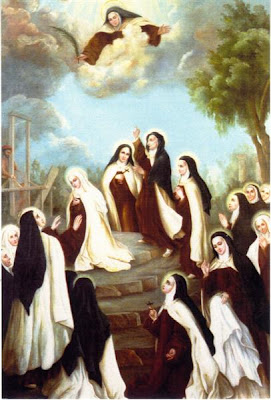
The I thought I ought to mark the day here by remembering Blessed Anne-Marie-Madeleine Thouret and the martyrs of Compiegne. Before being guilottined, they knelt and sang the Veni Creator. (Sniff, excuse me, no, it's just something in my eye hrrrmph. OK now.)

Their feast day is actually on Tuesday. I was trying to remember where I had heard of them before - and of course it was my niece's Confirmation. She chose Blessed Juliette Vérolot for her patron.

Whatever happened to mortal sin?

In the discussion about hell, one or two people have raised the question of mortal sin which is, of course closely connected. Now if we are honest, people are usually talking about sexual sins here. People are not usually worried about accidentally stealing a couple of thousand quid and then being run over by a bus. We’re not normally talking about compulsively breaking people’s legs and then having a sudden heart attack.

So first of all, some basics. For a sin to be a mortal sin, there must be all three of the following:

  • Grievous matter – the thing must be serious in itself. Sometimes the Church clarifies this question. For example, it is the teaching of the Church that in sexual sins, there is no “light matter”
  • Perfect knowledge – the person must know that the act is a sin and that it is serious.
  • Full consent – the person must give the full consent of their will to the act. This would not be present if they acted under force or fear, for example.
A number of problems have arisen in recent years. Some theologians have contradicted the teaching of the Church about the gravity of some sins – or even whether they are sinful at all. Contraception would be an example where this has happened.

For many people, deficient catechesis means that they do not know the teaching of the Church about some sins. We have to be careful here. If someone is married, they are likely to know from their own conscience that it is seriously wrong to have an extra-marital affair, even if nobody in the Church ever told them. But conscience can be badly formed. Many young people might grow up thinking that masturbation is not a sin at all because their sex-ed programme told them it was OK. Still their conscience might upbraid them a bit but sadly the sex-ed teacher might have enough credibility to convince youngsters that their conscience is “repression.”

Although these two factors might mean that an individual is not committing a mortal sin, that does not mean that everything in the garden is rosy. If a sin is objectively wrong, it will cause real harm. To take an example, if I really think that green means “stop” and red means “go”, it may be excusable for me to jump the red light but I could still end up killing innocent people. I might not go to hell for it but their families would be grieving: harm would be done.

Now the problems over false teaching on the gravity of sins and deficient catechesis can be put right by sound teaching and responsible catechesis.

The most problematic development, I think, is in the area of “full consent.” The development of popular psychology after the second world war meant that many good theologians did, and still do, consider that habit or compulsion reduces the full consent of the will. Before that, most moral theologians would have said that a habit of sin is simply another name for a vice.

Then there were all the hard cases, the Graham Greene books, the Portrait of the Artist sermon, the fears of boys in boarding schools, tales of insensitive mission preachers and confessors. What a relief to be able to say “Well technically it is a mortal sin but really it isn’t in your case because it’s a habit.” It was a trade-off. Hell was probably empty, everyone could go to communion – and nobody changed their lives.

So what’s the alternative? Are we to condemn millions of people to a hitherto improbable hell all of a sudden? The practical and reasonable alternative is to return to the teaching of St Alphonsus (and the other classic spiritual writers). He treated grave matter as mortal sin. He reflected on the awfulness of hell, and the remorse of the damned because of their folly in losing God for a trifling pleasure. He held out the prospect of peace of conscience, a godly life and the lived experience of the love of God and the advocacy of Our Lady.

St Alphonsus knew as well as we do that a person could be saved at the last minute by a brief act of contrition. What he also knew, and we seem to have forgotten, is that it is absolute folly to rely on this as though it were a sensible model for life. Our Lord told of the man who built his barns. St Alphonsus quoted that and St Augustine who said “God promises us his grace, he does not promise us tomorrow.”

In response to the preaching of St Alphonsus (and other great saints – choose your favourite), people changed their lives radically by using the means of grace. Thousands of people were converted from their indifference, the clergy were reformed and whole districts became fervent in the practice of the faith. Today we have given in to an institutional despair. Nobody can free themselves from a bad habit, nobody can follow a rule of life, nobody can fast or do penance – that kind of holiness is for the old days and you can’t go turning the clock back. (Oh no, specially not that!)

Let anyone suggest it and a thousand stories from the bad old days will be conjured up to haunt you. My great auntie had a headache on the way to Mass because of the midnight fast; Father Smith told my granddad off in confession; the mission priest said that one minute in hell was worse than a million years in prison; fish on Friday meant you had Dover Sole at posh banquets ...

There is a new generation in the Church that has opted to grow out of this routine and clichéd rejection of our own way of life. They are not too sure of themselves but they know what the Church teaches on faith and morals and they are trying to live it. What can be brought into the mix is the teaching of the saints on how to go about living it.

Their general pattern of teaching is: you start by thinking about heaven and hell. Loving God will take you to the one, and mortal sins will take you to the other. So you stop the mortal sins, confess them, turn your life around and live for Christ alone – and here’s a rule for that life [take your pick they all involve prayer, penance and self-discipline …]. Oh, and by the way here are some of the happiest and most balanced guys you’ll ever meet.

It’s been put various different ways but always the same basic pattern. As Jesus said:
If anyone wishes to be a follower of mine, let him affirm himself, put down his cross and have a rest.
No. Wait... how did it go?

Friday, July 13, 2007

Thinking about hell

Thanks very much to the commenters for the response to my "Defending St Alphonsus" post. A couple of questions have come up about mortal sin and hell. Let's have a look at hell first...

Far from being the mark of a vindictive and malicious God who doesn't care about us, hell is something that follows as common sense from what God has done for us in his infinite love. First he has created us free and immortal. As human people, we are made to his image such that we are able to love freely and for ever. By revelation we know that God has made us to love him freely and for ever and to receive his infinite and supremely benign love for all eternity.

It is easy to see that just as the infinite love of God for all eternity is our highest good, so the loss of this love is the greatest possible misfortune. If it were possible for someone else to take it away from us, we would rightly be in anguish and rage at the utter injustice of it. Thank God, this cannot happen: God is infinitely just. But we can take his love and throw it away ourselves by deliberately sinning against him. The folly and madness of voluntarily incurring this eternal deprivation is the chief pain of the damned (the pain of loss.)

It is entirely rational and prudent to have a holy fear of this loss. A husband who loves his wife but has done some stupid thing that threatens his marriage will be sensible if he fears to lose his wife and resolves with the utmost determination never to do that stupid thing again. His fear will be an entirely balanced and sensible reaction to the situation.

If on the other hand, he is living a good life generally and is meeting the obligations of his marriage, it would be damaging to the relationship if he were living in constant anxiety about losing his wife. He might occasionally think of such a fear if some "near miss" accident happens, for example, but generally, it is better for him to be finding ways to show genuine, practical love for his family by the good things that he does from day to day.

In our relationship with God, if we have committed some sin that is grave matter and therefore possibly a "mortal sin", we are right to be fearful, to make a good confession as soon as possible, and to make a firm purpose of amendment. To carry on as though we had not a care in the world and excuse ourselves would be like the man who tells his wife "get over it" or "boys will be boys". If a man said that, you would not think that he cared much about saving his marriage. If a sinner behaves in a similarly blasé manner, he clearly doesn't understand the danger of losing God for all eternity and how awful that would be.

By our prayer, penance and reception of the sacraments, we should get into the state of not committing any sins that are grave matter but living from day to day trying to overcome our venial faults, trying to pray better and living a life of practical charity towards others. Now and again, some bad thought or other temptation can remind us of the real danger of falling into sin and how we need to take the means to guard against dangerous occasions.

(I know that there are one or two questions about "mortal sin" and I'll look at those soon.)

Old piety rundown for seminarians

A commenter asked me to give a list of 10 books I would recommend to seminarians that would help to foster an ascetical life. Not counting the Gospels and the Fathers of the Church, and really off the top of my head, I would suggest:

  • The Imitation of Christ
  • St Francis de Sales - Introduction to the Devout Life
  • Lorenzo Scupoli - Spiritual Combat
  • Luiz of Granada - The Sinner's Guide
  • Louis de Montfort - True devotion to Mary
  • St Alphonsus Liguori - anything he wrote but particularly his sermons
  • Cardinal Manning - The Eternal Priesthood
  • Dom Chautard - The Soul of the Apostolate
  • E Escribano - The Priest at Prayer (if you can find a copy)
  • The manual for students at your own seminary (or more or less any seminary in the Latin Church) from any time before 1940
Many of the above are, of course, reprinted by TAN. In your seminary library, if you spend some time in the spiritual books section among the older books that are perhaps tucked away on high shelves, you may well find some original copies tucked away.

(Note that the above are intended to indicate books that will help "kick-start" you on a good ascetical life in preparation for the priesthood. If you do not have a good course which covers the spiritual classics, it would be good to get a copy of Tanquerey's "The Spiritual Life" and the works of St Teresa and St John of the Cross.)

Thursday, July 12, 2007

Defending St Alphonsus

It is interesting (and indeed welcome) to have some reaction to the prayer of St Alphonsus. "Anonymous sinner" struggles with the notion of a God who will damn people for an unrepented mortal sin, "Peter" thinks that recommending St Alphonsus is as loopy as promoting devotion to St Philomena, and an elderly priest questions the relevance of 18th century prayers for today.

Regular readers of the blog will not be surprised to find that I stick firmly to my guns on this one. Being thought "loopy" is certainly no deterrent. (St Philomena, pray for us.)

I do not find St Alphonsus' focus on the last things in any way gloomy or morbid. Hell is rarely mentioned nowadays except to try to explain why nobody is likely to go there; and yet it is a part of our faith expressed unambiguously in the Catechism of the Catholic Church. For that matter, it would be difficult to read the gospels honestly without accusing Jesus Christ of having the same preoccupation as St Alphonsus.

The point of St Alphonsus' prayers is not to make us all live in a state of perpetual anxiety but to motivate us to love God. The horror of sin has largely disappeared from Catholic spirituality and therefore people routinely commit sins that are objectively grave matter without the least idea that there might be an eternal danger in such a way of life, or even that they might be a reason not to go to Holy Communion before confessing them.

More seriously still, we have lived through an era in the Church when priests have engaged in grossly immoral behaviour, even sexually abusing children and young people - yet carried on saying Mass and ministering the sacraments without any sense that their sacramental ministry was sacrilegious. The possibility of eternal damnation seems not to have occurred to anyone.

Father anonymous asks whether any priests nowadays say the preparatory and thanksgiving prayers before and after Mass. He is probably right that these are rare and that people are surprised (even upset) if Father asks them to be quiet in Church before and after Mass or if he is not available immediately to sign Mass cards or have a chat.

Where he is wrong in my opinion, is to say that these prayers and those of St Alphonsus are anachronisms and will not come back. Expressive as they are of the eternal truths of our faith, they speak to our fallen human nature in a way that can never become outdated. I rejoice in the Holy Father's Motu Proprio freeing the Classical Roman Rite. But I think this must be accompanied by classical roman priestly piety and asceticism if there is to be a real reform in the Church. It is quite possible for the priest to pray before and after Mass - if he does, he will find that the people also catch on and the Church becomes quieter and more prayerful. If he is clearly saying the vesting prayers while vesting, people will soon learn that he does not encourage conversation at that time. There are plenty of other times he can talk to people and show what a jolly chap he is.

Whichever period of history you choose, whichever style of spiritual writing, whichever favourite saint, the reform of the Church, and particularly of the clergy, has always begun with a focus on the eternal truths, our unworthiness to minister at the altar, the infinite mercy of God and the objectively real prospect of either eternal happiness in heaven or eternal torment in hell.

The particular genius of St Alphonsus was to blend meditations on hell with a heartfelt sense of the infinite love of God who will do anything in his power to keep us from such a fate. In recent years, "spirituality" has ignored the eternal truths in favour of "self-esteem", being "integral", excusing ourselves because of our "brokenness", being a "whole person" and generally making sure that we always feel comfortable with ourselves, never have any fear of the loss of grace - and never really change.

Yes, the eternal truths are scary. St John Chrysostom said that in the presence of the august sacrifice of Christ in the Mass, we should be in fear and trembling with our hair standing on end. The almost total loss of this sense of holy fear from Catholic spiritual teaching is an even greater mark of the hermeneutic of rupture than the abandonment of the traditional roman liturgy.

The second-hand bookshops mentioned by Father are changing. The unwanted books are more likely to be the stacks of yellowing paperbacks from the 1960s and 70s promoting a new and easier spirituality: "self-actualization" and the "search for intimacy" that proved the shipwreck of so many priestly and religious lives. The "stacks of old piety" are being eagerly bought up by the younger clergy because they offer a solid and practical rule of life for the priest.

St Francis Xavier on the missions, St Francis de Sales converting 70,000 calvinists, St Charles Borromeo visiting his mountain parishes, St Robert Bellarmine engaged on his voluminous writing, Blessed Damien Veuster caring for those with leprosy, St John Bosco doing his wonderful work for boys - all these and countless priests who followed their teaching and example said the pre-Pius X breviary, made a meditation or two each day, and spent time in preparation and thanksgiving for Mass. They fasted, did penance, worked hard, took little time off, feared hell, desired heaven, loved God, and gave their lives in the service of others. They were the most "rounded" of "fully human" characters. Their way of life and the prayers they said will never be anachronistic because they express the timeless bedrock of genuine priestly piety. We will never reform the Church or ourselves without it.

Wednesday, July 11, 2007

Returning to St Alphonsus

Many months ago, I posted my translation of the Tuesday prayer from those composed by St Alphonsus Liguori for priests to say as part of their thanksgiving after Mass. After a reminder today, I have now posted a translation of the Wednesday prayer to continue the series. See the introduction for more information.

St Alphonsus was, in my opinion, a master of psychology where that discipline is seen in the light of the eternal truths (viz. death, judgement, hell and heaven.) He had a piercingly accurate understanding of fallen human nature and knew how to drive home the truths of the faith in such a way that people changed their lives - his prayers can still help us in our daily conversion to the closer following of Christ.

One project that I would like to get started is a "Wikipedia" style collaborative effort to collect Latin original texts and English translations of prayers for priests. At some point we could publish a little book with some of the classics that would support Pope Benedict's project for a hermeneutic of continuity.

St Alphonsus for priests (Wednesday)

Prayer to be said by the priest after celebrating Mass (Wednesday)

O my Jesus, I see how much you have done and suffered so that you might impose on me the necessity of loving you: and how ungrateful to you I have proved to be! How many times have I exchanged your grace for vile delectation and evil desire and lost you, O God of my soul? To the benefits of created things I have shown grateful appreciation; to you alone have I have shown myself ungrateful. Forgive me, my God; I grieve the crime of such an ungrateful soul, I mourn with all my heart, and I hope for forgiveness from you because you are infinite goodness. If you were not infinite goodness, I would have to despair and never again dare to implore your mercy.

Thanks be to you, my love, because you have sustained me for so long and have not damned me to hell which I have deserved. Indeed your patience alone with me, my God should draw me to love you. Who could ever have tolerated me except you, God, who are infinite mercy. It is long now since you invited me to love you; I do not wish to resist your love any longer; behold I give my whole self to you. I have sinned against you enough, now I wish to love you. I love you, O my highest Good, I love you, O infinite goodness, I love you, my God who are worthy of infinite love, and I wish to repeat always in time and in eternity, “I love you, I love you, I love you.”

O God how many years have I lost in which I could have loved you and progressed in your love, and I have used them up in sinning against you! But your blood, O Jesus, is my hope. I hope never to cease loving you. I do not know how much longer I have to live, but I consecrate the rest of my life to you, whether it be long or short. For this, you have so far waited for me. And so I wish to please you; I wish to love you always, most loving Lord, and I wish to love you alone. What are delights to me? What are riches? What are honours? You alone, my God, you are and always will be my love and my all.

But I can do nothing unless you assist me with your grace. Wound my heart, I pray you, inflame it with your holy love and join me wholly to you: and thus join me that I can never be separated from you. You promised to love the one who loves you: “I love those who love me.” (Prov 8.17) Now I love you; forgive my audacity, love me also and do not permit me to do anything that would prevent me from loving you. “Who does not love remains in death.” (1 Jn 3.14) Free me from this death by which I may be impeded from loving you. Make me always love you so that you are able always to love me; and thus may our love be eternal and never again may it be dissolved between you and me. Grant me this, eternal Father, through the love of Jesus Christ. Bestow this, most lovable Jesus, through your merits in which I trust that you may always be loved by me and I may always be loved by you.

O Mary, Mother of God and my mother, pray also to Jesus for me.

APGL Conference

Fr Aidan Nichols OP addressed the conference of the Association of Priests for the Gospel of Life today at the St Wilfrid's Hall at the London Oratory. His lecture was on the subject of "Vatican II, Culture and the Gospel of Life." It was a most stimulating and academically robust discussion of the hermeneutic of rupture and the hermeneutic of continuity as applied to the text of Gaudium et Spes. I hope to be able to publish the lecture in due course.

After lunch, organised by SPUC, I gave a short spiritual conference on the pro-life character of the priestly identity, related particularly to the Eucharistic Sacrifice. We made time for confessions, rosary and other prayers in the beautiful "Little Oratory." I am very grateful to the Oratory Fathers for allowing us to use this first-rate and easily accessible location for our conference.

Motu Proprio resources

St Michael's Abbey Press have a Motu Proprio page dedicated to resources that will help in the implementation of Summorum Pontificum. Nice idea!

Tuesday, July 10, 2007

Ruth Gledhill - "paradigm smashed"

Ruth Gledhill, writing in her blog on Times Online has a really quite good article on the Motu Proprio. As I have criticised her reporting before, I think it is only fair to draw attention to this article. And besides, she has featured the "Happy Days" video which is very kind. (At the time of writing it had over 300 views - the number is now over 22,000.)

She aptly quotes one of our more successful prime ministers:

In Churchill’s famous phase, today is “not the end. It is not even the beginning of the end. But it is, perhaps, the end of the beginning.”
Absolutely! We have a long way to go but Pope Benedict has firmly indicated the direction.

I did enjoy this part of the article, which I think is spot-on:
The Pope has worked for decades for a declaration that the Latin Mass was never abrogated. However, many Bishops are still working with the paradigm that it was superceded by the new Mass and needless to say this produces the hostility which traditionalists feel from Bishops throughout the world. This paradigm has now been smashed and it will take some if not many Bishops time to come to terms with it.
Yes, indeed, that paradigm has been well and truly smashed. Gledhill has also captured the essential dimension that is so often missed:
The young, more conservative priests who are the few that are being ordained will take full advantage of this sentence, not least because it restores the dignity of the priesthood and is a source of spiritual consolation. One can expect to see less burnout among the priesthood, as they are no longer encumbered with the enormous expectations placed on them as “presidents of a community celebration” rather act “in persona Christi” which is all the people really need them to be.
Yes, less burnour, more spiritual consolation and less encumbrance. With the classical use of the Roman Rite, the priest does not need to be a performer or anything else except to act in persona Christi.

This is an amusing and accurate comment:
§ 2 Clerics ordained “in sacris constitutis” may use the Roman Breviary promulgated by Bl. John XXIII in 1962.

Commentary
Fortunately, a Bishop even he wanted to be Big Brother had no real means of checking on this. It does, however, mean that there will be no more furtive Breviary reading!
Very true - and no more furtive use of the Roman Ritual for blessings, no more scruples about celebrating the occasional baptism in the old rite, no more worries about getting permission for couples who want the old rite of marriage, no need to worry the Bishop if an elderly person wants the last sacraments according to the usus antiquior.

Has anyone any ideas for a picture of a "smashed paradigm" :-)

Monday, July 09, 2007

Meeting Fr Benedict Groeschel

Fr Stephen Langridge had an evening of recollection today at the Holy Ghost parish, Balham with Fr Benedict Groeschel giving a talk on "The New Psychology of Virtue." Although there is a lot on my desk to get through, I took the decision a couple of weeks ago to book this evening into my diary because I have never met Father Benedict and I was very keen to see the man who has done so much wonderful work for the renewal of the Church.

The full Church was treated to a spiritually enriching, witty and down to earth talk on the problems of 20th century psychology and the importance of the concept and practice of virtue. After the talk, Fr Stephen Langridge celebrated Vespers and Benediction. As ever on these occasions, it was a pleasure to meet people who have read this blog as well as many old friends from Faith and from other contacts in Catholic London. A good number of seminarians from Wonersh were there too and I know that their presence is valued - they also benefit from such occasions where there is a real joy in the faith among lay people from every walk of life. At these events at the Holy Ghost, one always comes away reaffirmed in Pope John Paul's exclamation (taken up by Pope Benedict) "The Church is alive! The Church is young!

I picked up a copy of the book that Fr Benedict has published on the theme he was speaking about tonight:

Secularists attack Mom of 10

The National Secular Society have a piece entitled Religious school transport privilege axed in Cheshire at the end of which they link to Catholic Mom of 10 saying that "This Catholic mum lives up to every stereotype imaginable – and then some." Well, I suppose they should know about stereotyping Catholics.

Some of the secularists have been posting comments on her post Re sex-education. If you have time, you might like to go over and join in.

Sunday, July 08, 2007

Summorum Pontificum website

See the new Summorum Pontificum blog for links to coverage of the Motu Proprio. I think it is in everyone's interest if we send them links as we find them.

Champagne and cake

After our Saturday Holy Hour, there was a little celebration of Summorum Pontificum with champagne (and fizzy orange) and chocolate cake. At that time, only the Latin text was available so I gave a quick running translation and handed out copies of the accompanying letter in English. We toasted Pope Benedict and, as it was a gloriously sunny day, had another glass of champagne in the garden.

Later, I went over to the parish of St Mary Magdalen, in Wandsworth East Hill where a Pizza Proprio party was being held. Here is the parish priest, Fr Martin Edwards, pouring a glass of a special cocktail he had invented in honour of Mgr Wach of Gricigliano:

And here are some of the guests discussing the finer points of the document. The evening also included the singing of the Te Deum in the Church.

Some links for Summorum Pontificum

Just for your convenience, I have gathered a few links related to Summorum Pontificum.

TEXT
Summorum Pontificum - official Latin text on the Vatican website.

Translation of Summorum Pontificum - on the Vatican website but labelled "unofficial."

The Holy Father's accompanying letter - English version on the Vatican website.

New Catholic at Rorate Caeli has produced a pdf of the text of Summorum Pontificum and the English translation in parallel columns.

COMMENTARY
Fr John Zuhlsdorf has some helpful and sensible introductory comments

Shawn Tribe at the New Liturgical Movement has a Brief Summary of the Pre and Post MP Scenarios which I think sums up a lot of important points - especially his summary:

Overall, the significant, general shift in the post-MP Church is of course the de-marginalization of the Roman liturgical tradition and a re-assertion of a hermeneutic of continuity.
There are several other excellent posts on the New Liturgical Movement which offer informed and balanced commentary. Others have simply put a link to say something like "see informed commentary here" - a just recognition of the excellent quality of information and comment at that first class blog.

Fr John Boyle has a commentary with the insight and expertise of an experienced canon lawyer.

Fr Martin Fox has some good observations in his post Well, the pope done did it!. From the point of view of the "hermeneutic of continuity" I particularly like his summary:
This is about how the Church, and history, views Vatican II--and that's big This should signal it's time to stop using the "new v. old" Church and Mass way of explaining Vatican II. Sorry, that's both incorrect and now it's clearly unhelpful. The pope--the pope--is saying that's wrong. I know, a lot of us were told that, and on behalf of those who told you that, wearing a collar--I'm sorry. But the time has now arrived to stop.
Sandro Magister: Benedict XVI Liberalizes the Ancient Rite of the Mass – And Explains WhyAs ever, he shows how to do religious journalism with accuracy and insight.

Phil Lawler give the Catholic World News analysis.

The Committee on the Liturgy of the US Conference of Catholic Bishops has obviously taken the opportunity given by the advance release of the document to the Bishops. In their Newsletter dated June-July 2007 just published, they have the English text of the Motu Proprio itself and the accompanying letter. They then have 20 questions on the letter itself, including a comparison of Summorum Pontificum with Quattuor Abhinc Annos and Ecclesia Dei Adflicta, and 10 questions on the ordinary and extraordinary forms of the Missale Romanum. There are one or two things to quibble with (the comparison of old and new rites especially) but it rather puts us to shame over here.

Feedback on that video

Many thanks for all your kind comments about the video. It seemed to go down well, especially the "Happy Days" bit. Checking it on YouTube just now, it has had 9,904 views which actually just sneaks it onto page 5 of the "most viewed" section.

I feel I should respond publicly to one comment I received privately by email. In the first section, there are a couple of photos of quite unexceptional Novus Ordo Masses where the priest is doing nothing wrong. I can see that I might have caused offence by putting these next to the coffee-table and liturgical dance photos. The idea was only to contrast the appearance of the Novus Ordo Mass with the Classical Rite. I sincerely apologise if I caused any offence by this and volunteer the admission that if I had had a picture of myself celebrating the Novus Ordo, it would have done just as well.

One one forum, there have been a couple of comments saying that the video denigrated Pope John Paul II. To be honest, I am simply baffled by this. I suppose that if someone does not like the liberalisation of the Classical Rite, the video will be rather irksome and people would want to find some criticism of it. Fair enough - but how the blazes does the video denigrates Pope John Paul?!

But for the vast majority, it seems that it was taken in the spirit in which it was made - a piece of harmless fun to celebrate what I consider to be a quite momentous act of the Holy Father. Now I'd better explain why I think that...

Saturday, July 07, 2007

Summorum Pontificum celebration video

A light hearted celebration of Summorum Pontificum.


I stayed up far too late putting this together so I'll post it for you to enjoy over breakfast.

Friday, July 06, 2007

Sisters of the Gospel of Life

A new addition to the Catholic blogosphere: the Sisters of the Gospel of Life blog. They say,

We hope that by getting involved in the very active world of Catholic blogs we will be able to show people that active, orthodox and joyful religious life for young women today is not only possible but fantastic!
Please pray that this hope will be realised and bear fruit in many vocations to join the Sisters.

Summorum Pontificum embargo

Gerald Augustinus has a sensible post regarding the embargo on the Motu Proprio Summorum Pontificum.

Here is a link to the text of the notice to journalists. The text will be available to accredited journalists at 9am and embargoed until 12noon. I think it is right for bloggers to respect that. (And I'm not publishing comments drawing attention to the blog that has leaked bits of it.)

There is also a special announcement today from the Vatican Information Service:

VATICAN CITY, JUL 6, 2007 (VIS) - Tomorrow, Saturday July 7, the Vatican Information service will transmit a special service for the publication of the Apostolic Letter "Motu Proprio data" of His Holiness Benedict XVI, "Summorum Pontificum," concerning the use of the pre-1970 Roman liturgy. The document will be accompanied by an explanatory Letter from the Holy Father.
It is exceptional for the VIS to publish on a Saturday - this reflects the importance of this document and the wide public interest in it. 12noon tomorrow will be a severe test for the Vatican servers!

Summorum Pontificum celebrations

At Blackfen, we currently have Latin Mass at the Lady Altar on Saturday morning (currently Novus Ordo)at 10.30am, followed by Adoration of the Blessed Sacrament with the opportunity for confession. Benediction is as 12noon, followed by the Marian Anthem at the Lady Altar. Tomorrow, after Benediction has finished, there will be a little celebration with some champagne and chocolate cake. If you are in the area, you will be most welcome. My parish website gives directions to the Church.

The two young altar boys who serve the Saturday Mass are very keen to have the Classical Rite as they have now learnt how to serve it. They will be glad to know that the Holy Father has facilitated their legitimate aspirations! I'll make sure they get some of the cake and something suitable for them to drink too.

I'll be attending another celebration in the evening in a certain parish on the other side of South London that is not unsympathetic to the return of the Classical Rite.

CTS publication of Summorum Pontificum

A correspondent has heard from the CTS that they will be publishing a print copy of the Motu Proprio on the 1962 rites; it will be entitled: “Summorum Pontificum”. They don’t yet have a publication date but it will be sometime around 16 July 2007.

Thursday, July 05, 2007

Government closing on Catholic schools

A week ago, our new Prime Minister set up three new Government Departments to replace two previous ones (DfES and DTI). In addition to the "Department for Innovation, Universities and Skills" (DIUS) and the "Department for Business, Enterprise and Regulatory Reform" (DBERR), there is the new "Department for Children, Schools and Families" (DCSF).

The new minister in charge of the DCSF is Kevin Brennan. He has certainly wasted no time in showing us what the priorities will be for this new department entrusted with policy for schools and families - he has been to visit Stonewall's Education for All conference. There is an article and the full text of his speech in the Pink News article Government committed to stamping out gay bullying. (Brennan moved the Sexual Orientation Regulations in the House of Commons on 19 March this year.)

He speaks a great deal about homophobic bullying without defining what that means. And he makes it clear that the new guidance to be issued will "apply to all schools - including faith schools." To help you out, here is a definition of homophobia from the Department of Health's 2004 document on Challenging Homophobia in Schools:

Homophobia is a dislike or fear of someone who is lesbian, gay or bisexual (LGB). At its most benign it involves passive resentment of LGB men and women. In its most destructive form it involves active victimisation. Such attitudes can also affect anyone who is perceived to be homosexual or who does not conform to stereotypical standards of masculine or feminine behaviour.
This is a poorly worded statement by any standards. Presumably they ought to have written "a dislike or fear of someone because they are lesbian, gay or bisexual (LGB)" but we all know where this is going. This is not about stopping children calling each other nasty names or picking on a weak individual - as the Catholic Education Service have pointed out, existing anti-bullying policies already deal with those issues.

The drive here is to try to force faith schools (he means Catholic schools in particular) to avoid expressing the teaching of the Catholic Church that that homosexuality is a disordered condition, that homosexual acts are gravely sinful, that the family is the fundamental unit of society and that sex is only morally licit between a man and a woman who are married to each other. This teaching will itself be regarded as homophobic, and a form of bullying.

A lot of what Brennan says hinges on the issue of culture change. He compares the "homophobic language" of today with the racist language of the 1970s which few people now find acceptable. The culture change that Brennan is trying for force through in schools (and perhaps also by inspecting homeschooling families) is to make it wrong to deny that homosexuality as much a part of a person's natural make-up as the colour of their skin.

This policy is being driven by Stonewall and the National Secular Society. They hate our schools and want them either handed over to the state or forced to deny Catholic moral teaching. Quoted in the NSS article Catholic Church not fit to run schools, says GALHA), George Broadhead of the Gay and Lesbian Humanist Association makes it quite clear:
“It’s terrible to think that there are gay children in these establishments being bullied not only physically but also psychologically by the message they are getting from the Church authorities. Somebody has to speak up for them, and I am pleased that the Government recognises that gay kids are at particular risk in Catholic schools.”
Note that well - "bullying" is not just about physical or verbal abuse but the teaching of the Catholic Church.


PS - I was talking to Hilary White of LifeSite News about all this earlier. I see she has now posted her article - UK Minister Pledges Government Collaboration with Gay Activists in Stopping "Homophobic Bullying" in Schools

See also my previous post NSS and DfES show the next step which has links to other relevant sources.

Video of Pope Benedict's Private Mass

This is from RAI, (Italian TV), uploaded to Daily Motion by paristocrate

Harrisburg vocations up

Stephen (For God, For Country and For Yale) Has posted news of an upsurge in applicants for the seminary in the Diocese of Harrisburg, quoting the News Release of the Diocesan Office of Communications.

This diocese was brought to my attention a few weeks ago by a parishioner who had discovered their excellent programme for Formation in Chastity (pdf). The programme has also been adopted for use in the Diocese of Arlington - see this letter from Bishop Loverde.)

Respect for the elders

Do have a look at Andrew's moving and beautifully illustrated story of his grandmother's 81st birthday party (Milestones). It spoke very strongly to me as an object lesson in respectful love for our elders.

Abortion - changing hearts and minds

LifeSite News has a review of two films that are showing this summer Knocked Up and Waitress. (See: A Diamond in the Raunch) While not endorsing the general immorality of the films, (and not recommending that anyone go to see them) the review points out one positive element in both: they clearly show the humanity of the unborn child and give a positive portrayal of the decision of the mother not to have an abortion despite being pressured to do so. A quote from the review:

Yes, these films are inappropriate on many levels. But there is no escaping the fact that we are witnessing two Hollywood films in simultaneous release that value unborn life, openly reject the call for abortion, and argue that children can positively affect the lives of those who have them.
Many young people will see these films - let us pray that the lesson of the humanity of the unborn child will not be lost on them.

In a Pastoral Letter for the Day for Life, my Archbishop, Kevin McDonald, said:
There will be no change in the legislation until there is a change in the hearts and minds of people. We must not lose hope that that prayer will be answered.
I think this is an important point. Changing hearts and minds is the most important priority - I pray that the depiction of the unborn child by Hollywood will help us a little.

Wednesday, July 04, 2007

Fr Douglas ordination video

A short video showing Fr Kevin Douglas being vested in stole and chasuble at his ordination last week.

APGL Conference next Wednesday

There will be a conference held by the Association of Priests for the Gospel of Life next Wednesday, 11 July, in St Wilfrid’s Hall at the London Oratory, Brompton Road, SW7 2RP

The Conference is open to all priests.
Deacons and seminarians are also welcome.


Programme
Registration at 11.15am
Keynote Speaker: Fr Aidan Nichols OP,
John Paul II Memorial Visiting Lecturer at Oxford University
"Vatican II, Culture, and the Gospel of Life"

A buffet lunch will be provided.
Pro-life literature will be available.

The afternoon session will include a Spiritual Conference, Adoration (with Confessions), Rosary and Benediction. Tea will be served after Benediction and the Conference will conclude by 4pm

To help us with catering, please send an email to conference@apgl.org.uk if you are coming to the conference. There is no charge but donations will be welcome.

(The Oratory is next to the Victoria and Albert Museum. (Nearest tube station South Kensington.) Enter the courtyard in front of the Oratory House. St Wilfrid’s Hall is upstairs in the building on the left.)

Happy 4th of July

Currently 30% of this blog's readers are from the United States of America. So may I wish you a very happy day today if you are celebrating in the land of the free and the home of the brave. God bless America!

Ordinary and extraordinary

Rorate Caeli has a light-hearted post with pictures of the ordinary and extraordinary rites of Mass as they are called, apparently in Summorum Pontificum (the Motu Proprio expected on Saturday.)

Jesuit spiritual resources

Companion of Jesus offers a collection of Ignatian and other Jesuit prayersm and the spiritual exercises (including a pictorial version.)

H/T to the Curt Jester

Westminster Cathedral blog on 99 names

Mgr Mark Langham has posted on the The Beautiful Names concert in which the 99 names of Allah were sung in Westminster Cathedral. In addition to his post about the concert itself, he has a generous and fair-minded post about the protest against it, describing it as "dignified and prayerful."

There are several good photos of the Prayer Vigil taken by Marcin Mazur. In one of them you may recognise two Catholic bloggers.

RSV Catholic edition online

For ages now, I have had the RSV bible from Etext Center on my Firefox toolbar. Thanks to PhatCatholic, I learn that the Catholic edition is now online.

It is well implemented with all the books listed on a single screen. Each book opens up quickly as one page with anchor links to individual chapters. The bonus is that it is far quicker than the Etext version.

Former gay activist tells story

At 22, Michael Glaze was the editor of Young Gay America and a leading gay activist. He has decided to tell publicly the story of how he left all that behind.

God came to me when I was confused and lost, alone, afraid and upset. He told me – through prayer – that I had nothing at all to be afraid of, and that I was home; I just needed to do a little house cleaning in my mind.
See How a 'gay rights' leader became straight.

H/T Cosmos, Liturgy, Sex

Blogger's Choice Awards

The Religion category seems to have become a contest between various popular Catholic blogs. So feel free to vote for me and put me ahead of some of my blogging friends. Or alternatively vote for one (or several) of the other Catholic blogs - there are some really good ones in the top ranking.

Farm Street Mission-Retreat

There is a month long mission-retreat at Farm Street every evening in July, given by Fr John Edwards SJ. Each evening there is Mass at 6pm followed by a Mission Service with Exposition of the Blessed Sacrament, a sermon which will cover different topics of faith (“The Instruction”), practical helps to prayer (“The Way of Praying”), and Benediction at about 7:15pm. The following is from the Farm Street Website:

There will be opportunity for confession before Mass and after the service. Participants may depart at any time and may attend as many evenings as they like. Each evening will stand alone. The month will conclude with a celebration of the Feast of St Ignatius on Tuesday 31st July at 6pm with a sung Mass (with instrumentalists joining the choir), and with Fr Provincial Michael Holman, SJ celebrant. At this Mass, Fr Paul O'Reilly SJ, who often helps with our week-end Masses, will take his final vows. All friends of Farm Street Church and particularly all alumni/ae of Jesuit schools are cordially invited to the Mass and reception in the Hall.
Fr John Edwards is an excellent preacher and I warmly recommend this Mission to anyone living or working in London.

Tuesday, July 03, 2007

Cardinal Kung Foundation on Pope's Letter to China

Joseph Kung of the Cardinal Kung Foundation has written a prelimary assessment welcoming Pope Benedict's letter to the Catholics of China.

The Cardinal Kung Foundation has energetically promoted the cause of the underground Church in China and some commentators have wondered what their reaction would be to the letter which in some respects attemtps to conciliate the underground and the patriotic Church.

I was most impressed by the booklet "Stories form the Catholic Church in China" published by Aid to the Church in Need. The short stories are very moving and quite astounding in some cases. One that is relevant to the present case is that of the reconciliation between an "official" Bishop and his underground counterpart.

It is in the interests of the old-fashioned atheists in the Chinese government to foster discord between the patriotic and the underground Churches. As so often in persecution, those who are actually involved understand the pressures that others are under and are more willing to promote reconciliation than armchair observers who do not face imprisonment and torture.

I pray that the Holy Father's letter will be a real source of joy and hope for all the Catholics in China. The Chinese Government has, predictably, tried to suppress its publication. (Information from Zenit and further info from Fr Z.)

Our Lady of China. Pray for us.

I Was Just Flipped Off by a Silver-Haired Old Lady with a 'Honk If You Love Jesus' Sticker on the Bumper of Her Car'

If you need cheering up, go to NPR's page for Antsy McClain's Trailer Park Troupe, click on song number 2, let the advert run and then listen to the song.

H/T Catholic and Enjoying It

("Flipped off" does not sound particularly rude in English. If it means something ghastly in American, please let me know asap and I'll change the title.)

Cast your vote

There is a poll in a paper Fr Z refers to as "one of the worst, one of the most liberal newspapers in the USA, the execrable Minneapolis Star-Tribune" The poll asks "Should the church allow wider use of the Latin Mass?" Ignore the ignorant wording - just go and vote here :-)

Monday, July 02, 2007

Infanticide and culture

The Telegraph recently carried an article Girl survived tribe's custom of live baby burial. This tells of some Amazonian indians in Brazil, who practise infanticide. Babies who are considered 'abnormal' (which includes being twins or triplets, let alone physical defects) are buried alive, or 'suffocated with leaves, poisoned or simply abandonned in the jungle'.

You won't be surprised to know that a certain Dr Erwin Frank 'an anthropology professor at the Federal University of Raiaima Sate in the Amazon' defended the custom, saying 'This is their way of life and we should not judge them on the basis of our values. The difference between the cultures should be respected'.

Alternatively, it puts into context what Pope Benedict said to the bishops of Brazil on 13th May 2007:

'The ‘Utopia’ of going back to breathe life into the pre-Columbian religions, separating them from Christ and from the universal Church, would not be a step forward: indeed, it would be a step back. In reality, it would be a retreat towards a stage in history anchored in the past.'
A step back indeed!

Needless to say, the Pope was heavily criticised for venturing any criticism of the pre-Christian civilisation ...

The feminisation of the Church

John Allen's column this week is titled Lay ecclesial ministry and the feminization of the church. He quotes statistics that bear out something I have mentioned before:

For a church long perceived as bastion of male privilege, it's striking that these new lay professional roles are held disproportionately by women. As of 2005, roughly 80 percent of lay ecclesial ministers in the United States were women.
I imagine the numbers would be roughly similar in England.

One of the key problems in my opinion is that of the promotion of lay ministry as an answer to all our problems. To quote Christifideles Laici,
In the same Synod Assembly, however, a critical judgment was voiced along with these positive elements, about a too-indiscriminate use of the word "ministry", the confusion and the equating of the common priesthood and the ministerial priesthood, the lack of observance of ecclesiastical laws and norms, the arbitrary interpretation of the concept of "supply", the tendency towards a "clericalization" of the lay faithful and the risk of creating, in reality, an ecclesial structure of parallel service to that founded on the Sacrament of Orders. (n.23)
and further on,
[...] it is necessary that in acknowledging and in conferring various ministries, offices and roles on the lay faithful, the Pastors exercise the maximum care to institute them on the basis of Baptism in which these tasks are rooted. It is also necessary that Pastors guard against a facile yet abusive recourse to a presumed "situation of emergency" or to "supply by necessity", where objectively this does not exist or where alternative possibilities could exist through better pastoral planning. (ibid)
Some of my more cynical brethren among the clergy will say at this point that this is a return to the supposed situation of the past where the laity were supposed to "pray, pay and obey". In fact, Christifideles Laici offers a genuine understanding of the lay apostolate (as distinct from lay ministry) which calls to mind that much neglected document of Vatican II, Apostolicam Actuositatem (Decree on the Lay Apostolate)
The various ministries, offices and roles that the lay faithful can legitimately fulfill in the liturgy, in the transmission of the faith, and in the pastoral structure of the Church, ought to be exercised in conformity to their specific lay vocation, which is different from that of the sacred ministry. In this regard the Exhortation Evangelii Nuntiandi, that had such a great part in stimulating the varied collaboration of the lay faithful in the Church's life and mission of spreading the gospel, recalls that "their own field of evangelizing activity is the vast and complicated world of politics, society and economics, as well as the world of culture, of the sciences and the arts, of international life, of the mass media. It also includes other realities which are open to evangelization, such as human love, the family, the education of children and adolescents, professional work, and suffering. The more Gospel-inspired lay people there are engaged in these realities, clearly involved in them, competent to promote them and conscious that they must exercise to the full their Christian powers which are often repressed and buried, the more these realities will be at the service of the Kingdom of God and therefore at the service of salvation in Jesus Christ, without in any way losing or sacrificing their human content but rather pointing to a transcendent dimension which is often disregarded" (ibid)
When somebody does a reading at Mass or acts as an extraordinary minister of Holy Communion, they are doing something that a priest can do. One of my parishioners (now deceased) arranged for a group of fellow-employees at the Bank where she worked, to say the Rosary at the tea break. That is not something I can arrange, it is a specifically lay apostolate. The same goes for a father teaching his children to behave decently, a post office worker gaining such respect among his younger colleagues that they refrain from swearing when he is around. Yes, that actually happened - in Peckham of all places. It was a West Indian man whom his young co-workers held in high esteem.

While we promote lay ministry instead of genuine lay apostolate, we will probably continue the feminisation of the Church. The lay apostolate on the other hand, will help to involve people of both sexes with many different gifts to bring to the evangelisation of our culture - including men willing to engage in a rearguard action in the culture war that we have largely lost in modern Britain.

Religious reporting: an interesting comparison

The Independent leaves its readers in no doubt where it would like to stand on the Motu Proprio question if it actually knew anything about it. Church split feared as Pope backs return of 'anti-Semitic' Latin Mass (30 June). A couple of quotations:

The 16th-century Tridentine Mass - which includes references to "perfidious" Jews - was abandoned in 1969 [...]

Cardinals, bishops and Jewish leaders are concerned by the text of the "old" Mass, which has passages, recited every Good Friday, which say Jews live in "blindness" and "darkness", and pray "the Lord our God may take the veil from their hearts and that they also may acknowledge our Lord Jesus Christ".
Now compare this coverage with another newspaper:
The text is based on the Tridentine Mass promulgated by the Council of Trent in the 16th century. Originally this mass contained a Good Friday prayer for the conversion of "the perfidious Jews."

But in the 1960s, after his historic meeting with the historian and Holocaust survivor Jules Isaac, Pope John XXIII ordered this terminology removed, and the version that will be used dates back to 1962, when this phrase had already been eliminated.
Where do you have to go for such informed comment on Catholic issues? The Jerusalem Post. Pope explains revived Mass (1 July)

The article goes on to express concern at the difference between the 1962 and 1965 versions of the Good Friday prayer because the former prays for the conversion of the Jews. That we could discuss at length. But I would want to contrast the generally well-informed and fair-minded coverage of the Jerusalem Post with the bigoted headline of the Indie and its attempt to play up and exacerbate division within the Church.

Sunday, July 01, 2007

Problems with being a moderately techno-savvy 49 year old priest

1. The technical gadgets you buy assume that the user is a young person who does not have macular degeneration. Therefore you have to wear reading glasses to see the menus and settings.

2. Young people say that you are “cool” when that is actually the last thing that you want to be. Then they start asking you for technical advice.

3. Older people think you are being profligate and wasting time when in fact the gadgets are quite cheap and save a lot of time. Then they start asking you for technical advice.

4. People of your own age in the Church who are frightened of the internet think that you are doing something highly dangerous and should probably be stopped somehow. Then they start asking you for technical advice.

5. People of any age who are far more techno-savvy than you are constantly encourage you to try new things. You succumb to the temptation, exacerbating problems 1-4 above.

It's my birthday today. I'm 49. No presents or cards expected. You say a prayer for me and I'll say an act of contrition.