Therefore every scribe who has been trained for the kingdom of heaven is like a householder who brings out of his treasure what is new and what is old.
New blog from Brighton
Laurence England, a parishioner of Fr Ray Blake at St Mary Magdalen's, Brighton, has recently started a blog called That the bones you have crushed may thrill (ponderings of a Catholic layman) which is well worth a look.
The Church Music Association of America and Jeffrey Tucker of the New Liturgical Movement have made available the 1962 Missal online in pdf format (72Mb). The file is hosted at Musica Sacra , the website of the CMAA, thanks to a generous gift from Fr Robert Skeris While you are at it, take a look at the articles clarifying the rules for music at Low Mass and music at High Mass .
The Truth About Margaret Sanger is a blog dedicated to exposing the truth about the founder of Planned Parenthood. The blog carries items of general pro-life interest but focuses particularly on the eugenic thinking of this iconic figure in the anti-life promotion of abortion and birth-control. They are currently running the 3rd Annual Margaret Sanger at the Ku Klux Klan Rally Art Contest which invites various representations of Margaret Sanger's speech in 1926 to the Women's Branch of the Silver Lake Ku Klux Klan as mentioned in her own 1938 autobiography. The contest will not accept photoshopped entries this year but will accept any of the following: Drawings, cartoons, historical novels, haiku, dance, plays, videos, paintings, quilts, rap, puppetry, modern interpretations of Sanger speaking to the Klan, reenactments of the speech on YouTube, mime, audio recordings of actual Sanger quotes she may have reused when speaking to the Klan
A commenter says (of St Jerome's translation of Genesis 3.15) "That is not what the lectionary says." I am sure he/she is right, whichever lectionary is used. In fact, the Nova Vulgata , the Church's new official translation of the Bible in Latin, translates the Hebrew with the neuter ipsum . Here is the (old) Vulgate text again for the sake of reference: Inimicitias ponam inter te et mulierem et semen tuum et semen illius ipsa conteret caput tuum et tu insidiaberis calcaneo eius. (I will put enmities between thee and the woman, and thy seed and her seed: she shall crush thy head, and thou shalt lie in wait for her heel.) The word ipsa translates an epicene Hebrew personal pronoun: one that has only one form to denote either male or female. It can legitimately be translated either as "he", "she", or "it." In one place, St Jerome quoted the Vetus Latina version which gives ipse . (Lib. Quaest. Heb. in Gen. PL 23.943) and this has been t...
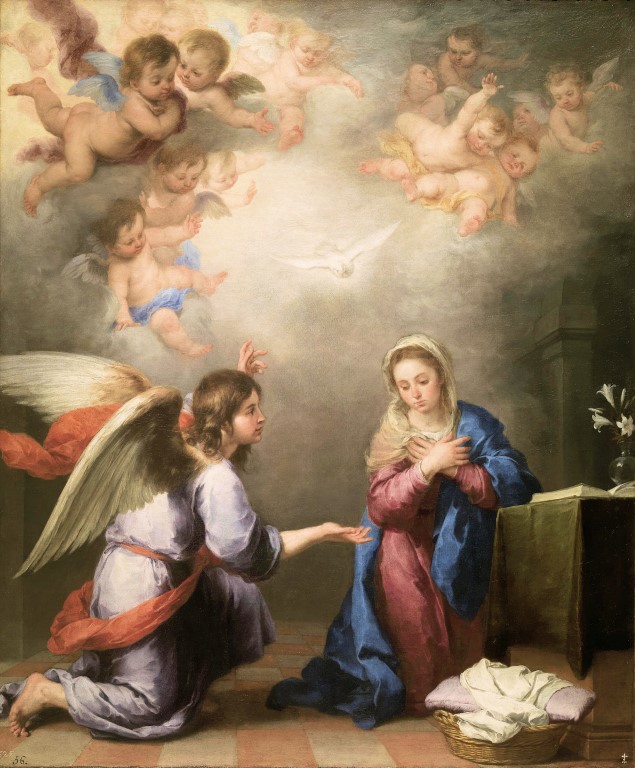
The angels call for our veneration and awe as part of God’s creation. Part of the destructive modernism of the 1970s included advice to Catholic school teachers that they should not talk to children about angels. This wrought lasting damage which continues to need rectifying. We should include in our prayers a heartfelt recourse to our own Guardian Angels. The Archangel Gabriel “God is my strength” would be terrifying were he to appear to any of us. Our Lady was “troubled” at the word of Saint Gabriel and wondered at the manner of the salutation. Immediately, according to his mission, the awesome messenger explained himself. Modern retelling of the event is often reduced to the jejune “Mary said Yes to God”. In fact, she said “Behold the handmaid of the Lord; be it done to me according to thy word”. This conveys more accurately the flawless faith and trust of the Immaculata. In the infinitely wise providence of the Father, we now know the structure of the event in even more detai...
On the feast of St Ignatius, I offer my prayers and good wishes to some great Jesuits. Just off the top of my head, I think of Fr Joseph Fessio SJ the founder of Ignatius Press which has not only published the English translations of various works of Cardinal Ratzinger/Pope Benedict, but has also given a break for good Catholic authors both of theology and of Catholic fiction. Then there is Fr Bob Spitzer SJ, with whom I studied in Rome many years ago, and Fr Paul Mankowski SJ who has written some superb articles over the years. Here in England, I recall Fr Anthony Meredith SJ, the great fatherly commentator on the Fathers of Cappadocia and in Rome, there is Fr Gilles Pelland SJ, the fierce French-Canadian patristics scholar was a bit harsh when I first arrived in the Holy City, but seemed to soften a bit when after 5 years he seeme satisfied that, though English, I was not a modernist. Many of my Jesuit priest friends and mentors have now reached “that night when no man can work”...