Pages

Tuesday, 12 June 2007

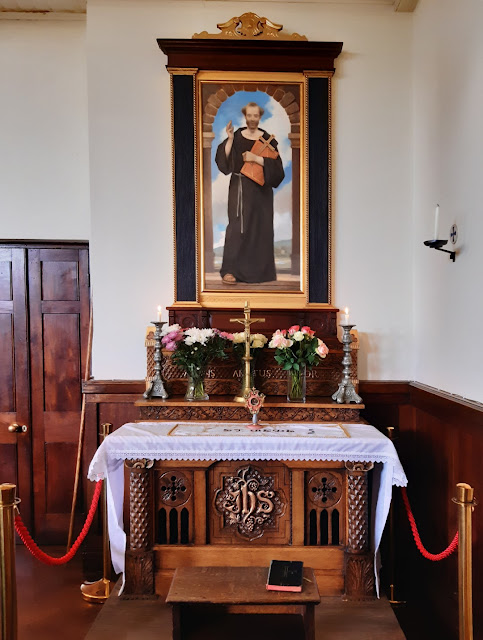
More photos of St Theresa's

Fr Stephen Reynolds of St Theresa's has sent some more photos of his Church to myself and Carolina Cannonball (The Crescat) where I found the photos I posted the other day. They were actually only the Daily Mass Chapel.

Here is the main body of the Church, before:
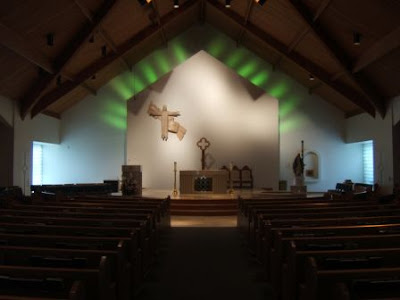
and after:

Here is a closer view of the High Altar:
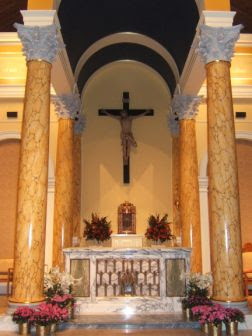
Fr Reynold's commented,
In the reordering of the church, a restored 53-rank Aeolian Skinner pipe organ was integrated into the design. The baldacchino was an absolute necessity, since our church does not have a choir loft, and the organ had to be placed on either side of the sanctuary. The baldacchino directs one's eye and attention to the altar, rather than allowing the organ installation to visually dominate the church.
Beneath the High Altar are relics of St Therese of Lisieux:

The architect, Duncan Stroik, has also designed their new school building, construction of which will commence in September.
13 comments:

John Browne said...

Breathtaking, is all I can say.

Panda Rosa said...

The Before picture reminds me of my present church, which is equally spare in design. But then, I'm a Presbyterian, it's supposed to be that way.
Catholics are lucky.

Andrew said...

I love the new look as well as Stroik's previous work.

But looking at the exposed relics, I was wondering whether it is allowed under the current rules? I was under the impression that the relics had to be sealed up in the altar?

Just a thought.

Rita said...

That's much better!

Laura The Crazy Mama said...

OH MY GOODNESS! Now THAT is a renovation!!!!!!! What a change! I wonder what the parish thinks of everything? Why did they let it get so ugly in the first place?

Liam said...

It barely looks like the same church and what a difference it makes. In the 'before' picture it appears like a Protestant Church as many Catholic Churches do from its architectural vintage. In the 'after' picture it genuinely appears like a Catholic Church.

The whole Church seems to offer a different philosophy and theology. It is surprising what a difference good architecture makes.

Captoe said...

It's heartening to see this. Thanks

Anonymous said...

What an amazing change. The new altar looks magnificent - just like it ought to. Duncan Stroik is brilliant. He is also doing the chapel at Thomas Aquinas College. It looks like it is going to be beautiful.

Fr. Stephen B. Reynolds said...

Having read your comments, I thought it opportune to add a little background to our renovation projects at St. Theresa.

Unfortunately, when the current parish church was built in the early 1980's, the budget was quite limited, resulting in a straightforward, if bland, structure.

The remodeling of the chapel was promted by two concerns: the need for additional confessionals (there was only one), and the gift of a stained-glass window of our patroness, Ste. Therese of Lixiuex. Given the constraints of the original building, Duncan did an admirable job of transforming and ordering the space.

The chapel occupies one transept of the church, separated from the nave by a folding wall which can be opened on the weekend to supply more seating for Sunday Masses. This explains the presence of chairs, which can be turned around, rather than pews, which cannot. Be assured that the chairs have kneelers.

The Blessed Sacrament is moved from the side chapel to the main tabernacle for the weekend Masses. This arrangement is far from ideal, but is an unchangeable constraint, apart from building a whole new edifice.

The remodeling of the sanctuary of the church was prompted by the need to provide for the installation of a new pipe organ. I also wanted to install a proper tabernacle and crucifix. Given that the church does not have a loft, with no possibility of inserting one in the existing structure, a forward placement of the organ was the only realistic solution.

In order that the organ not be the center of one's attention, a new emphasis needed to be given to the altar. This was accomplished by the addition of an engaged baldacchino, which also shelters a new tabernacle (the former was located to the side) and crucifix. The inspiration for the sanctuary design was a monument by Sansovino in the church of San Salvator in Venice. Our version is simpler, and of wood rather than polychromed marble.

The sanctuary itself was expanded slightly to either side, and a new altar and ambo were designed to better harmonize with the new architecture. The baptismal font was left in its original location, as moving it to the entrance of the church would have required significant effort and expense.

The dramatic colors were purposely chosen, and while they are bold in comparison to the white, in person they are nevertheless serene, adding a calming, pellucid quality to the chapel and church. The unfinished ovals above and to either side of the altar now display the painted arms of our archbishop and the Holy Father. The faux-marbre colums are quite stunning in person. We now have six candlesticks on the latar, arranged in two groups of three.

There is a sense in which the church renovation resembles a stage set (shades of the Teatro Olimpico in Vicenza, perhaps?), an inevitable impression in that the entire church was not remodeled in a manner consistent with the sanctuary. However, given that the church may need to be significantly expanded or even replaced in the next ten years due to the rapid growth of our suburban setting, a limited scope of remodeling was warranted.

The cost of the projects was fairly modest, and much lower than one might think. An absolutely necessary part of that equation, however, was the work and creativity of a competent architect.

As for the provision of celebrating Mass ad orientam, I am in general sympathy with that desire. Nevertheless, one cannot make that shift overnight. A baldacchino (or tester, or corona lucis) is a step int he right direction.

In the near future, I hope to post more pictures on our parish website: www.StTheresaSugarLand.org.

Please keep us in your prayers, and do pay us a visit, if you should be in the Houston area.

P.S. We will begin construction on a Stroik-designed school building this fall.

Anonymous said...

It is significant that this work has been well-received but I suspect it would give Palladio a Stroik if he saw it. Father, why don't you post a photograph of the re-furnished St Joseph's chapel in the London Oratory to show how Classical architecture should be designed and executed? Then, find photographs of the isolated, Catholic private chapel of St Rita of Cascia, designed by Craig Hamilton, in Scotland. Hamilton's chapel is an exquisite little building, impeccably detailed by one of the most sophisticated new Classicists working today. He is able to reinterpret precedents with knowledge and conviction, much like the design of St Joseph's chapel. It's worth the effort of tracking down. Last year St Rita's chapel secured the Georgian Group's annual award for the best new building in the Classical tradition. It contains echoes of Dance, Soane and Cockerell inside but has an entrance front that plays games in the manner of Michelangelo. This is real Classical architecture and makes Stroik's references to Palladio's Teatro Olympico in Vicenza look ham-fisted and insulting. If you find pictures of these works I suspect they will sweep the Catholic websites. They represent real Classicism, not set-dressing, and both are integrally Catholic.

ali said...

in the "before" picture... I don't get the greenish alien lights...

Anna said...

Yay!

Mary said...

Soooo happy! (I invoke a rather casual use of 'happy' prominent among the young which means here not only 'This makes me so happy' but also "The redesign of the church itself is 'happy'" or felicitous. Actually I guess it's a pretty old use of it--felix peccatum Adae, eh?) Thank you and many thanks to the architect! Reminiscent of the "altar improvement" video on YouTube, but better!

Related Posts Plugin for WordPress, Blogger...