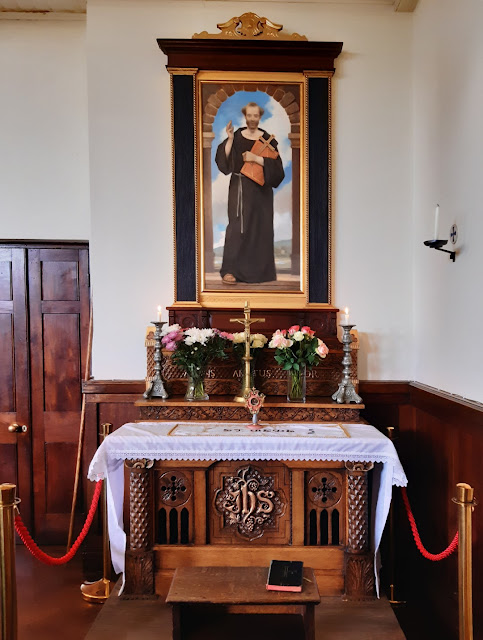
Sandro Magister has a most interesting article about a two volume work by Carlo Fantappiè entitled "Chiesa romana e modernità giuridica (The Roman Church and juridical modernity)" which looks at the Code of Canon Law promulgated by Pope Saint Pius X. (See: Saint Pius X, a Backward Pope? No, an Unprecedented Cyclone of Reform) He appends a review of the book by Gianpaolo Romanato.The thesis is that far from being a static, reactionary pontificate, the reign of Pope St Pius X was a cyclone of modernisation in response to the changed conditions in society that had developed during the 19th century. The code of canon law made possible a disciplinary and administrative uniformity that enabled the Church to deal with the modern nation state.
The effect of this centralisation and the increased emphasis given to papal authority within the Church certainly brought about many positive developments. Regarding the Liturgy, however, as Alcuin Reid pointed out in his work "The Organic Development of the Liturgy, there were some elements that could be judged in a less favourable light: for example the wholesale revision of the psalter of the Roman Breviary which resulted in the transformation of the Divine Office so that it lost its continuity with the ancient Roman office. Similarly, the introduction of the idea of "partecipazione attiva" (the original expression was in Italian) has left us with problems that the Church still continues to wrestle with.
Pope Benedict's concept of the "hermeneutic of continuity" can be seen, 100 years later, as an important corrective to this conception of papal authority. With no little humility, our present Holy Father has highlighted the responsibility of the papacy to respect the liturgical tradition of the Church.
2 comments:
The difficulty with the “reforms”, ie changes made by Pius X is that they inevitability ended u p prioritising power and authority (of the Pope and the Bishops) over Reason and Tradition. This is best seen in the promulgation of the Code of Cannon Law. The very idea of a code in this sense is very much an Enlightenment project first embodied in the Code Civil of Napoleon (1803) and then in the great German Civil Code (BGB) of 1900. Such codes under the guise of tiding up the law inevitable prioritise the individual will of a particular legislator (in the churches’ case the Pius X) at a particular point in time (1917) over the collective will of the entire church as embodied in the decision of diverse popes down the ages in various Papal Encyclicals, Motu Propria etc and also in the countless judicial decisions of the Church Courts. This “common law” approach to law making is the very embodiment of the idea of Tradition (the “democracy of the dead” as Chesterton once described it) of the Church as a collective enterprise passed on and modified down the ages.
The deep irony of the supplanting of traditional modes of law making by positivistic ones is that although Pius X was trying to preserve the content of tradition (as opposed to its form) he unwittingly paved the way for the wholesale abolition of Tradition in the wake of Vatican II. The over centralisation of the church and the stress on obedience from top to bottom meant that when the “centre” ie Paul VI was captured by the liberals, led by Bugnini then the vast majority of the clergy and laity, although horrified by the changes had no intellectual basis upon which to base any resistance – the notions of reason and tradition having been played down in favour of blind obedience. The result was that numerous priests, religious and laity either bowed the e knee and implemented, the detestable reforms by stripping their altars and, church out their graduals and missals and embraced the reforms through gritted teeth and tearful eyes or they simply abandoned the church either (a minority) to go with Lefrevre or, sadly (the majority) to give up the faith altogether. Contrast this with the potion of the Orthodox who, whatever other faults they may have, have never lost sight of the collective nature of tradition and who would never accept the wholesale reform of their liturgy in the way the Latin Church did in the 1960’s and 70’s.
I find this strangely reassuring. I argued along very similar lines in my thesis that far from being an ignorant, hidebound, consevative peasant (as Chadwick and others ALWAYS argue), Pope St Pius X was something of a innovative tinkerer who was responding to what Dobbelaere later defined as 'organizational secularization' (i.e. secularization within a religion, cf: the modernist crisis).
One other line which I think is interesting is to compare the dynamics between the pontificates of Leo XIII and Pius X, with the dynamics between the pontificates of JPII and BXVI. While Leo XIII and JPII tended to look very much 'ad extra', PX and BXVI concern themselves with the Church 'ad intra'. I'm talking about tendencies, not exclusive agendas of course. So while both Leo XIII and JPII write important letters and initiate major initiatives (Libertas, Rerum novarum, Ralliement, Evangelium Vitae, Pastores dabo Vobis), Pope Pius X and BXVI legislate in important and far-reaching ways within the Church's life (Church music, first Communion, anti-modernist oath, Summorum Pontificum).
Time alone will tell for sure who were the 'greater' popes.
Post a Comment