Therefore every scribe who has been trained for the kingdom of heaven is like a householder who brings out of his treasure what is new and what is old.
Me|Church - where it's all about you
I found Igniter Media via Fr Stephanos who posted this video on his blog. I thought it was very funny. Enjoy!
Fr Z has initiated a roaring discussion by asking the simple question whether maniples can be used in the Novus Ordo Mass. ( What Does The Prayer Really Say?: Maniples ) One commenter has referred to an important source for the question that has proved popular among modern liturgists. An answer in Notitiae of 1978 said: "When the rubrics of the Missal of Paul VI say nothing or say little on particulars in some places, it is not to be inferred that the former rite should be observed. Therefore, the multiple and complex gestures for incensation as prescribed in the former Missal are not to be resumed." This is, of course, a strange answer. Saying that it must not be inferred that a rite should be used does not imply that it must not be used. We need to check the Latin of this text. (If anyone with access to a library can check it, I have seen the reference given elsewhere as Notitiae 14 (1978) 301-302, no. 2) Let us in any case take the more restrictive interpretation, bel...
The Church Music Association of America and Jeffrey Tucker of the New Liturgical Movement have made available the 1962 Missal online in pdf format (72Mb). The file is hosted at Musica Sacra , the website of the CMAA, thanks to a generous gift from Fr Robert Skeris While you are at it, take a look at the articles clarifying the rules for music at Low Mass and music at High Mass .
When I studied Latin in Rome with Fr Reginald Foster, he used to suggest that a good word for a car was autorhaeda , a word in fact used in the Acta Apostolicae Sedis of 1965 when speaking of a visit made by Pope Paul VI to the Basilica of St Chrysogonus in Trastevere. The word raeda (without the "h") was used by Caesar, Cicero and Horace for a travelling wagon with four wheels and the addition of "auto" does not make for too awful a neologism. In the Rituale Romanum , the blessing for a motor vehicle is the Benedictio vehiculi seu currus . The word currus is normally translated as chariot and reflects the way that people often view their car. Since one's motor vehicle is more likely to be the locus of one's death or injury than many other artefacts, it does make sense to have it blessed. Above you can see us striding purposefully past the Georgian houses of Victoria Road and here is the blessing of the classic mini: The blessing given in the ...
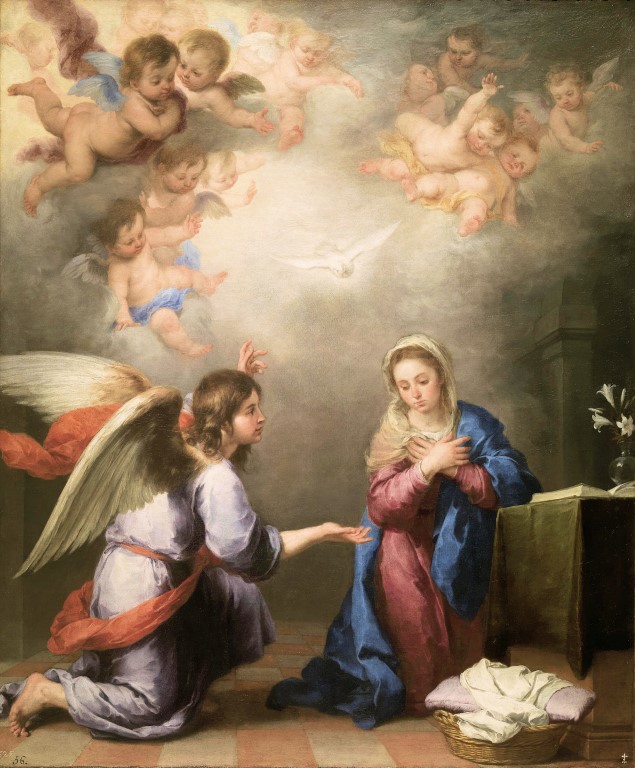
The angels call for our veneration and awe as part of God’s creation. Part of the destructive modernism of the 1970s included advice to Catholic school teachers that they should not talk to children about angels. This wrought lasting damage which continues to need rectifying. We should include in our prayers a heartfelt recourse to our own Guardian Angels. The Archangel Gabriel “God is my strength” would be terrifying were he to appear to any of us. Our Lady was “troubled” at the word of Saint Gabriel and wondered at the manner of the salutation. Immediately, according to his mission, the awesome messenger explained himself. Modern retelling of the event is often reduced to the jejune “Mary said Yes to God”. In fact, she said “Behold the handmaid of the Lord; be it done to me according to thy word”. This conveys more accurately the flawless faith and trust of the Immaculata. In the infinitely wise providence of the Father, we now know the structure of the event in even more detai...
Gregorian Chant Hymns is a most helpful website that I mentioned in a post just over a year ago. As I said then, the site "[...] promotes the learning of Gregorian Chant by making sheet music, recordings, translations, and instructions. There is a short guide to Gregorian Notation (those square notes) and to Latin pronunciation. Everything is available free of charge, in line with other great traditional music websites." Work has continued at the site and there is now a section which makes available pdf (or .docx format) booklets for Vespers for every Sunday of the Year and a few major feasts. There is the basic booklet for ordinary Sunday Vespers which is supplemented by separate files for the Sundays after Pentecost which contain the Magnificat and Collect. Then there are booklets, for example for Advent and Lent, where the office is different from the regular Sunday Vespers with its antiphons. All of the booklets have texts and notation for Benediction and the Maria...